Lead Glaze in Victorian Majolica Pottery: A Complete Technical Guide
Victorian majolica is defined by its glaze. The rich turquoise, deep cobalt, warm ochre and vivid green that make these pieces so visually compelling are all products of coloured lead glazes — a technology refined over two thousand years before reaching its peak at the Minton factory in the 1850s. This guide explains exactly what lead glaze is, how it developed, and why it matters for understanding and identifying Victorian majolica.
What Is Lead Glaze?
All lead glazes share the same fundamental composition:
- Silicates (sand or flint, which form the glass) combined with potash (an alkali flux that lowers the melting point to a manageable temperature) and lead oxide (which helps the glaze fuse to the clay body and increases viscosity, improving coverage)
- Vibrant and translucent in appearance due to their high refractive index
- Fired at around 800 degrees Centigrade — high enough to fuse the lead-glass mixture to the clay biscuit beneath, producing literally a lead-glass layer bonded to the clay body
The result is a glaze of exceptional brilliance and depth — qualities that set Victorian majolica apart from almost every other ceramic tradition.
How to recognise lead glaze: If you find a piece with a deliberately unglazed area, or a glaze miss, you will clearly see the coloured glazes applied on top of the unglazed buff biscuit body. The colours sit on the surface rather than being absorbed into it.
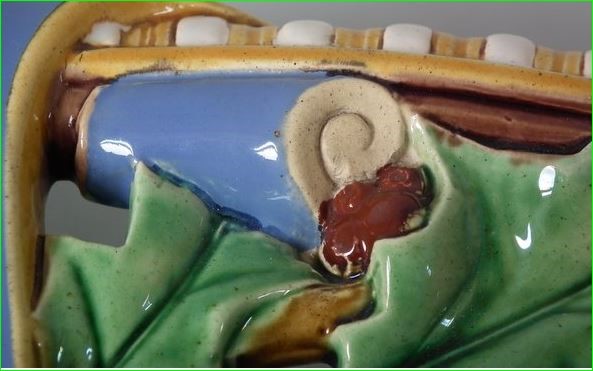 Lead-glaze earthenware glaze miss showing buff biscuit block-painted with coloured lead glazes — a useful diagnostic feature for identifying lead-glazed wares
A History of Lead Glaze: From Rome to the Victorian Age
Lead glazes did not appear fully formed in the Victorian period. They were the product of two millennia of gradual refinement, each stage building on the last.
Circa 100AD — Roman Origins
The use of lead glaze on clay pots to solve the problem of porosity has been found throughout the Roman Empire, from North Africa to the north of England. The Romans understood that a vitrified glaze surface made pottery practical for storing liquids and food.
Circa 700AD — Chinese Sancai
The Chinese elevated lead glaze from a practical solution to an art form. The magnificent Tang dynasty Sancai (‘three colours’) wares — horses, camels, figures and vessels — were glazed with coloured lead glazes block-painted directly onto a buff biscuit body and fired. The green glaze runs and the use of the natural buff body as part of the decorative scheme anticipate techniques that would reappear in Victorian majolica over a thousand years later.
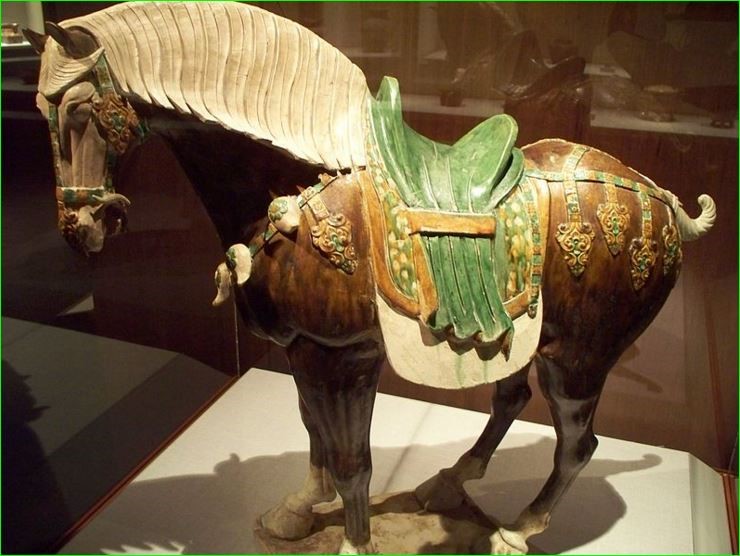 Circa 700AD Tang dynasty lead-glazed Sancai horse, 27 inches high — coloured lead glazes block-painted directly onto buff biscuit, over 1,300 years ago
Circa 1300 — Marzacotto in Italy
By around 1300, Italian potters had developed ‘Marzacotto’ — a significant advance in lead glaze technology. The clay body was covered with a slip of white earth, slightly baked, then glazed with a wet mixture of lead oxide and glass (marzacotto) and fired again. Colours were achieved using metal oxides: iron for yellow, copper for green, manganese for black, cobalt for blue. This introduction of slip between body and glaze opened new decorative possibilities and directly influenced what followed.
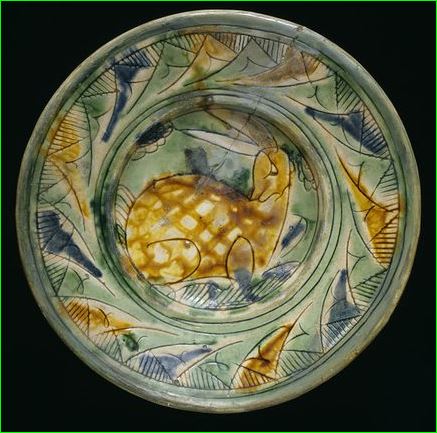 Earthenware body covered with white slip, incised decoration and painted with coloured lead glaze. Courtesy of the V&A, dated circa 1490
Circa 1550 — Bernard Palissy
Bernard Palissy is one of the great figures in the history of ceramics. A French Huguenot potter working in the mid-sixteenth century, he is best known for his extraordinary ‘Rustic Figulines’ — naturalistic dishes and platters encrusted with life-size lizards, frogs, shells, fish and plants, all rendered in coloured lead glazes of startling realism.
Palissy succeeded, after years of hardship, in developing formulae for coloured lead glazes that fired reliably at high temperature. The legend of him burning his furniture to fuel his kiln may be apocryphal, but it captures the obsessive dedication required. His reward was the patronage of Catherine de Medici and a place in ceramic history.
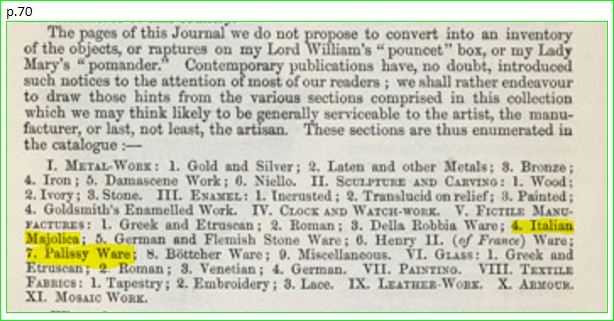
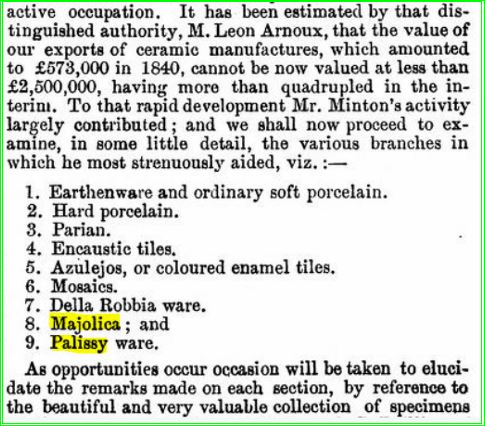
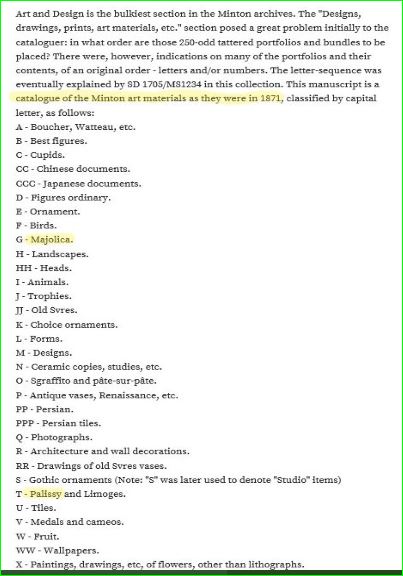
His influence on Victorian majolica was direct and acknowledged — Minton initially called his new lead-glazed wares ‘Palissy ware’ in explicit homage.
 Statue of Bernard Palissy on the colonnade of the Musée du Louvre, Paris — holding one of his celebrated vases
Circa 1760 Onwards — English Development
English potters of the eighteenth century developed existing lead glaze traditions in several important directions:
Circa 1760 — Author Pat Halfpenny defines ‘coloured glazed figures’ as biscuit painted with coloured lead glazes then high temperature fired. The period sees early experiments with coloured lead glazes applied directly to the clay body.
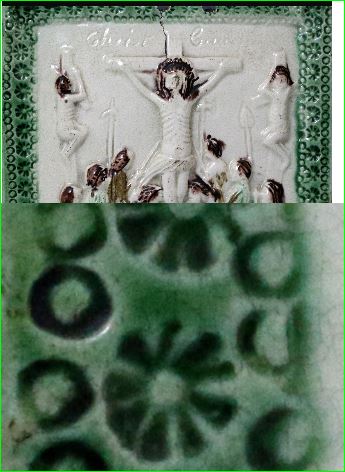 Plaque circa 1760, green, brown, and plain (‘pearl’) glazes applied directly to a creamware body
Circa 1765 — Greatbach, Wedgwood and Whieldon produce ‘Cauliflower ware’ — body painted with yellow and green coloured lead glazes, then high temperature fired. The moulded naturalistic forms anticipate Victorian majolica directly.
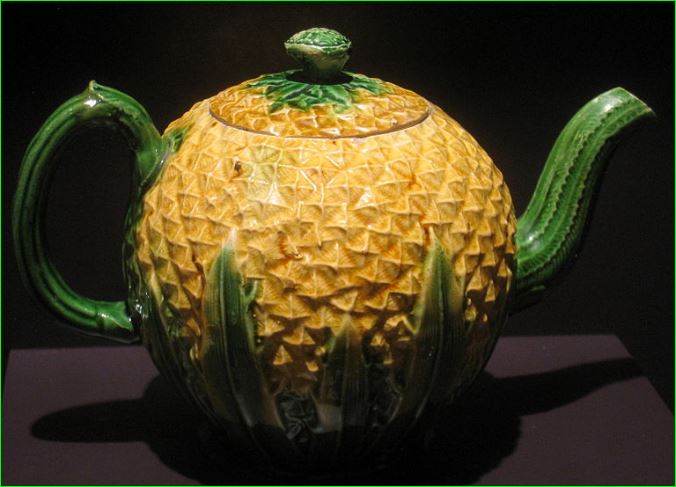 Circa 1765 Whieldon ‘cauliflower’ teapot. Coloured lead glazes applied directly to the biscuit — a direct forerunner of Victorian majolica
Circa 1770 — ‘Prattware’ underglaze painted figures proliferate. Here the biscuit is painted with oxide colours, then dipped in plain lead glaze, then fired — the lead glaze going on top rather than being the colour carrier itself.
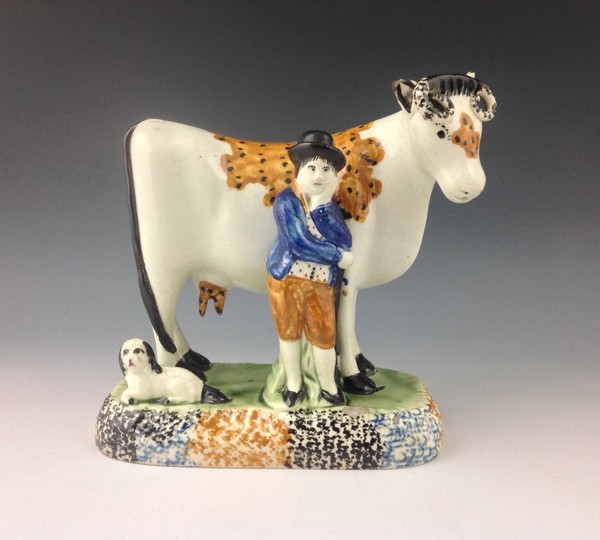 Circa 1770 figure made in Yorkshire. Oxide colours painted direct on creamware body then dipped in plain lead glaze
Circa 1780 — ‘Enamel painted figures’ appear, with lead glaze underneath and enamel colours on top, requiring multiple firings at decreasing temperatures.
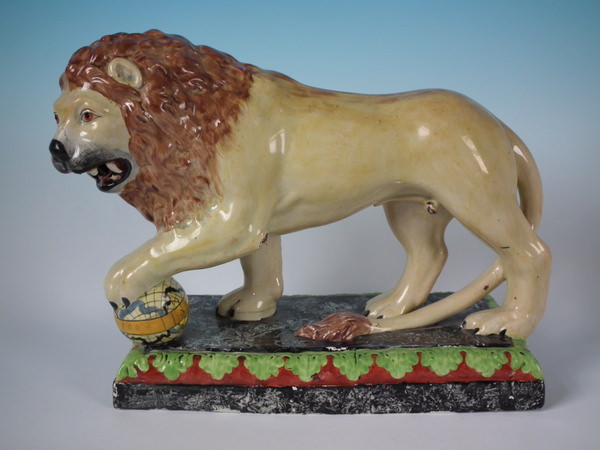 Circa 1780 ‘Enamel painted figure’ of a performing lion
Circa 1830 — ‘Green ware’ dessert services by Wedgwood, Brameld and others exploit the natural pooling properties of green lead glaze to create an attractive intaglio effect on relief-moulded surfaces — leaf-moulded dessert services that proved enormously popular across England and France.
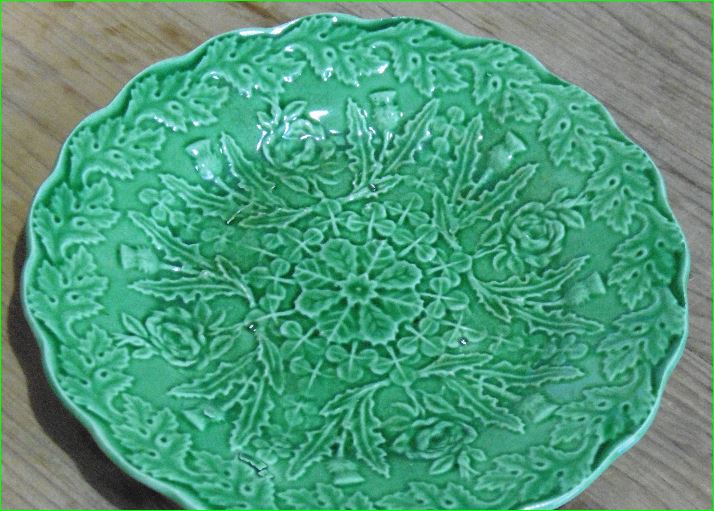 Circa 1830 Brameld platter. Lead glaze coloured green with copper oxide
1850 — Majolica Perfection
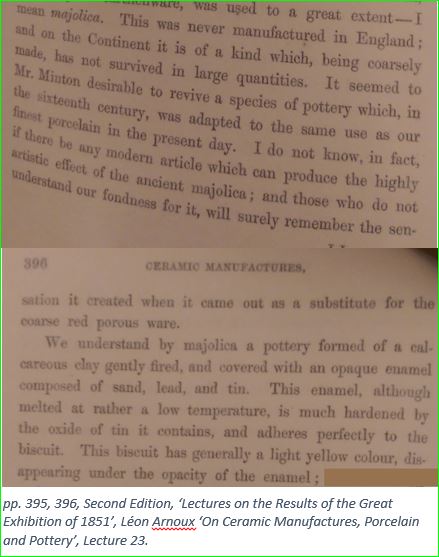
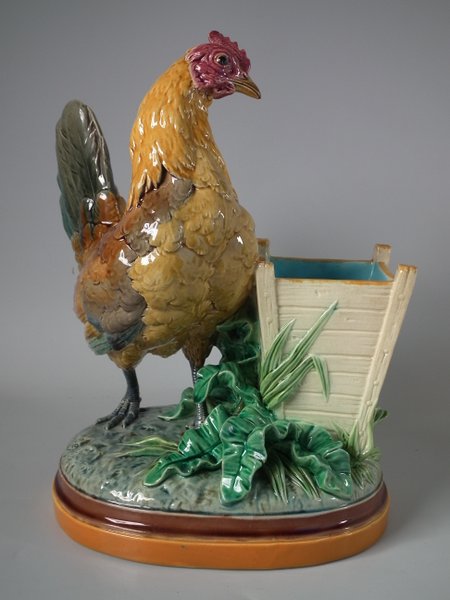
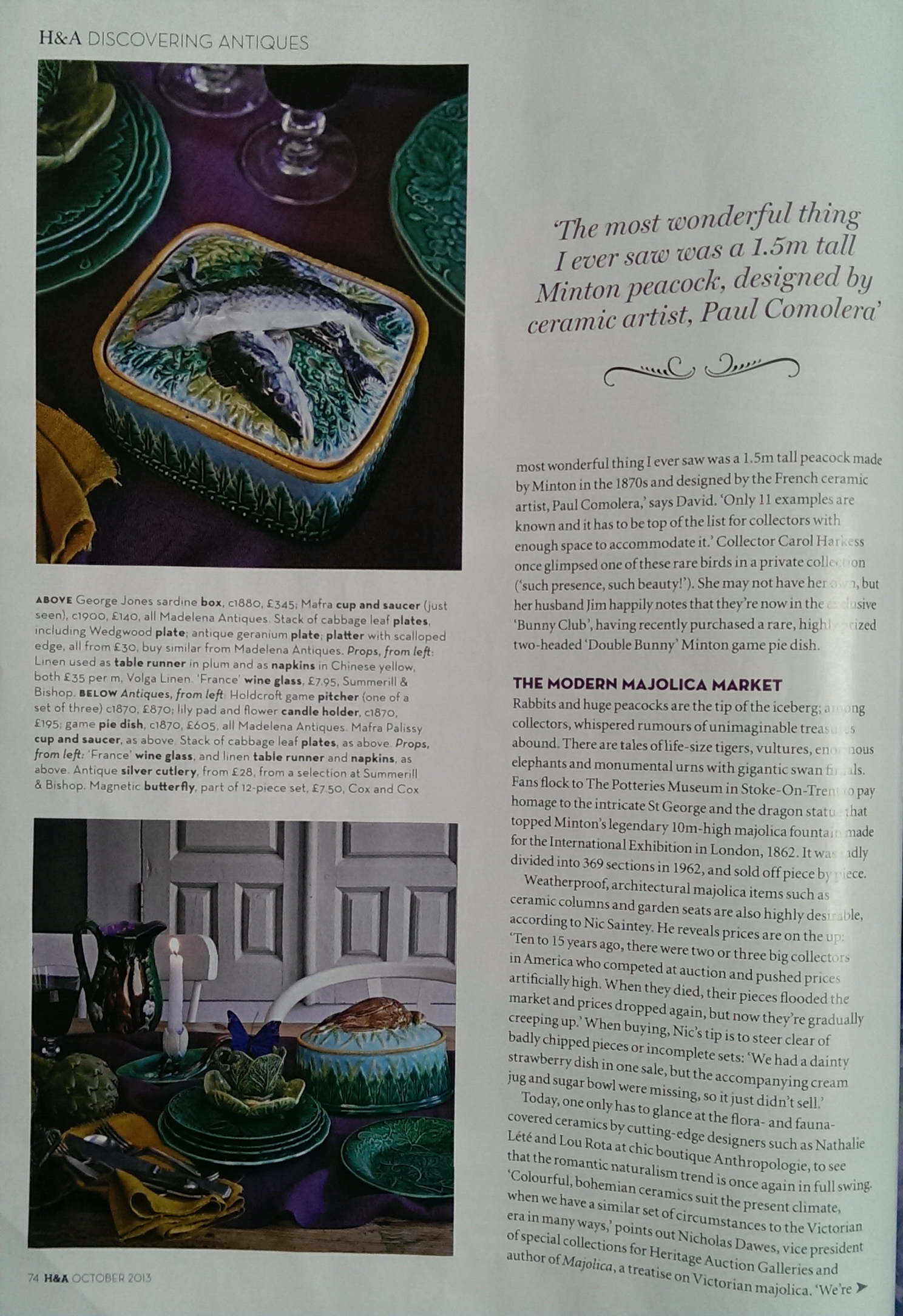
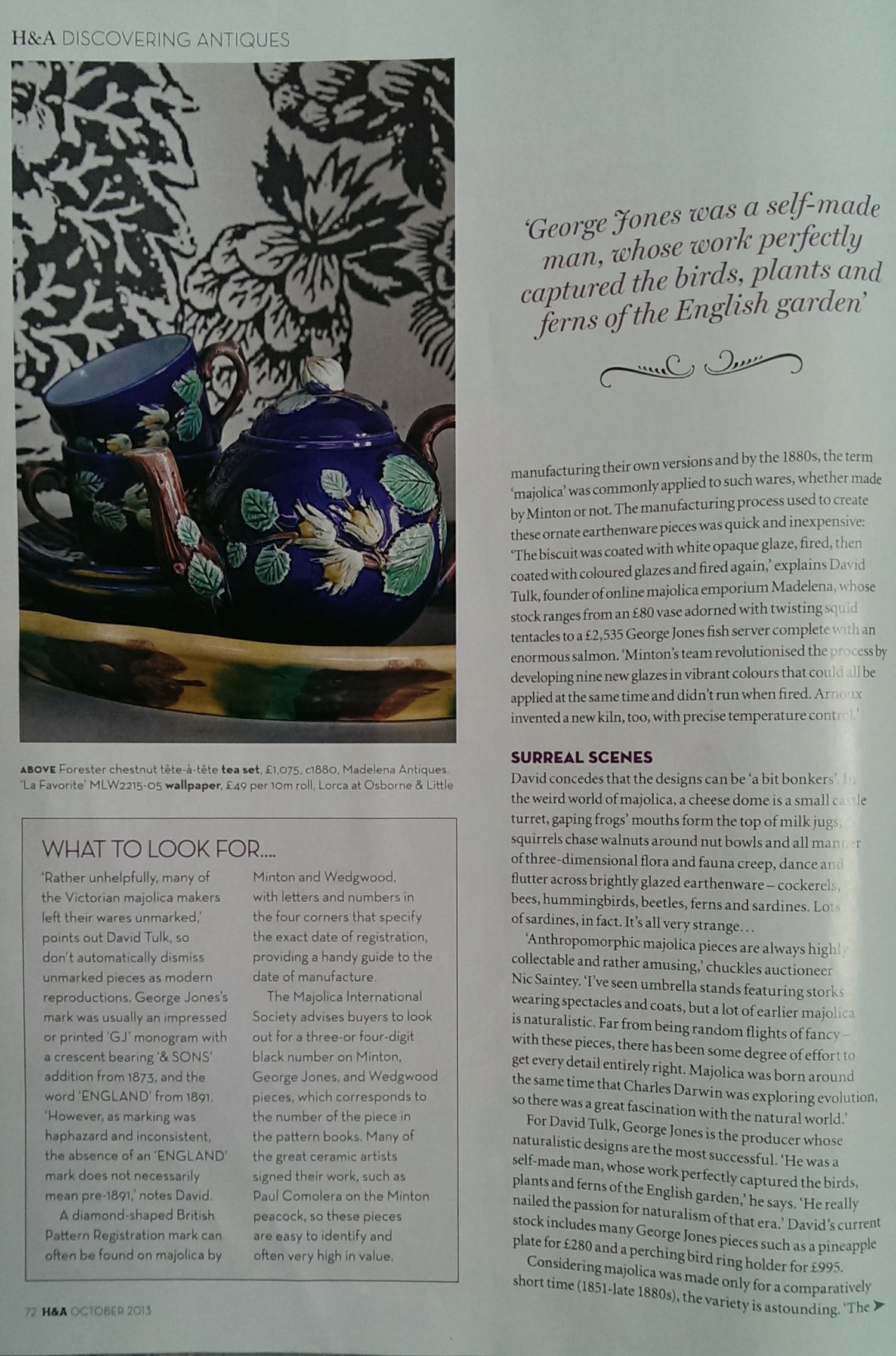
All of this led to a single moment of synthesis. At the Minton factory in Stoke-on-Trent, the French chemist and art director Leon Arnoux developed a range of coloured lead glazes of unprecedented quality. Applied directly to a relief-moulded biscuit body and fired simultaneously at high temperature — without the colours running into one another — these glazes created the product Mintons called ‘Palissy ware’. The public knew it only as majolica.
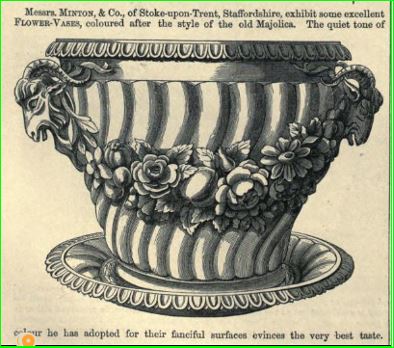
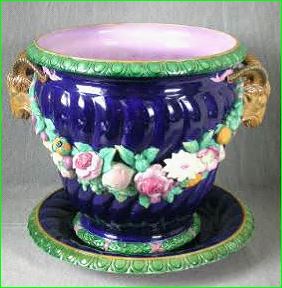
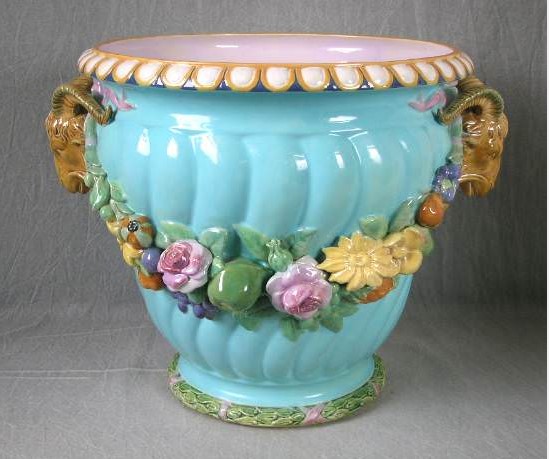
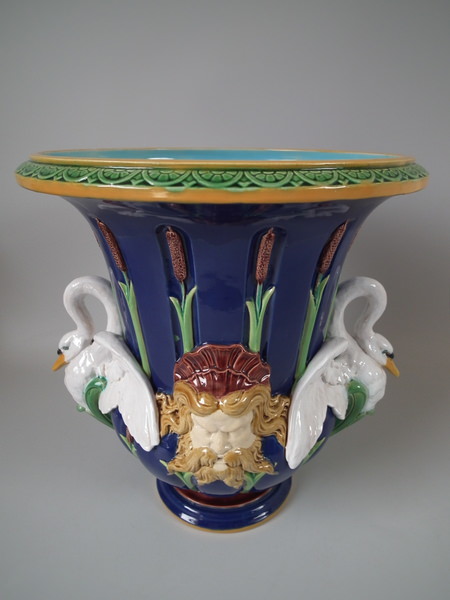 Minton majolica jardinière circa 1873.
What Arnoux achieved was technically remarkable. Previous coloured lead glazes had required careful separation to prevent colours bleeding. Arnoux formulated glazes that could be applied side by side and fired together, each retaining its brilliance and definition. Combined with the sculptural ambition of Minton’s modellers, the result was something entirely new.
Shown at the Great Exhibition of 1851, Minton’s majolica was an immediate sensation. Within a decade, factories across Britain, Europe and America were producing their own versions.
Lead Glaze vs Tin Glaze: What’s the Difference?
This is one of the most frequently misunderstood distinctions in ceramic collecting, and worth understanding clearly.
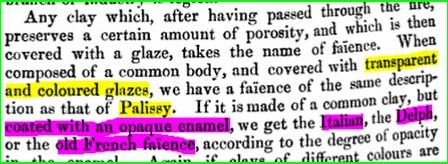
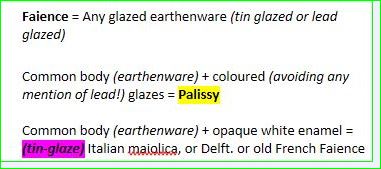
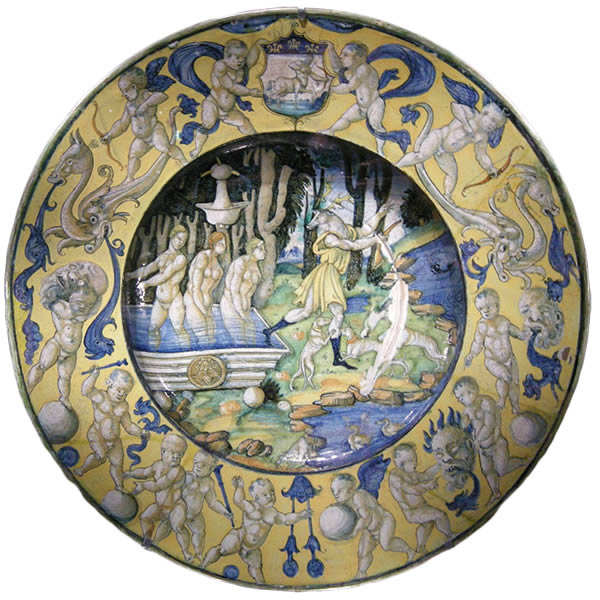
Tin glaze is lead glaze with added tin oxide. The tin oxide scatters light, creating opacity and giving the glaze a white or whitish colour. This white surface was ideal for painted decoration — the tradition of Italian Renaissance maiolica, Dutch Delftware, French faience, and English tin-glazed earthenware all depend on this opaque white ground.
Lead glaze without tin is translucent. Applied to a coloured clay body or over coloured slip, it allows the colour beneath to show through while adding depth, brilliance and a glassy surface.
The practical differences between the two traditions are significant:
Materials — Lead-glazed majolica uses coloured glazes applied directly to a relief-moulded biscuit body. Tin-glazed wares use a flat or simply shaped body dipped in opaque white tin glaze, onto which decoration is painted freehand.
Cost — Lead-glazed majolica requires one fewer process than tin-glazed ware. The absence of the dipping stage, and the fact that no skilled freehand painting is required, made Victorian majolica less expensive to produce — which contributed directly to its commercial success with the Victorian middle classes.
Durability — Lead glaze is more durable than tin glaze, making lead-glazed majolica more suitable for domestic and outdoor use. Tin-glazed surfaces are more prone to chipping and flaking.
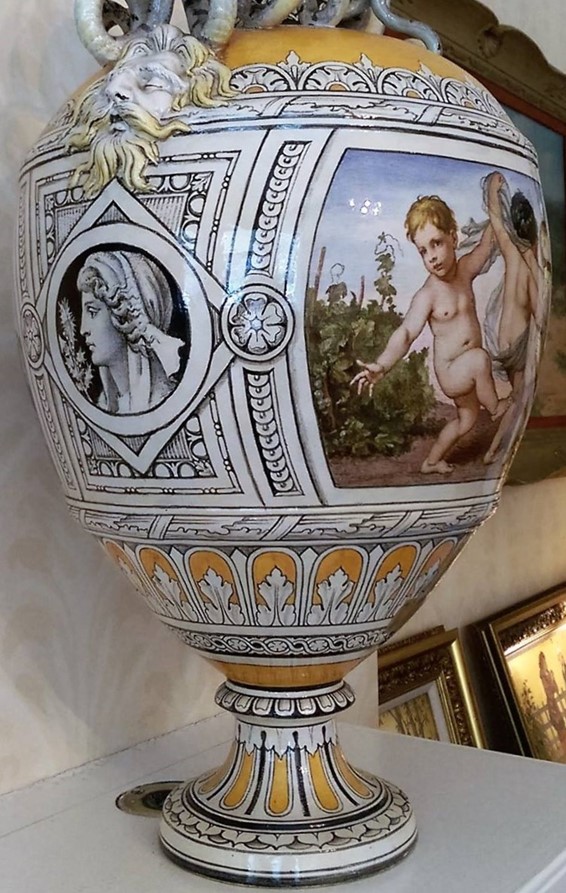
Terminology — The naming of these wares has caused confusion for over 150 years. The convention now generally accepted is: Maiolica (with an ‘I’) for Italian tin-glazed Renaissance earthenware; Majolica (with a ‘J’) for Victorian lead-glazed earthenware. Minton complicated matters by naming both their lead-glazed and tin-glazed wares ‘majolica’ — the tin-glazed version is now correctly referred to as ‘Minton tin-glaze majolica’ or simply ‘Minton maiolica’.
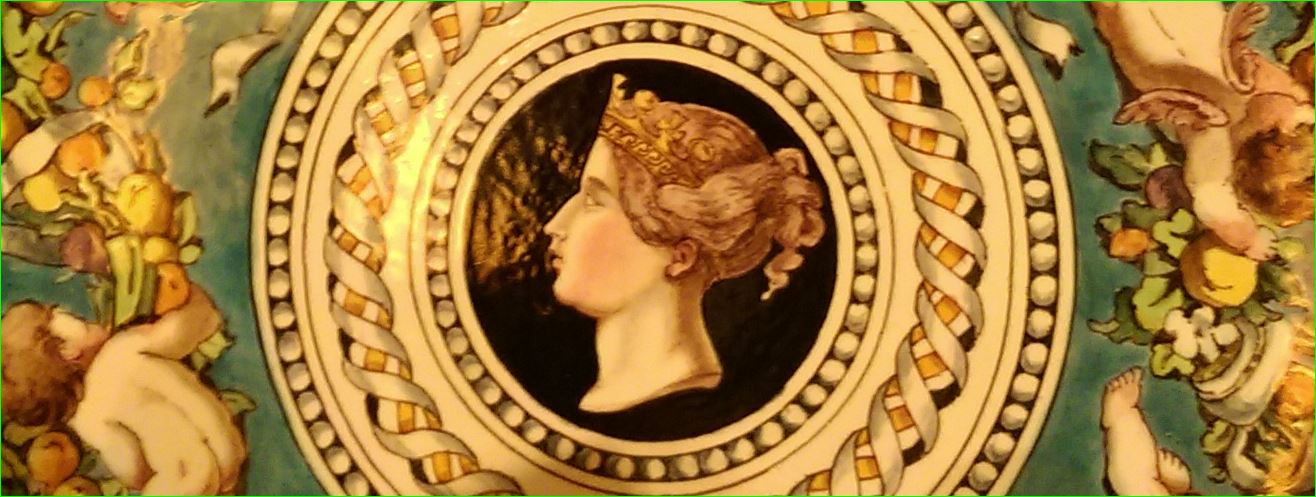 Rare Minton tin-glazed ‘majolica’ plate, circa 1860 — brush-painted decoration on opaque white tin-glaze enamel. Note the fundamental difference from the translucent coloured lead glazes of standard Victorian majolica
Why This Matters for Collectors
Understanding the distinction between lead-glazed and tin-glazed wares is practically useful when identifying and valuing pieces.
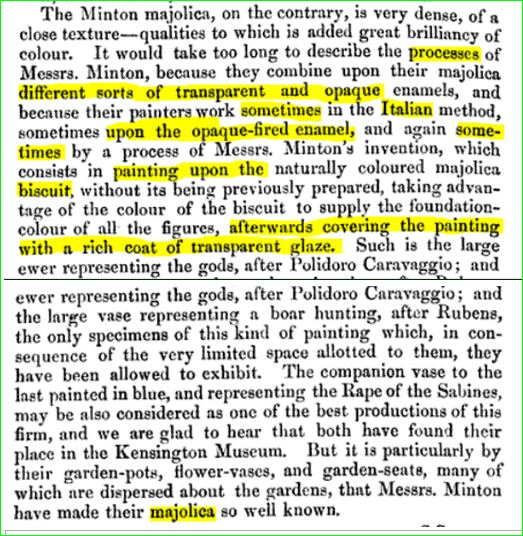
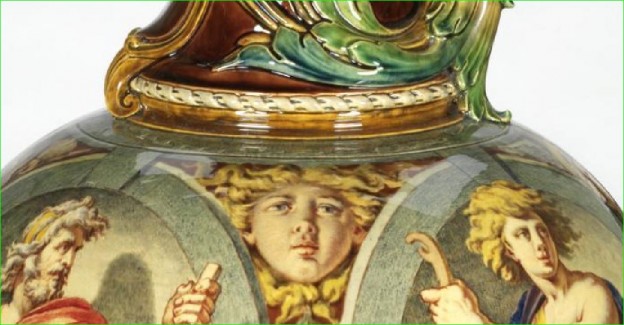
A central panel on a Victorian majolica piece that appears at first glance to be tin-glazed with painted decoration is almost always something different — finely applied coloured lead glazes painted directly onto the biscuit body, with a clear lead glaze added before firing. This technique, used to spectacular effect on certain Minton exhibition pieces, demands extraordinary skill and precision from the decorator.
Genuine pieces combining both lead and tin glaze do exist — Minton produced a small number — but they are rare and represent a distinct category of their own.
For the collector, the key practical point is this: the brilliant, translucent, deeply coloured glazes of Victorian majolica are lead glazes, not tin glazes. Their distinctive visual quality — the depth, the pooling in relief hollows, the way colours sit side by side without bleeding — is a direct product of the lead glaze technology perfected by Leon Arnoux at Minton in the 1850s.
Further Reading
For those wishing to go deeper into the technical and historical literature:
At Madelena we specialise in antique Victorian majolica pottery. Browse our current selection of antique majolica for sale, or explore our introduction to majolica pottery for more background on the subject.






![IMAG0589_1[1]](https://madelena.com/blog/wp-content/uploads/2014/01/IMAG0589_11-214x300.JPG)
![IMAG0591_1[1]](https://madelena.com/blog/wp-content/uploads/2014/01/IMAG0591_11-215x300.JPG)
![IMAG0593_1[1]](https://madelena.com/blog/wp-content/uploads/2014/01/IMAG0593_11.JPG)