Tag: madelena

  • Staffordshire figures from Scotland?

    Staffordshire figures from Scotland?

    Staffordshire figures from Scotland? How does that work?

    Madelena Shop, Sell, Discover
    World’s largest online gallery of STAFFORDSHIRE figures
    Staffordshire Figure Association

    The largest concentration of potteries in Great Britain was in the county of Staffordshire
    Staffordshire figures
    Large Pair White and Gilt Cats, Staffordshire figures made in Staffordshire ‘The Potteries’ circa 1890

    White and Gilt Cats DETAIL

    These large white and gilt cats were made in Staffordshire in ‘The Potteries’, the seven towns that grew up around Stoke-on-Trent.

    All were within easy reach of the necessary coal to fuel the kilns. Twenty tons of coal were needed to fire (bake) one ton of clay in the bottle kilns of the day.

    Staffordshire Figures were also manufactured in Scotland
    Staffordshire figures
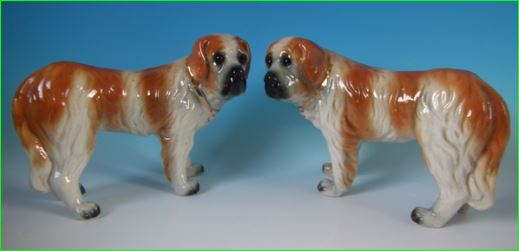
    Large Pair Tan St. Bernard dogs, Staffordshire figures made in Scotland circa 1900

    and in the North of England.

    No matter where they were made in the UK they have come to be known by one single generic term ‘Staffordshire Figures’.
    Tan St. Bernards DETAIL

    Staffordshire Figures
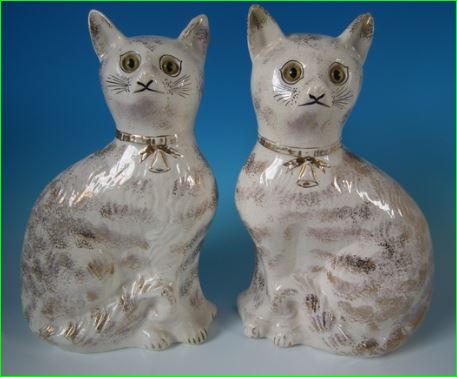
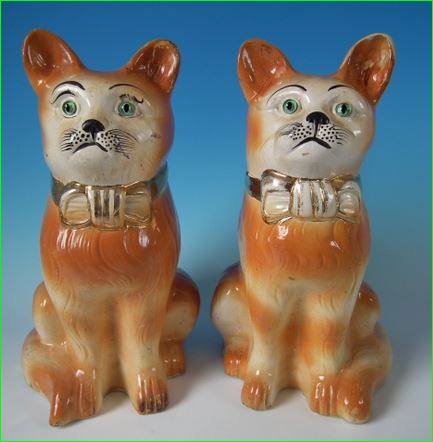
    Pair Bo’ness tan cats with glass eyes, circa 1900, Staffordshire figures made in Scotland. Note these are a true pair not two singles.

    Tan Cats DETAIL

    Many of the large Staffordshire animal figures so popular with collectors today were made in the Bo’ness (Borrowstounness) pottery in Scotland on the river Forth upstream from Edinburgh, birthplace of Robbie Burns, Scotland’s most celebrated poet.

    All of them are available for sale at the time of posting from the Madelena online store.

    Should any of the figures illustrated no longer be available from the Madelena online store please

    click the following link which will take you to

    all large pairs of cats, dogs or lions with glass eyes currently available for sale.
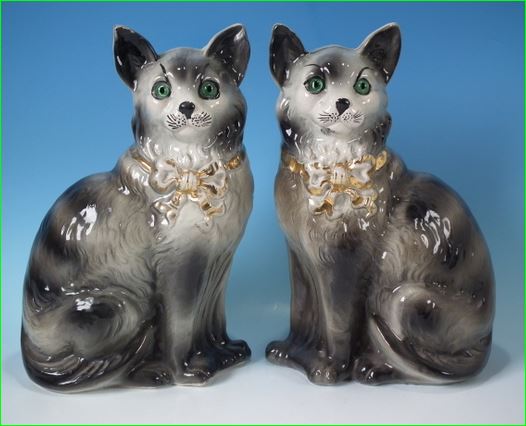
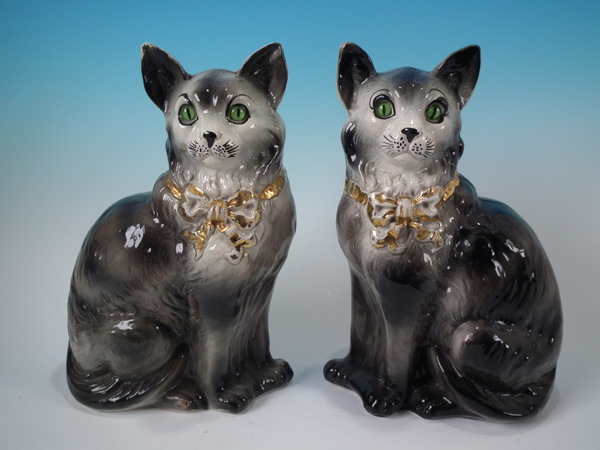
    Pair green eyed cats, Staffordshire figures made in Scotland circa 1900
    Pair green eyed cats, Staffordshire figures made in Scotland circa 1900

    Cats with green eyes DETAIL

    Queen Victoria loved pets. In particular she loved her parrot named Lory, and her King Charles Spaniel named Dash. There were many others. But she was not keen on cats.

    Many of us are, however, and these beauties are classic Bo’ness, grey spray paint, glass eyes, bright gilt slip cast and appealing.
     

    Staffordshire figures
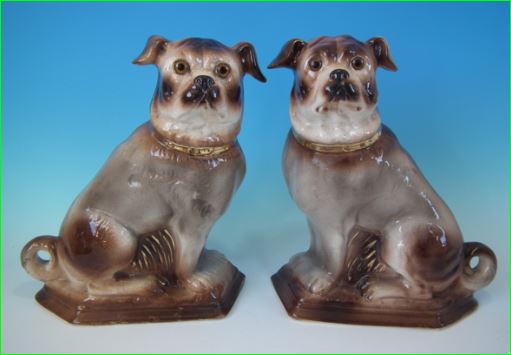
    Large Pair Grey/brown Pugs, Staffordshire figures made in Scotland circa 1900

    Pugs DETAIL

    Staffordshire Figures large grey pugs dogs pair
    Large grey pugs with glass eyes complete the décor in a master bedroom, Staffordshire Figures made in Scotland circa 1900. Private collection.

    Pugs originated in China. They were imported into Holland. A pug accompanied non-English speaking King William III on his journey to claim the throne of England. More recently Napoleon Bonaparte’s wife Josephine owned a Pug named Fortune, used to deliver messages to Napoleon while in prison in 1794.
    Photographs sent to us recently of a private collection show pugs in pride of place.
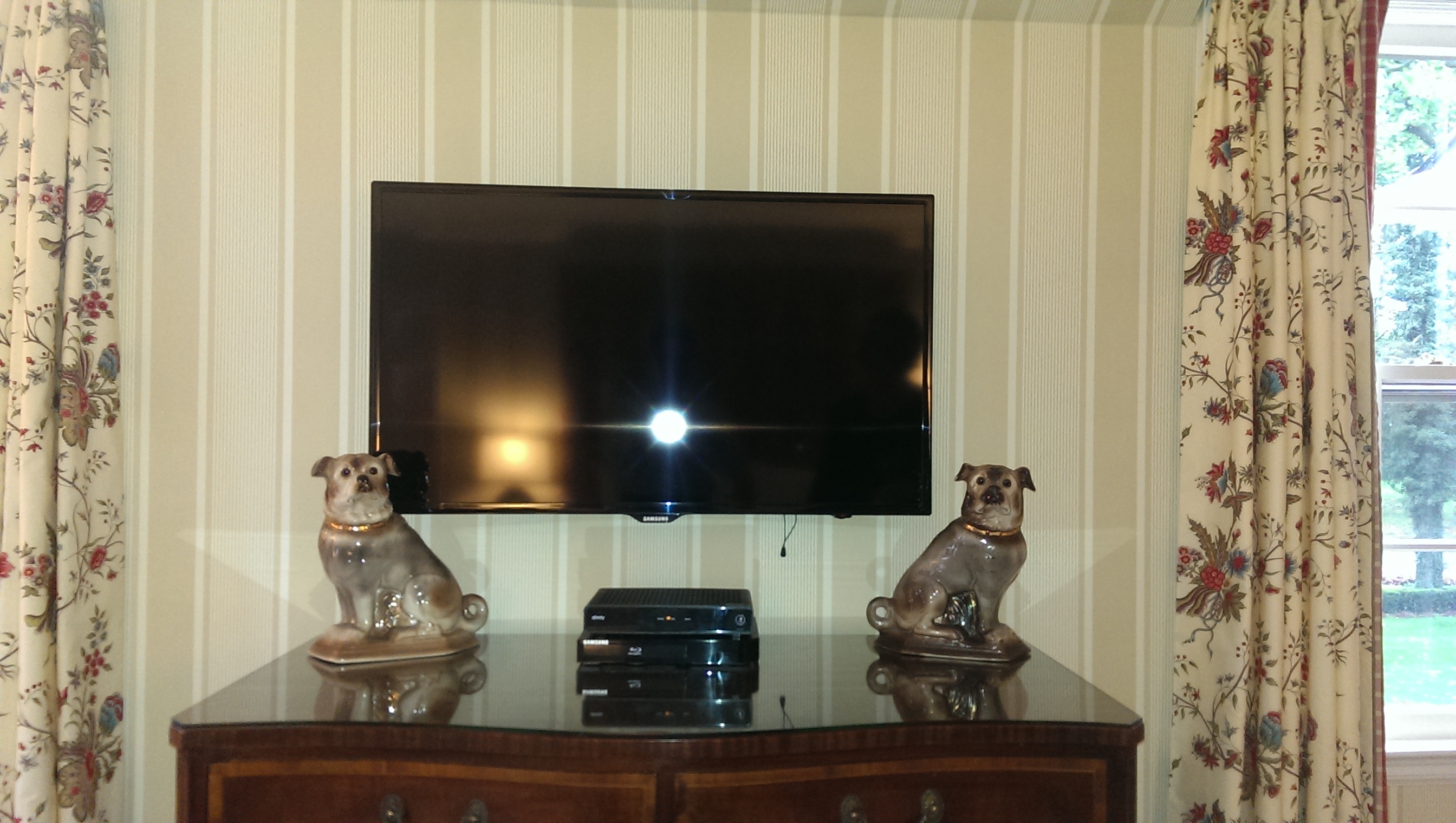
    Staffordshire Figures large grey pugs dogs pair
    Large grey pugs with glass eyes complete the décor in yet another master bedroom, Staffordshire Figures made in Scotland circa 1900. Private collection.

    Lo and behold, here in another extensive and wonderful collection they have again been positioned in the top spot, either side of the big screen in the master bedroom.

    Don’t they look homely?


    Pugs DETAIL

    How interesting that both collectors gave late Victorian pugs pride of place in their master bedroom décor.
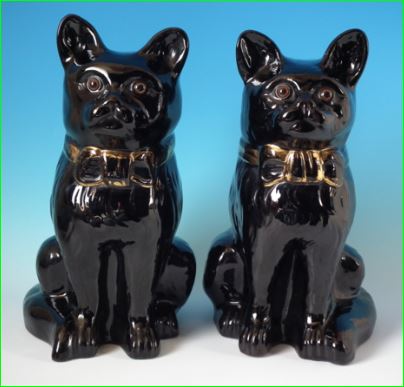
    Staffordshire figures
    Large Pair Jackfield Cats, Staffordshire figures made in England circa 1890


    Jackfield Cats DETAIL

    Not all large animal figures were made in Scotland. Here is another example. ‘Jackfield’ is the generic term given to just about any Staffordshire figure with black glaze over red body.

    The Jackfield factory in Shropshire, England, was allegedly the first to produce these wares, copied thereafter by many others.
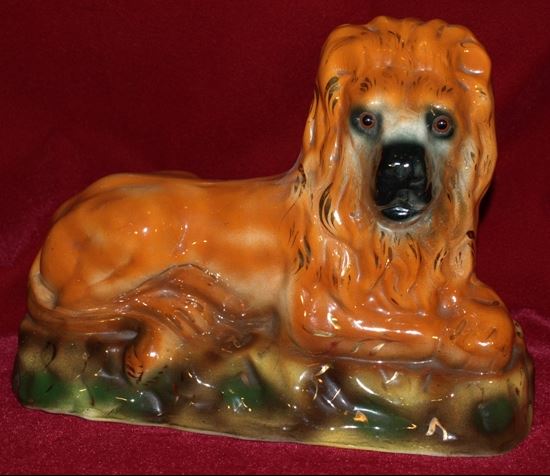


    Staffordshire Figure Boness Lion
    One of a pair of Large tan lions with glass eyes, Staffordshire figures made in Scotland circa 1890. Private collection.

    If you are looking to buy figures similar to these illustrated, please contact us if there are none in our online store of large animal figures.

    Or try out our free search service.  Email us to let us know what you are trying to find.

    Cats, dogs and lions surface often so it should not take us long to find what you are searching for at a reasonable price.
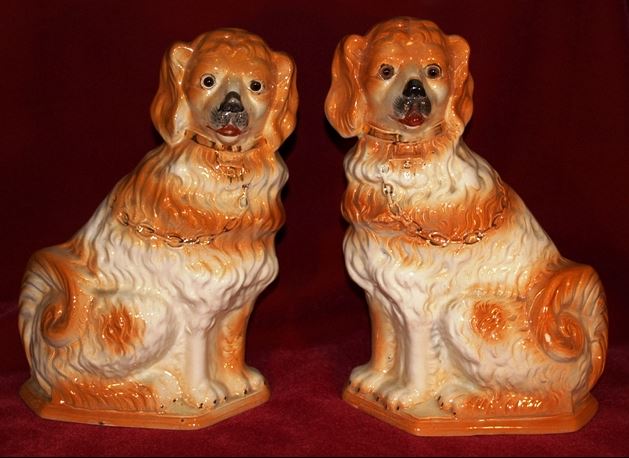
     

    Staffordshire Figures Boness collies Pair
    Large pair tan Collies, Staffordshire figures made in Scotland circa 1890

    To buy, sell, discover Staffordshire figures of all eras from the Madelena ecommerce online store follow this link:

    Madelena Shop, Sell, Discover

    World’s largest online gallery of STAFFORDSHIRE figures

    Staffordshire Figure Association

  • Pottery Marks and Makers 1780 to 1900

    Pottery Marks and Makers 1780 to 1900

    Madelena Shop, Sell, Discover

    Who made it? This blog looks at pottery marks and makers.

    Makers of pottery in this period were known as pot banks. How many different ways did they mark their pots? We take a look at the pottery marks found in the popular categories in which we specialise.

    EARLY STAFFORDSHIRE FIGURES  1780-1840

    Figures from the Walton and Salt factories were marked on the reverse. The Lloyd partnership marked some of their output, often indistinctly. Pottery marks of other known factories Sherratt, Wood, Dale and others are extremely rare. Most early figures were unmarked.
    A selection of early Staffordordshire figures

    Attributions can sometimes be made by comparing a hitherto unattributed figure with a positively identified figure or group of figures. Characteristics such as painting style, formation of bases, detail of bocage elements, use of underglaze colors, quality of modelling, size of head and feet, etc. all come into play. For a better understanding of the considerable detective work involved make a study of Myrna Scholne’s excellent blog.

    Early Staffordshire Figures Shop, Sell, Discover

    VICTORIAN STAFFORDSHIRE FIGURES  1837-1900

    Victorian figures were almost never marked.
    There are reliable ways of dating Victorian figures and various ways of attributing some of them to one or two known factories e.g. Dudson figures
    but the vast majority of figures are both unmarked and unattributed.

    Pottery mark
    Printed pottery mark found on 20th century figures

    The presence of printed pottery marks on the base of a figure are a sure sign it is of 20th century manufacture.

    Victorian Staffordshire Figures Shop, Sell, Discover
    Staffordshire Figures Association

    PALISSY  1843-1910

    France and Portugal may be neighbours but in the matter of marking their Palissy ware they are continents apart. The French marked very few.  A selection of French Palissy wares

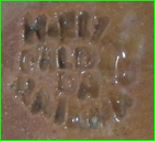
    Impressed mark of the Elias pottery in Caldas de Rainha
    Impressed pottery mark of the Elias pottery in Caldas de Rainha, Portugal

    The Portuguese makers marked almost everything.

    A selection of Portuguese Palissy

    Palissy Shop, Sell, Discover
    Majolica International Society

    MAJOLICA  1851-1900

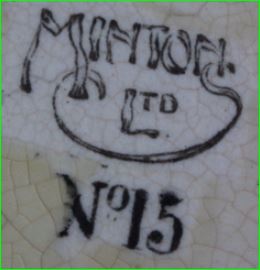
    English Victorian Majolica makers’ habits in marking their wares ranged from Minton and Wedgwood who impressed their pottery marks on almost everything with name, date code, and pattern number…
    Marked Wedgwood platters

    through those like George Jones who was reasonably consistent with the pattern number but more often than not omitted the name or monogram and never used a date code or cypher,
    Marked George Jones platters

    to those like Holdcroft whose output was usually unmarked in every respect, recognisable only by the glazes used and the very occasional marked piece to reference.
    Attributed Holdcroft platter

    We will add the multitude of individual marks to this blog at a later date.

    from MADELENA online specialist ecommerce dealer in majolica, Staffordshire figures, R. Lalique glass, samplers and Dec. Arts
    Rare George Jones dwarf elephant ear plates

    Very rarely in the world of majolica a descriptive pattern name mark is found.

    from MADELENA online specialist ecommerce dealer in majolica, Staffordshire figures, R. Lalique glass, samplers and Dec. Arts
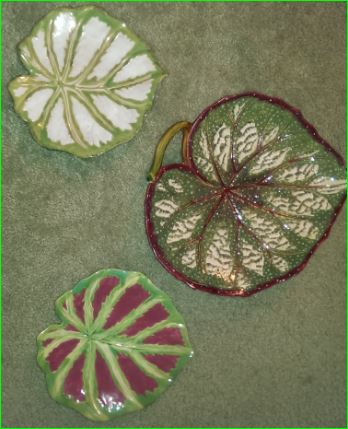
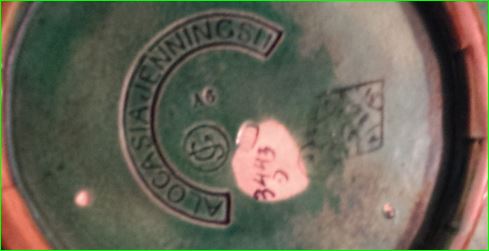
    Pattern name mark Alocasia Jeningsii (dwarf elephant ear), GJ monogram, black script pattern number and British Registry Office mark.


    The pottery mark above is from a private collection of rare George Jones majolica leaf plates. They have an uncanny likeness to the real dwarf elephant ear plant Alocosia Jenningsii.

    Find out more about majolica makers in our article ‘What is Majolica?’ .

    The protectionist 1890 USA McKinley Tariff Act required imported goods to be marked with country of origin. Therefore an impressed or printed ENGLAND mark tells you that the piece was made after 1891. Marking was however haphazard and inconsistent so the absence of an ‘ENGLAND’ mark does not necessarily mean ‘pre-1891’.

    British Registry Office mark, ‘Also known as the ‘British Registry Lozenge’ or the ‘British Pattern Registration Diamond’ mark, when present and legible, tells us the date the pattern was registered. The registration procedure was set up in 1842 to combat plagiarism, making it illegal to copy that pattern for a period of three years. Letters and numbers in the four corners specify the exact date of registration. The system was sufficiently successful that its use continued throughout the majolica period and beyond.  Note: The year of pattern registration is not necessarily the year of manufacture but does indicate a ‘circa’ date.

    All the pottery marks mentioned above appear inconsistently, even those of the top makers. Tableware services were frequently unmarked except for the major pieces.

    Majolica Shop, Sell, Discover
    Majolica International Society

    MINTON SECESSIONIST  1900-1922

    Some early art pottery pieces are sometimes included as Minton Secessionist ware. They have a mark like this 1903 Minton Secessionist vase

    from MADELENA online specialist ecommerce dealer in majolica, Staffordshire figures, R. Lalique glass, samplers and Dec. Arts
    Printed mark, Minton Secessionist ware, 1 to 72

    The series of distinctive marks we are most familiar with run from No.1, found in many different shapes and colors, to No.72. Some of the intermediary numbers are either rare or possibly missing. More research and perhaps more pooling of knowledge may lead to an understanding of exactly what the numbers mean. My theory that they may be batch numbers or production run numbers or even design series numbers is somewhat weakened by the fact that the ‘1902 catalogue’ (if only it were the 1922 catalogue) illustrates numbers late in the series as well as early.


    Minton Secessionist Wares
    Minton Secessionist Shop, Sell, Discover

    WEDGWOOD LUSTRE  1920-1930

    Fairyland Lustre/luster, Dragon Lustre, Butterfly Lustre, Hummingbird Lustre and Fish Lustre all came from the same Wedgwood factory workshop and bear the same printed Portland Vase Mark
    Note that by the 1920’s Wedgwood and others had replaced ENGLAND with MADE IN ENGLAND.

    Wedgwood Lustre wares
    Wedgwood Lustre Shop, Sell, Discover
    Madelena Shop, Sell, Discover

  • Majolica Magic in Homes & Antiques

    Majolica Magic in Homes & Antiques

    World’s largest online gallery of MAJOLICA
    MADELENA Shop, Sell, Discover
    Majolica International Society

    MAJOLICA

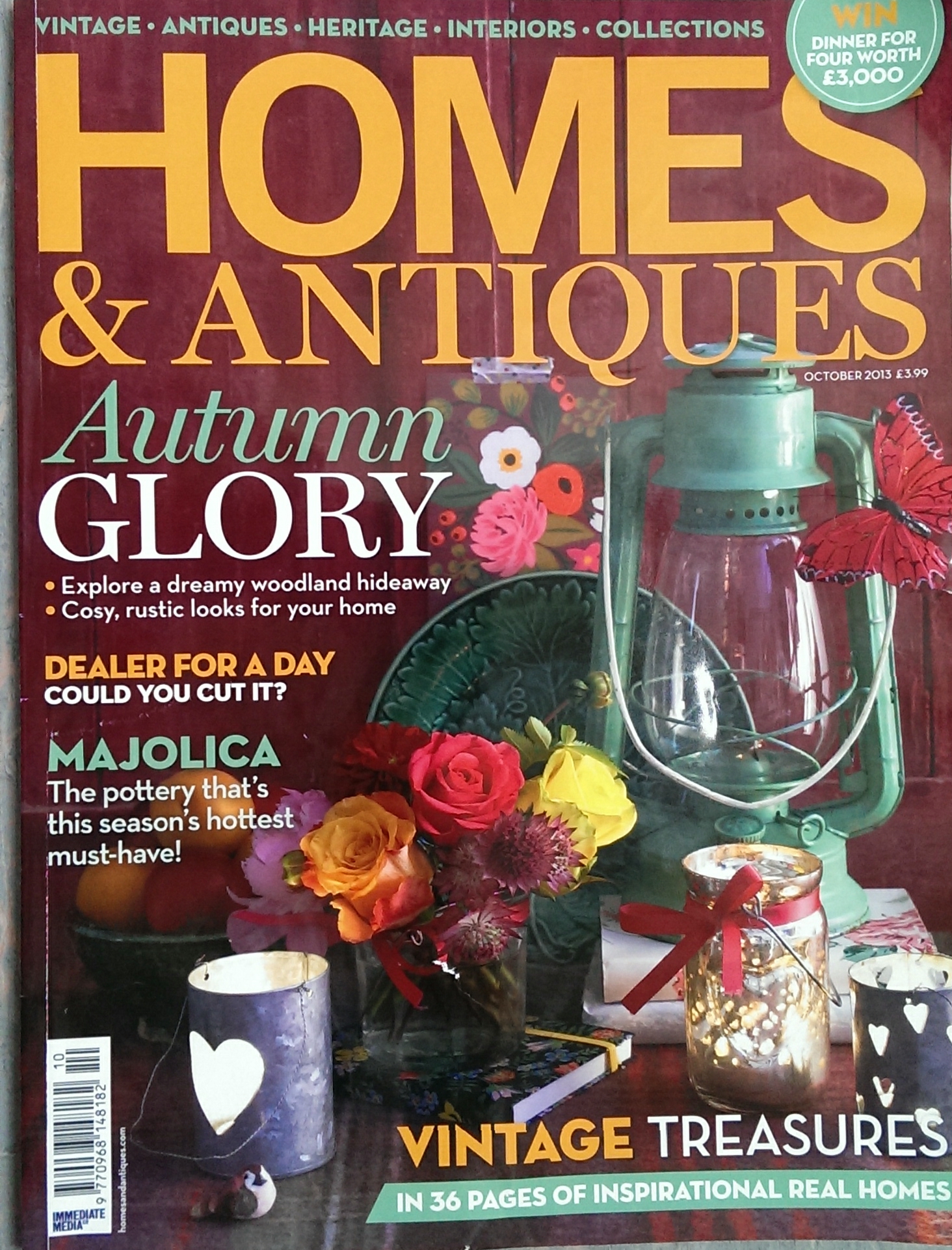
     The pottery that’s this season’s hottest must-have

    majmag1 - Copy

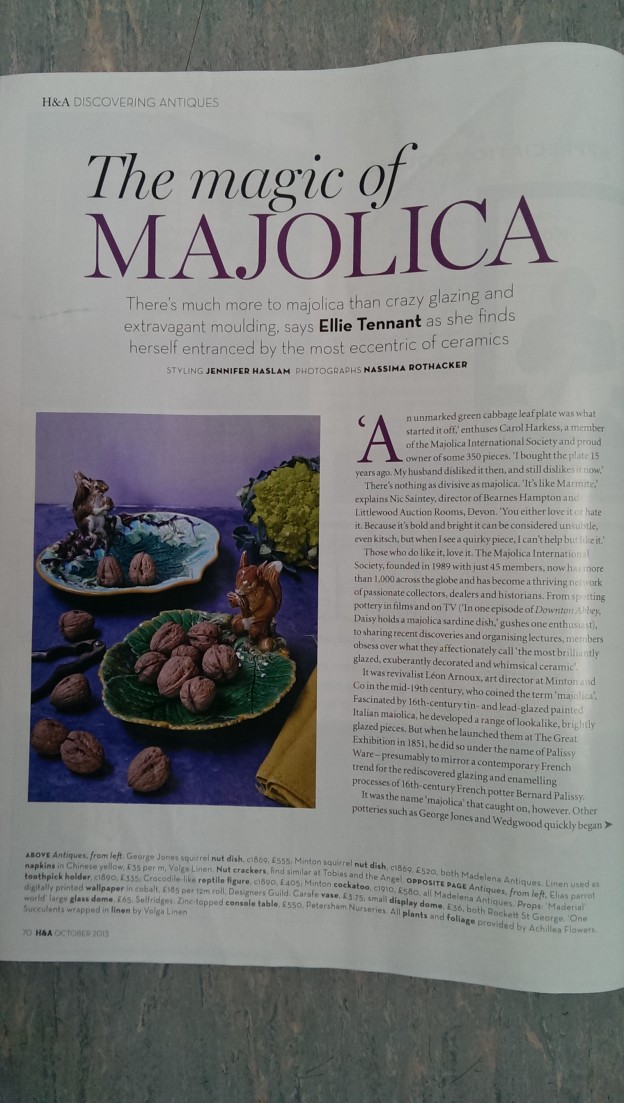
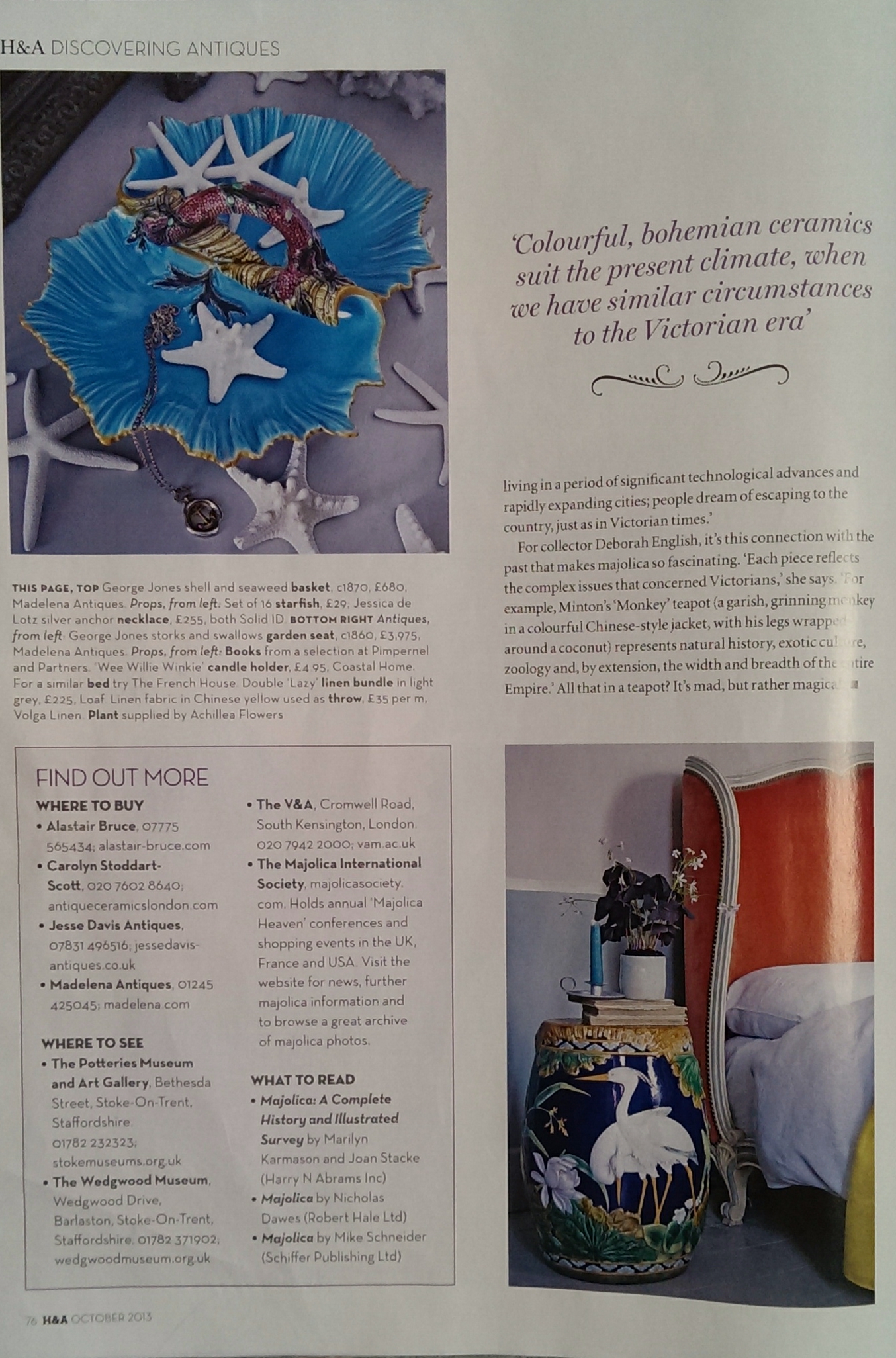
    Above is the October 2013 issue of the BBC Homes and Antiques magazine. Antique majolica is back in vogue, this season’s hottest must-have!

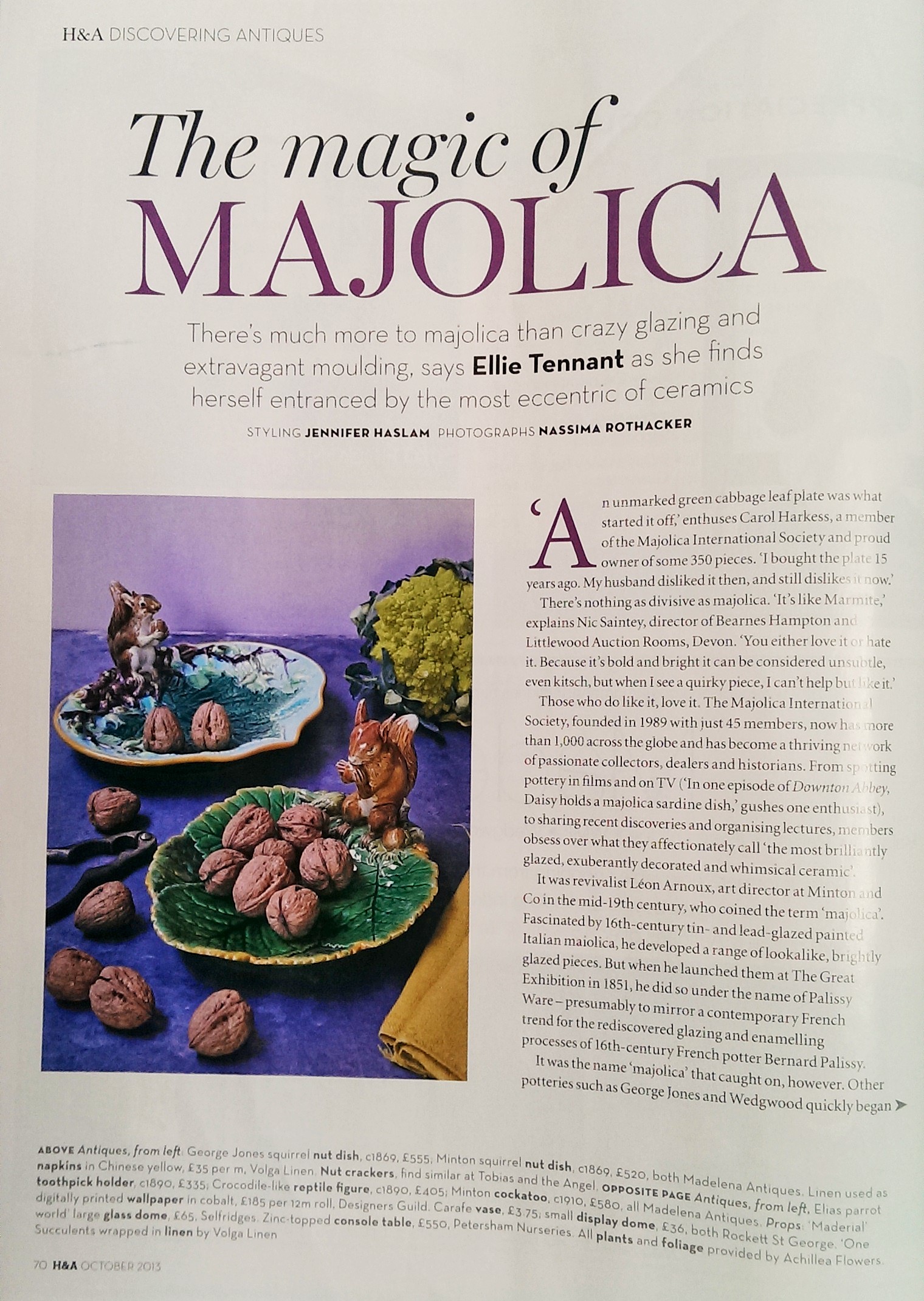
    Ellie Tennant, the interiors journalist wrote the piece. She does a great job communicating the appeal of this magical ceramic. Ellie interviews well known figures for her article. Many of you will know Nick Dawes the author of “Majolica” from his Antiques Road Show appearances. Deborah English is a collector and scholar building a definitive online majolica library. Carol Harkess is another keen collector, President of the Majolica International Society and latest member of the ‘bunny club’.

    The items displayed in the beautiful interiors photographed by Homes & Antiques were loaned by Madelena.

    The article runs to seven pages and is very positive and enthusiastic about all the things that make antique majolica so incredibly appealing. We hope to obtain a pdf to share with you, but meanwhile here are some pictures to be going on with.

    More great articles are to be found in the members library Majolica International Society

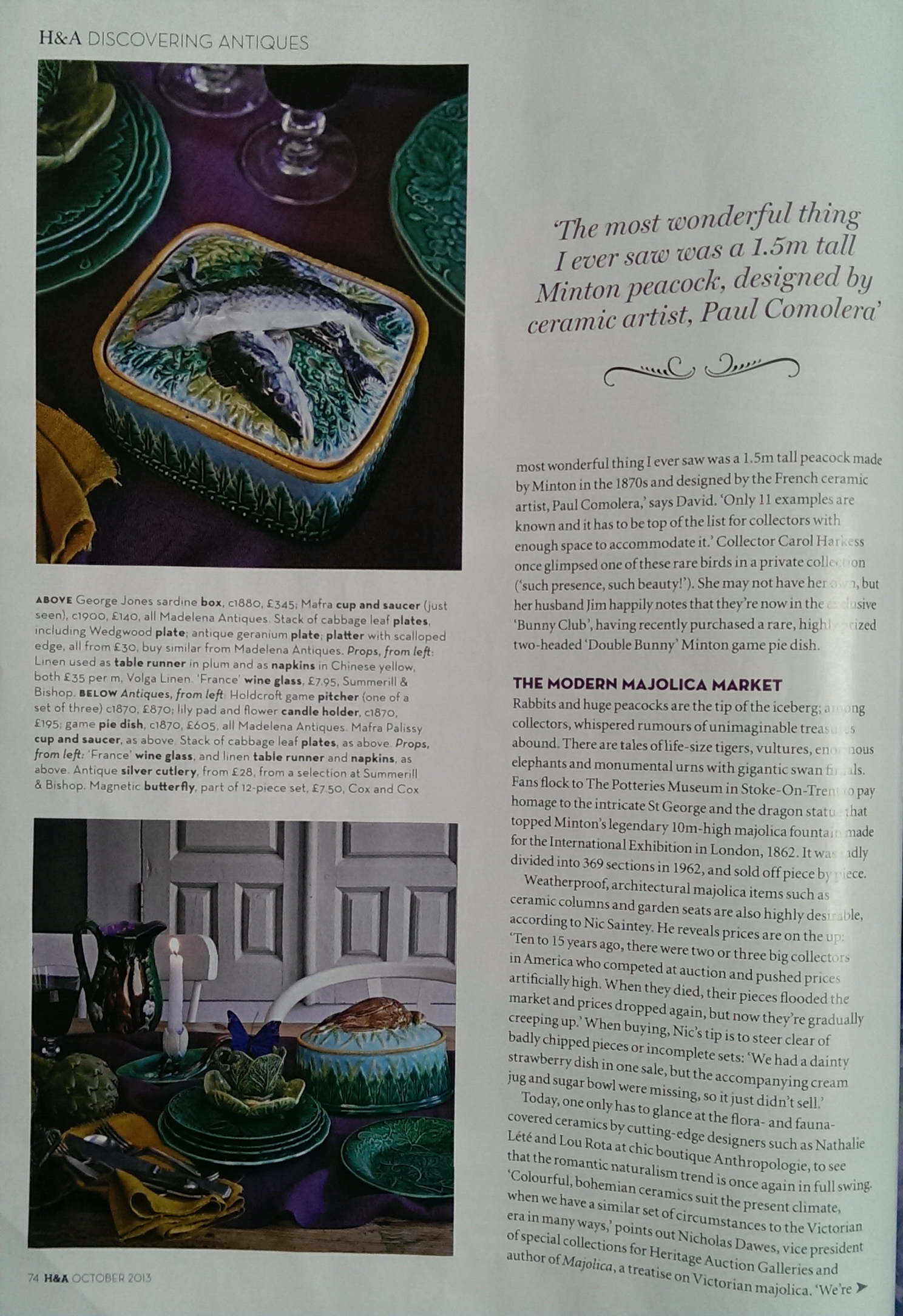
    majmag2 (2)

    Green majolica plates, sardine dishes, game pie dishes, Palissy cup and saucer and various serving trays
    Green majolica plates, sardine dishes, game pie dishes, Palissy cup and saucer and various serving trays

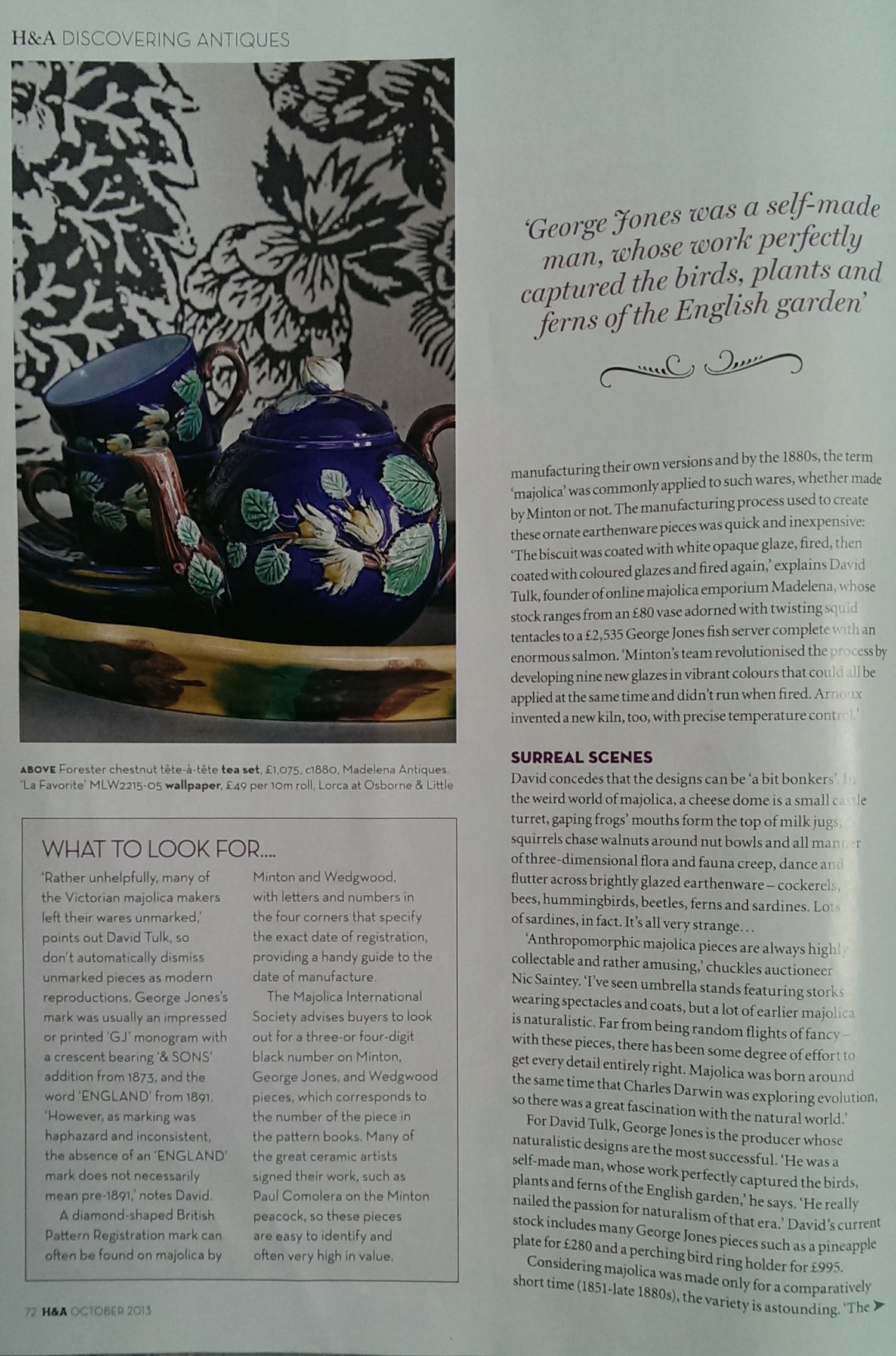
    IMAG0589_1[1]

    IMAG0591_1[1]

    George Jones tea service (part). George Jones was a self made man, whose work perfectly captured the birds, plants and ferns of the English garden
    George Jones tea service (part). George Jones was a self made man, whose work perfectly captured the birds, plants and ferns of the English garden

    IMAG0593_1[1]

    George Jones shell and seaweed server; George Jones Storks and Lilies garden seat
    George Jones shell and seaweed server; George Jones Storks and Lilies garden seat


    More magical majolica

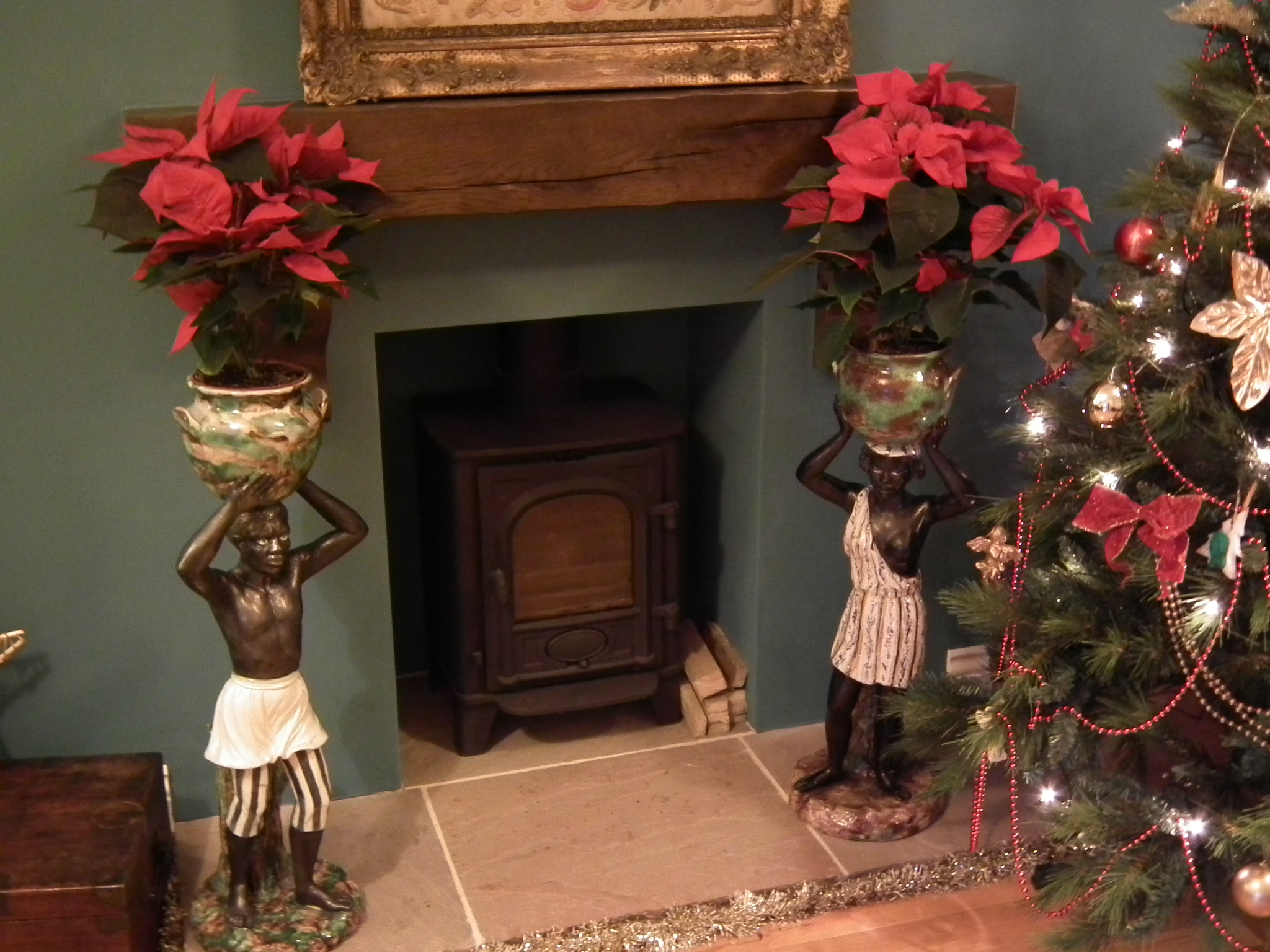
    More pictures, non-professional this time, of majolica in home décor, from around Christmas time…

    A cosy fireside. More pairs…

    Large pair blackamoor figures
    Large pair blackamoor figures

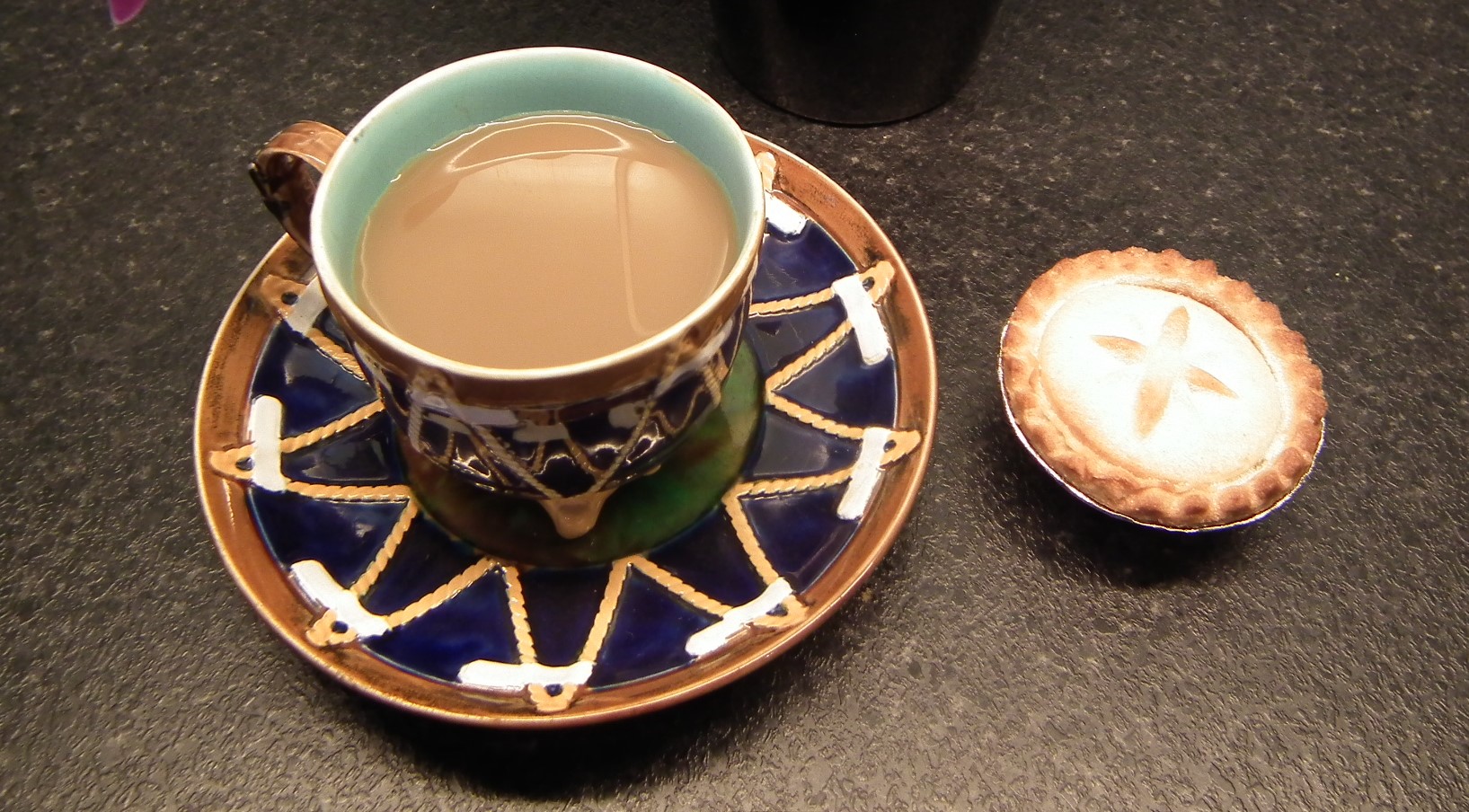
    A cuppa waiting to be sipped. George Jones Drum cup and saucer
    More cups…

    George Jones drum cup and saucer
    George Jones drum cup and saucer

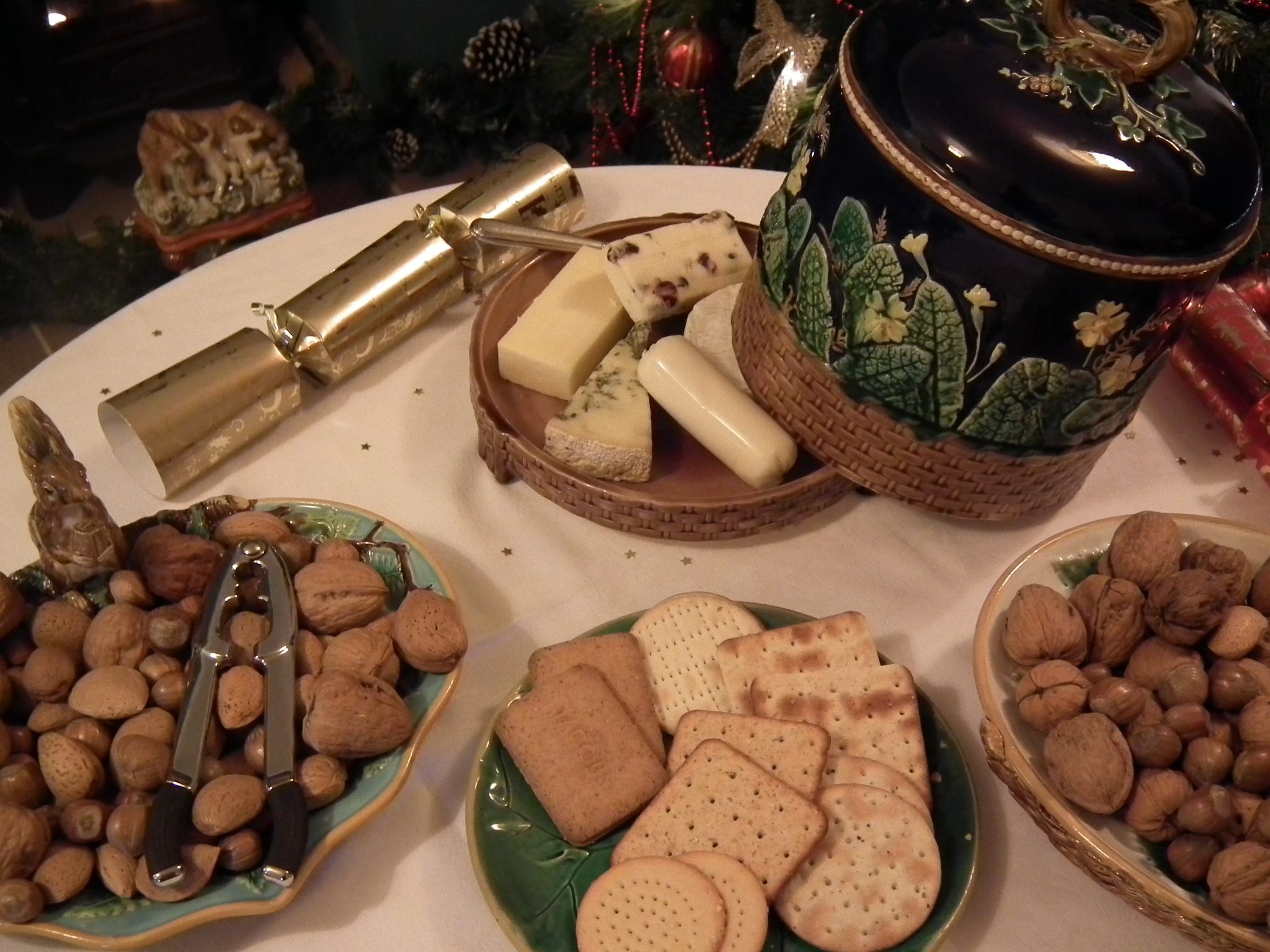
    Cheese, nuts and (English) biscuits on the table for later. More serving dishes… More cheese domes…

    Wedgwood cheese dome and stand, George Jones squirrel nut dish, and two majolica plates
    Wedgwood cheese dome and stand, George Jones squirrel nut dish, and two majolica plates

    …and fruit decorating the counter More baskets…

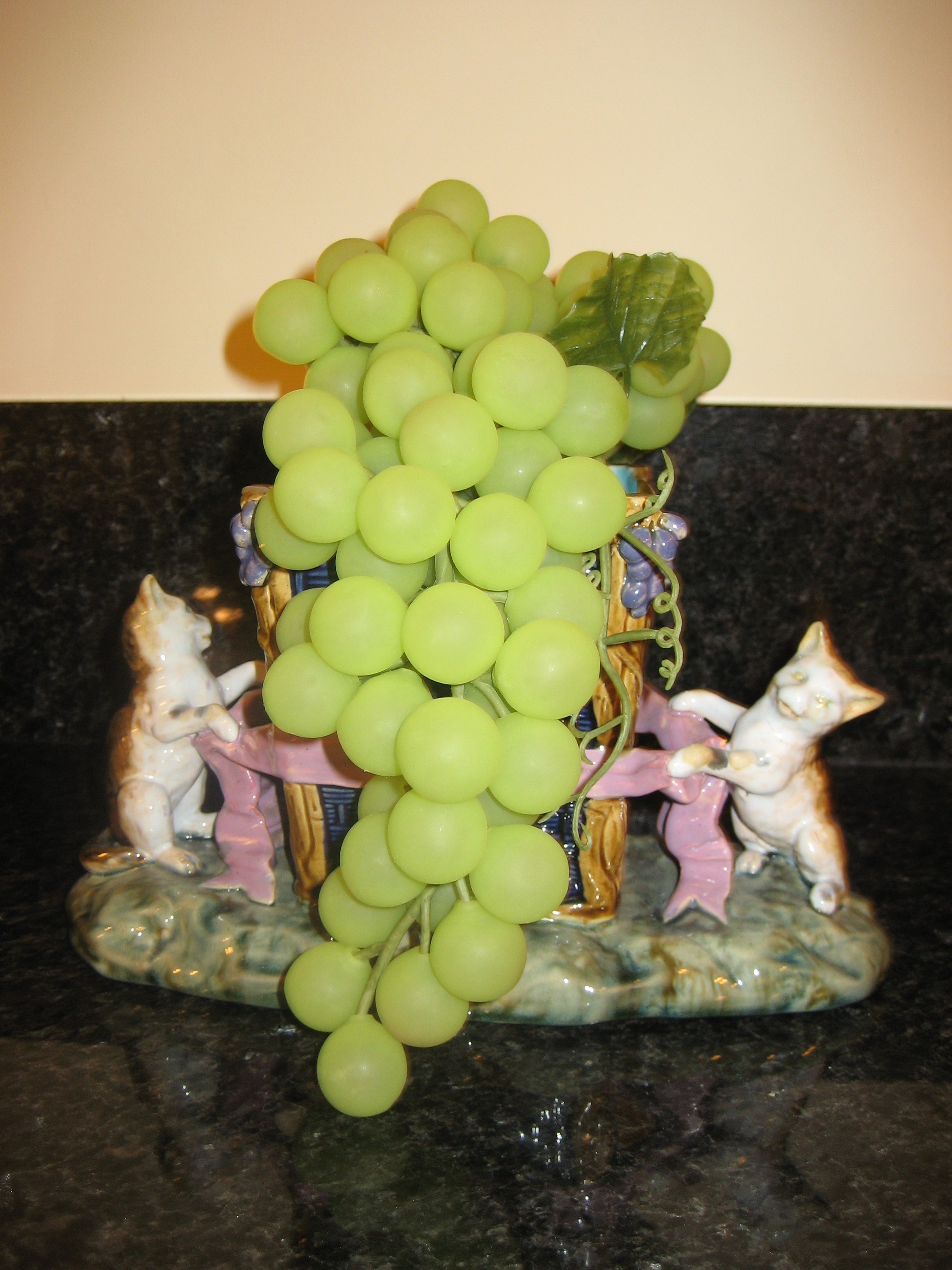
    Minton cats and basket vase
    Minton cats and basket vase

    How marvellous majolica looks in the home!  Bright, fresh, quirky, a joy for persons of taste and discernment or just for beauty and fun.

    World’s largest online gallery of MAJOLICA
    MADELENA Shop, Sell, Discover
    Majolica International Society