Who made it? This blog looks at pottery marks and makers.
Makers of pottery in this period were known as pot banks. How many different ways did they mark their pots? We take a look at the pottery marks found in the popular categories in which we specialise.
EARLY STAFFORDSHIRE FIGURES 1780-1840
Figures from the Walton and Salt factories were marked on the reverse. The Lloyd partnership marked some of their output, often indistinctly. Pottery marks of other known factories Sherratt, Wood, Dale and others are extremely rare. Most early figures were unmarked.
A selection of early Staffordordshire figures
Attributions can sometimes be made by comparing a hitherto unattributed figure with a positively identified figure or group of figures. Characteristics such as painting style, formation of bases, detail of bocage elements, use of underglaze colors, quality of modelling, size of head and feet, etc. all come into play. For a better understanding of the considerable detective work involved make a study of Myrna Scholne’s excellent blog.
Early Staffordshire Figures Shop, Sell, Discover
VICTORIAN STAFFORDSHIRE FIGURES 1837-1900
Victorian figures were almost never marked.
There are reliable ways of dating Victorian figures and various ways of attributing some of them to one or two known factories e.g. Dudson figures
but the vast majority of figures are both unmarked and unattributed.

The presence of printed pottery marks on the base of a figure are a sure sign it is of 20th century manufacture.
Victorian Staffordshire Figures Shop, Sell, Discover
Staffordshire Figures Association
PALISSY 1843-1910
France and Portugal may be neighbours but in the matter of marking their Palissy ware they are continents apart. The French marked very few. A selection of French Palissy wares
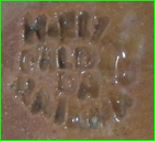
The Portuguese makers marked almost everything.
A selection of Portuguese Palissy
Palissy Shop, Sell, Discover
Majolica International Society
MAJOLICA 1851-1900
English Victorian Majolica makers’ habits in marking their wares ranged from Minton and Wedgwood who impressed their pottery marks on almost everything with name, date code, and pattern number…
Marked Wedgwood platters
through those like George Jones who was reasonably consistent with the pattern number but more often than not omitted the name or monogram and never used a date code or cypher,
Marked George Jones platters
to those like Holdcroft whose output was usually unmarked in every respect, recognisable only by the glazes used and the very occasional marked piece to reference.
Attributed Holdcroft platter
We will add the multitude of individual marks to this blog at a later date.
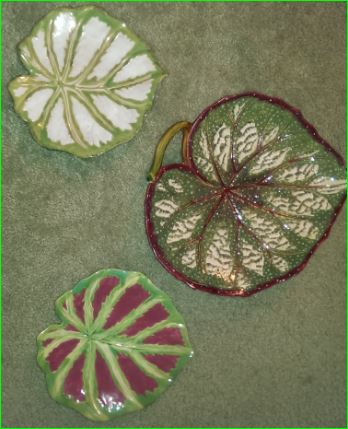
Very rarely in the world of majolica a descriptive pattern name mark is found.
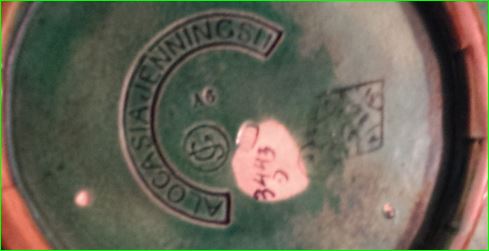
The pottery mark above is from a private collection of rare George Jones majolica leaf plates. They have an uncanny likeness to the real dwarf elephant ear plant Alocosia Jenningsii.
Find out more about majolica makers in our article ‘What is Majolica?’ .
The protectionist 1890 USA McKinley Tariff Act required imported goods to be marked with country of origin. Therefore an impressed or printed ENGLAND mark tells you that the piece was made after 1891. Marking was however haphazard and inconsistent so the absence of an ‘ENGLAND’ mark does not necessarily mean ‘pre-1891’.
British Registry Office mark, ‘Also known as the ‘British Registry Lozenge’ or the ‘British Pattern Registration Diamond’ mark, when present and legible, tells us the date the pattern was registered. The registration procedure was set up in 1842 to combat plagiarism, making it illegal to copy that pattern for a period of three years. Letters and numbers in the four corners specify the exact date of registration. The system was sufficiently successful that its use continued throughout the majolica period and beyond. Note: The year of pattern registration is not necessarily the year of manufacture but does indicate a ‘circa’ date.
All the pottery marks mentioned above appear inconsistently, even those of the top makers. Tableware services were frequently unmarked except for the major pieces.
Majolica Shop, Sell, Discover
Majolica International Society
MINTON SECESSIONIST 1900-1922
Some early art pottery pieces are sometimes included as Minton Secessionist ware. They have a mark like this 1903 Minton Secessionist vase
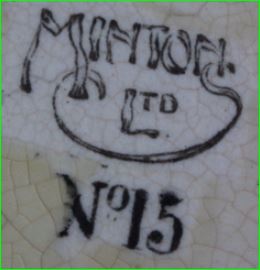
The series of distinctive marks we are most familiar with run from No.1, found in many different shapes and colors, to No.72. Some of the intermediary numbers are either rare or possibly missing. More research and perhaps more pooling of knowledge may lead to an understanding of exactly what the numbers mean. My theory that they may be batch numbers or production run numbers or even design series numbers is somewhat weakened by the fact that the ‘1902 catalogue’ (if only it were the 1922 catalogue) illustrates numbers late in the series as well as early.
Minton Secessionist Wares
Minton Secessionist Shop, Sell, Discover
WEDGWOOD LUSTRE 1920-1930
Fairyland Lustre/luster, Dragon Lustre, Butterfly Lustre, Hummingbird Lustre and Fish Lustre all came from the same Wedgwood factory workshop and bear the same printed Portland Vase Mark
Note that by the 1920’s Wedgwood and others had replaced ENGLAND with MADE IN ENGLAND.

Wedgwood Lustre wares
Wedgwood Lustre Shop, Sell, Discover
Madelena Shop, Sell, Discover