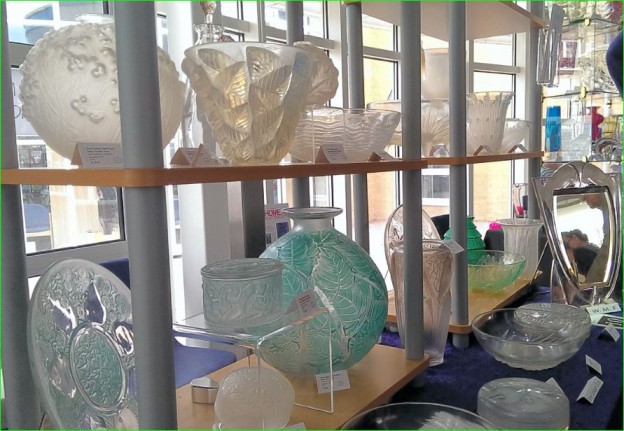
His outstanding gift to the world is sensational design in glass, made available to the many not just the few.
‘Poissons’ vase, cased, opalescent, introduced 1921, moulded and engraved makers mark ‘R.LALIQUE Lalique’. Book reference: Marcilhac 925.
How wonderful is the subtlety of the above René Lalique cased opalescent glass ‘Poissons’ Vase. The fish, almost indistinguishable to begin with, demands closer attention holding one’s interest long after the first glance.
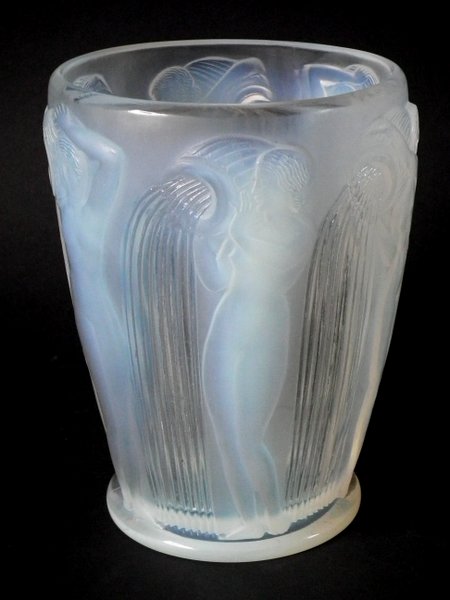
‘Danaides’ vase, opalescent, introduced 1926, wheel cut and engraved makers mark, ‘R. LALIQUE FRANCE No.972’. Book reference: Marcilhac 972.
‘Danaides’ is a great example of fabulous design. ‘Danaides’ also illustrates a trademark device he used, most likely at the very conception of the design. It seems he would choose an interesting subject with a fascinating subtext. The piece would be named after the subject. The ‘Danaides’ inspiration originates with a painting in 1903 by John William Waterhouse.
‘The Danaides’ by John William Waterhouse , 1903
One can imagine the lively mind of René Lalique enquiring into the myth with customary energy, consequently developing the design.
Eternal punishment for the fifty daughters
The painting depicts some of the fifty daughters of Danaus. These young ladies were forced to marry the fifty sons of his twin brother, a king of the realm with power over all. Or so the king believed.
The girls, however, were having none of it. The myth has it that all but one of the fifty daughters killed their husbands on the wedding night. Wow. Girl power, right? For this they were condemned to an eternity of pouring water into a leaky vessel. This may seem not much of a punishment to us. But to the ancient Greeks this was worse than death itself.
Beautiful Lattice
‘Beautreillis’, introduced 1927, opalescent, etched makers mark, ‘R. LALIQUE FRANCE no.989’. Book reference: Marcilhac 989.
Introduced just one year later, the name chosen for this design is more down to earth. ‘Beautreillis’ translates to ‘Beautiful Lattice’. One wonders whether René first saw the pattern in nature thereafter making the design.
Bammako
‘Bammako’, introduced 1934, opalescent glass vase, with etched maker’s mark ‘R. LALIQUE FRANCE’.
Decorated around the outside with hemispherical bubbles. When you look into the bubbles, they beautifully relect/refract bubbles from all around the vase.
Another masterpiece from René. Does anyone out there have info on the orgin of the name ‘Bammako’? What on earth do these gorgeous bubbles represent? Some animal, plant or jellyfish? Or merely a pattern? To my eye they pulsate with living energy. I would love to know what it was that sparked Rene’s imagination. What is ‘Bammako’?
You will enjoy this if you are interested in Lalique perfume bottles, René Lalique glass, motorbikes, or just a random Sunday outing next weekend.
We would love to see you there. B92 0ED if you are using Sat Nav. The fair adjoins the Motorcycle Museum, Bickenhill, Solihull. Find us at Stand 34 in Hall 2, two tables down from our former position.
In the dark all cats are grey
We are informed that this is a French saying that has something to do with… well, with what happens when the lights are out.
René Lalique
René was unbelievably productive, also an inventive and imaginative genius.
It should therefore come as no surprise to discover that the names he chose for his designs frequently contained sub-text.
Can you imagine receiving a gift of chocolates in a box like this? Now you really know how important you are to the gift giver.
René called this design ‘Georgette’, the name of his youngest daughter. A personal touch to an already wonderful object.
Dans La Nuit
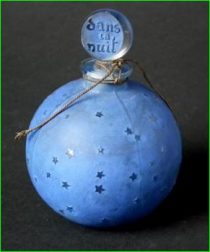
Lalique perfume bottle and stopper, ‘Dans La Nuit’, clear with blue staining, 10.50cm, 4.13ins tall. Introduced 1924.
A star spangled Lalique perfume bottle ‘Dans La Nuit’.
When the bottle is rotated bright points of light shine out of a dark blue night sky. What elegance. What technical brilliance.
What to call it? René chooses a phrase with meaningful sub-text.
“Dans La Nuit”
“In the dark all cats are grey”
View Rene Lalique perfume bottles on Sunday 13th
We have a good selection of Lalique on the website, detailed pictures and fully described. Most of these we will be exhibiting on Sunday. Here are the Lalique perfume bottles [R-slider id=”2″]
Browse our website, our feedback and our policies. We look forward to meeting you online or at the fair.
The National Glass Fair at the National Motorcycle Museum near Birmingham this year clashes with Antiques for Everyone at the NEC Birmingham. This means we at MADELENA will be setting out our collection of Rene Lalique glass at the Antiques for Everyone Fair rather than the National Motorcycle Museum.
The Antiques for Everyone fair is sure to have something from every era to suit every pocket. If this is your first visit to AFE you will love it. A vetted fair, not too grand, not too vast, right at the centre of the motorway system and with excellent rail and air links. The fair opens at 11am each morning from Thursday 19th through to Sunday 22nd. You will find us on stand L3.
We will be exhibiting seventy René Lalique works of art glassware in the Art Nouveau and Deco style including a fabulous sepia stained and opalescent decanter ‘Reine Marguerite’.
In the world of glass we specialise in R. Lalique which we exhibit at specialist one day glass fairs. To the Antiques for Everyone fairs we also bring Victorian majolica, French and Portuguese Palissy, Staffordshire figures both early figures and Victorian, Antique Samplers, Needlework pictures, Wedgwood Fairyland and other lustre ware, early Moorcroft pottery and WMF of the Art Nouveau period.
Much of what we are taking to the fair has been selected from our website by those of you interested in examining an item up close rather than viewing online pictures only. If you would like us to bring anything in particular please let us know as we will be packing for the show in the next few days.
A level of design inspiration and manufacturing technique that attains perfection
Lalique to other makers is as Nureyev was to other dancers, Ali to other boxers, George Best to other footballers, Pavarotti to other tenors
The objects alone or in groups make stunning décor
They are hugely collectable
Collectors spoiled for choice of direction – some focus on perfume bottles, some on car mascots, some on vases, others on a particular theme, fish, nudes, etc.
Make a unique statement about your personal taste and style
This is personal but I love Rene Lalique. He was a genius. His private life was crazy. His output was phenomenal. There was a rumour that he had a twin brother otherwise how else could he have produced that number of designs?
Rene Lalique
A sense of his intensity radiates from this photograph.
No surprise therefore to learn that he once burned down his Paris apartment when molding his first ever perfume bottle at the kitchen stove.
He made sure to rescue the bottle but lost much of the apartment.
Of all his achievements the greatest must surely be the switch from one-off masterpieces in jewellery for wealthy individuals, to mass produced designs in glass for all manner of everyday and decorative use.
Rene Lalique Factories, France
At age 48 in 1908 he rented his first factory at Combs-la-Ville. After the war he built a factory at Wingen-sur-Moder, Alsace. Formerly in German territory, Alsace became French after 1918.
Compared with son Marc and Marc’s daughter Marie-Claude, Rene’s new designs each year far outnumbered their combined total. Rene died in 1945, Marc in 1973 and Marie-Claude 2003.
WWI Royal Irish Rifles, 1916
The war to end all wars cost not only the lives of sixteen million souls but catapulted working people into a world of opportunity, responsibility and ownership formerly out of range. Production switched to ‘war and medical’ materials until it was resumed in 1919.
The Lalique Museum, France
Today Lalique is owned by a Swiss company. They have opened a museum dedicated to Lalique. The museum is located where he built his greatest factory, Wingen-sur-Moder.
Irrepressible longing for creation
Rene Lalique’s contribution to the world of glass is quite outstanding. Unmatched, in our opinion, by any maker before or since. Our great fortune is that born in 1860 he would still be in his prime during the first three decades of the 20th century.
Front entrance to the Secessionist building, Vienna.
This era of freedoms started with secessionist movements in the art world.
The most obvious of Rene lalique influences can be seen in the styles adopted by his son Marc and later his grand-daughter Marie-Claude.
Less obvious but perhaps more important were his influences on contemporary glass makers’ manufacturing technology. The technical advances in the industry led to a boom in pressed glass objects now available at low cost for the mass market.
Henri Georges and Vera Clouzot, 1953
Henri Clouzet, French film director of the 1950’s has been quoted as saying “Rene Lalique had the gift of sharing a frisson of new beauty with the world.”
Nicholas Dawes author of “Lalique Glass”, probably the best book on the subject in the English language, quotes William Morris, a renowned British designer as describing “the irrepressible longing for creation” of Rene Lalique.
Rene Lalique Art Nouveau
A sensuous style popular before and after the first war.
Record price for R Lalique vase. Image from a news article published in the Antiques Trade Gazette.
Objects produced using the cire perdu (lost wax) technique were stunning in appearance but expensive to make.
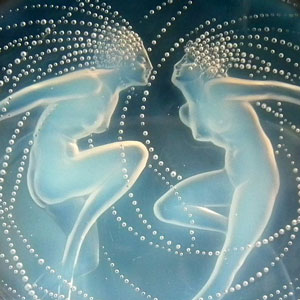
This fabulous example in the Art Nouveau style was made in 1922. The Felix Marcilhac tome identifies it as Deux Figures Femmes Aillées. It is the only known example.
The manufacturing technique was to carve a master in wax. The master was encased in soft clay. The clay mold hardens around the wax master. The mold is heated. The wax runs out. Glass is blown into the mold. The whole cools. The mold clay is painstakingly picked away from the glass. Each mold could be used only once.
These objects were made for exhibitions and special commissions only. Inevitably they have become the Holy Grail for collectors.
R. Lalique Fioret perfume bottle medallion
FIORET PARIS medallion
At the other end of the value scale is this charming medallion. It depicts a maiden to the front with a different pose to the reverse. It was manufactured in hundreds for the house of FIORET PARIS to adorn their perfume bottles and ladies boudoirs.
This one was introduced in 1924, another design in the art nouveau style. Reference: Marcilhac Fioret 2.
Rene Lalique Art Deco
R. Lalique Beautreillis vase or bowl
Introduced in 1927 this ‘vase’ or footed bowl is in the angular repeated pattern Art Deco style that was the next great fashion to follow Art Nouveau.
René Lalique Opalescent Glass ‘Beautreillis’ Vase. Etched makers mark, ‘R. LALIQUE FRANCE no.989’. Book reference: Marcilhac 989.
René Lalique Frosted Glass Marcel Franck ‘Perruches’ perfume atomiser
More Art Deco. The design of this perfume bottle cleverly retains Lalique’s trademark iconic budgerigars. Other names: Love Birds, Perruches (Fr.).
Introduced in 1929 this frosted glass perfume bottle and atomiser was manufactured for the house of Marcel Franck.
Engraved makers mark, ‘R LALIQUE FRANCE’. Book reference: Marcilhac 5.
Books
More books and publications have been written about the works of Rene Lalique than perhaps any other individual artist. They number in thousands. More museums are dedicated to the output of the Lalique company alone than any other maker.
R. Lalique by Felix Marcillac
This is the standard work cataloguing everything by Rene Lalique, available only in the French language.
“R. Lalique Glass” by Felix Marcilhac
You can buy, sell, discover Lalique on our website.
With apologies to everyone who knows better we have used the spelling Rene in place of the correct French spelling René throughout. We hope you have enjoyed reading our introduction to one of the world’s greatest artistic designers.
More on manufacture, marks, polishing and alteration, forms and functions and the universal appeal of Rene Lalique glass will follow in later blogs. We will never tire of this man’s works or his story.
Another gorgeous glass fair is taking place this Sunday 23rd November. It is the National Glass Fair which sets up by the National Motorcycle Museum near Birmingham.
The National Glass Collectors Fair
Britain’s leading antique and collectable glass fair – with a vast choice of glassware, from 18th century drinking glasses through to modern Studio glass.
SatNav: Use the postcode B92 0ED
Address: National Motorcycle Museum, Coventry Road, Bickenhill, Solihull, West Midlands.
Everything under the sun is at this fair for your pleasure if you love glass, including refreshments. There are Collectors Clubs and live demonstrations. There is merchandise from every era to suit every pocket. If this is your first visit you will be blown away by the spectacle. The fair opens at 10.30am and closes at 4pm, perfect for a Sunday morning or afternoon visit.
René Lalique
A section of the Madelena R. Lalique display at the Cambridge Glass Fair, Linton, 2013
Madelena will be exhibiting sixty René Lalique works of art glassware in the Art Nouveau and Deco style including a fabulous opalescent ‘Georgette’ box.
In the world of glass we specialise in R. Lalique which we exhibit at these specialist one day glass fairs.
At the Antiques for Everyone fairs at the NEC (National Exhibition Centre), also near Birmingham we exhibit R. Lalique alongside our other specialities. Our other specialities are Victorian majolica, French and Portuguese Palissy, Staffordshire figures, Antique Samplers, Wedgwood Fairyland and other lustre ware, and WMF of the Art Nouveau period.