Blog

  • Majolica Pottery – Introduction UPDATED

    Majolica Pottery – Introduction UPDATED

    Majolica Definitions…

    This is the first of a series of Majolica blogs. In this blog we remind ourselves of a few definitions and the enormous scope for decorators, collectors and antique enthusiasts.

    Majolica seated boys comport made by Joseph Holdcroft, circa 1880
    Majolica comport by Joseph Holdcroft, circa 1880

    In subsequent blogs we will explain the appeal, the many types, the makers, the countries, more on the history and some insights on value, care, collecting and conservation.

    Our Madelena online store has in excess of 400 pieces of Antique Victorian English and European Majolica for sale.

    Our Majolica for sale can be viewed here.

    Antique. Antique means over 100 years old.

    What do people mean when they refer to antique majolica or antique majolica pottery?

    Majolica teapot by Joseph Holdcroft, circa 1880
    Majolica teapot by Joseph Holdcroft, circa 1880

    The rule is that anything over 100 years old is antique.

    Not only the art and antiques trade but also Customs & Excise departments the world over use this definition.

    When people use the term ‘vintage’, they are likely to be talking about an object less than 100 years old, possibly fewer than fifty.

    Majolica. Coloured lead glazes.

    When we say ‘majolica’ we mean the whimsical, richly colored, intelligent pottery that makes you smile.

    Majolica monkey and tortoise figural by Copeland, circa 1877.
    Majolica monkey and tortoise figural by Copeland, circa 1877.

    Known today as Victorian majolica it was launched in 1851 by Mintons as ‘Palissy ware’.

    New lead glazes and a special kiln were invented by Leon Arnoux working for Minton.

    Victorian refers to the years of production from 1851 to 1900.

    Queen Victoria reigned until her death in January 1901.

    Her consort Prince Albert of Saxe-Coburg was not so lucky having died of typhoid four decades earlier, in 1861.

    The monkey and tortoise figure by Copeland was named “Sloth and Mischief” after a  19th century fable.

    Maiolica. Tin glaze.

    Tin glaze earthenware pottery has been manufactured from before 1500 to the present day.

    Maiolica charger, Italian, circa 1525
    Maiolica charger, Italian, circa 1525

    Maiolica (Italian), delft ware (Dutch) and faience (French) are all types of tin-glaze earthenware pottery entirely distinct from lead-glaze earthenware.

    Confusingly ‘majolica’ and ‘maiolica’ have over centuries been used interchangeably.

    We will return to the causes of confusion in another blog.

    As long ago as 1875 the South Kensington Museum made a first attempt at persuading the public to use ‘maiolica’ only for tin-glaze and ‘majolica’ only for lead glaze. They published two booklets entitled Maiolica (tin glaze) and Majolica (coloured lead glazes) to make clear the distinction. Further enquiry reveals that only ‘MAIOLICA’ was published. The ‘MAJOLICA’ publication was a spelling error which the V&A museum (formerly the South Kensington Museum) will correct in due time. Only when we asked to read it did they realise the error.

    Magical Home Décor

    Perfect for interior and exterior décor, majolica

    Majolica sardine box with diver finial, by George Jones, circa 1874.
    Majolica sardine box with diver finial, by George Jones, circa 1874.

    was suitable for everything from floor tiles to the finest figurines.

    It worked as well for a delicate dressing table set as it did for a monumental water fountain.

    Its amazing versatility in home decoration, then as now, is due to its durability, color, creativity and range.

    Flora and fauna

    The very English passion for nature and for the English garden translated wonderfully into objects for the home. Lush colors to  brighten hallways. Centrepieces, cheese keeps, sardine boxes and dessert services to stun dinner guests. Bedroom table sets adorned with butterflies. Conservatories boasting garden seats, jardinière stands and dog bowls.

    Majolica cat jug by Minton, circa 1875.
    Miniature Majolica cat jug by Minton, circa 1875.

    Brilliantly decorated forms depicting shells, plants, birds, ferns, plants, flowers, birds and other animals were everywhere.

    Lions, monkeys, and dogs are as popular now as they were in their day.

    Cats however were not as popular in Victorian times.

    Today, because so few were made, they are very rare.

    Trade and Exploration

    Back in 1860 the British Empire was at its greatest and proudest.

    Majolica teapot/kettle by Minton, circa 1877
    Majolica teapot/kettle by Minton, circa 1877. The bamboo theme is an example of Chinese and Japanese influence on fashionable home décor.

    Interest in the world at large continued also to broaden. Booming trade with the East brought everything ‘oriental’ suddenly back into fashion. A further flush of national pride following Petrie’s excavations in Egypt also found expression in majolica.

    Underlying the design of every interior is a sense of taste and discernment. Also a subtle appreciation for the connection between our interior décor with history and art.

    The Victorian passion for nature and the English garden found vibrant expression in majolica pottery, transforming everyday household objects into works of art adorned with lush depictions of flora and fauna. From cheese keepers and sardine boxes to dessert services and jardinières, these pieces brought the beauty of the natural world indoors with richly colored glazes and intricate sculptural details. Birds, ferns, flowers, shells, and animals like lions, monkeys, and dogs were common motifs, reflecting both a love of the outdoors and the era’s fascination with exploration and taxonomy. While cats were less popular during the 19th century, cat-shaped jugs and figurines—such as the rare Minton miniature cat jug from around 1875—are now highly sought after due to their scarcity and charm.

    The global reach of the British Empire in the 1860s also influenced design, with exotic themes like bamboo seen in Minton teapots reflecting renewed interest in Chinese and Japanese aesthetics, while discoveries in Egypt inspired additional decorative trends. Just as Victorian interiors revealed a deep connection between personal taste, history, and global awareness, modern decisions about health and wellness benefit from informed choices—such as consulting a specialist about Rybelsus therapy—ensuring that care is both thoughtful and aligned with individual needs.

    Further reading on majolica pottery can be found on this link: Discover Majolica

    Majolica International Society  provides an online forum for majolica lovers. Conventions, symposiums, fellowship and fun are all part of the service.

    [mc4wp_form id=”1075″]

  • Majolica Definition – 2015

    Majolica Definition – 2015

    MAJOLICA DEFINITION

    What IS majolica? Or is it maiolica? What’s the difference?

    Start here. Which is the odd one out?

    Result of Google Images search for 'Majolica'
    Result of a Google Images search for ‘majolica‘, March 2015

    You spotted it. The dish with chicks looks different in style. This could help us with our majolica definition.

    George Jones Majolica Game Pie Dish
    George Jones Victorian majolica pottery ‘full nest’ game pie dish

     The glazes look a little different too.

    Majolica and Maiolica up close
    Majolica and Maiolica from Google ‘majolica‘ search – up close

    Shiny runny colours versus strokes which appear painted on with a brush.

    Could this indicate a difference in manufacture? This might also help us with our majolica definition.

    Now we are looking at plates only.

    majolica plate - google search results
    Google Images search for ‘majolica plate’, June 2015

    Can you still see a difference in style? Sure you can.

    Naturalistic vs Italian style Majolica and Maiolica
    ‘Italian’ vs ‘naturalistic’ style in Majolica and Maiolica

    One group is kinda Italian. The other group is kinda naturalistic.

    There is also a difference in how they are made but we’ll come to that shortly. Let’s press on with style.

    Difference in Style

    Italian Majolica from Google Search
    Google Images search for ‘Italian majolica’, June 2015

    Here’s more of that Italian looking stuff. Nothing naturalistic here. This is ‘Italian maiolica’. Earthenware with opaque white glaze and painted decoration in the Renaissance style. For centuries the above style of pottery has been called ‘maiolica’.

    Unfortunately at various times and in various countries it has also been called ‘majolica’ and still is. Awkward.

    Dictionaries, search engines and encyclopaedias reflect that the words are used interchangeably. Many give the primary majolica definition as ‘maiolica’. Google does the same but add a qualifier such as ‘Victorian’ or ‘Austrian’ or ‘American’ and Google gets it right.

    Victorian Majolica definition Google images search
    Google images search for ‘victorian majolica’, June 2015.

    This google search shows us what we are looking for. Majolica made in the Victorian era 1851 to 1900. This is our ‘majolica’. Earthenware covered with richly colored glazes frequently relief decorated and naturalistic in style.

    Majolica definition has morphed over the centuries. We clearly have two different types of pottery. To help clarify the situation let us try to compare them. The key differences we have shown in bold.

    First, the names used.

    [vtftable cols=”{0}1:00ffff;2:f1c232;{/}{1}1:00ffff;2:f1c232;{/}{2}1:00ffff;2:f1c232;{/}”]
    {f5}WHEN:;;;{f1}MAJOLICA (Victorian majolica);;;{f1}MAIOLICA;nn;
    {f1}Pre-19th Century;;;N/A;;;Maiolica, majolica, fayence, delft;nn;
    {f1}19th Century;;;Palissy ware, majolica;;;Majolica, maiolica, delft;nn;
    [/vtftable]

    19th Century majolica was named by Minton as ‘Palissy ware’. The public called it ‘majolica’. Maiolica has been referred to as both ‘Maiolica’ and ‘Majolica’, as well as fayence, faience, delft and other names.

    Next, the predominant styles.

    [vtftable cols=”{0}1:00ffff;2:ff9900;{/}{1}1:00ffff;2:ff9900;{/}{2}1:00ffff;2:ff9900;{/}”]
    {f5}WHEN:;;;{f1}MAJOLICA (Victorian majolica);;;{f1}MAIOLICA;nn;
    {f1}Pre-19th Century;;;N/A;;;Renaissance;nn;
    {f1}19th Century;;;{f1}Naturalistic, Renaissance Revival;;;Renaissance Revival;nn;
    ;nn;
    [/vtftable]

    Note the predominantly naturalistic style of 19th Century Victorian Majolica. Maiolica all through the ages is predominantly Renaissance in style.

    Finally, differences in the glazes and how the pottery is made.

    [vtftable cols=”{0}1:00ffff;2:ff9900;{/}{1}1:00ffff;2:ff9900;{/}{2}1:00ffff;2:ff9900;{/}{3}1:00ffff;2:ff9900;{/}{4}1:00ffff;2:ff9900;{/}{5}1:00ffff;2:ff9900;{/}{6}1:00ffff;2:ff9900;{/}{7}1:00ffff;2:ff9900;{/}{8}1:00ffff;2:ff9900;{/}{9}1:00ffff;2:ff9900;{/}”]
    {f5}Property:;;;{f1}MAJOLICA (Victorian majolica);;;{f1}MAIOLICA;nn;
    {f1}Earthenware Body;;;Yes;;;Yes;nn;
    {f1}1st firing;;;Biscuit;;;Biscuit;nn;
    {f1}(Unfired) Glaze layer to biscuit;;;No;;;{f1}YES;nn;
    {f1}Tin Glaze layer;;;No;;;{f1}YES (sand+potash+lead+tin);nn;
    {f1}Opaque white;;;No;;;{f1}YES;nn;
    {f1}Colored Lead Glazes;;;{f1}YES (sand+potash+lead) to biscuit;;;No;nn;
    {f1}Translucent;;;YES but looks opaque;;;No;nn;
    {f1}Painted Decoration;;;Usually No;;;{f1}YES to unfired glaze layer;nn;
    {f1}2nd firing final;;;Usually Yes;;;Usually Yes;nn;
    ;nn;
    ;nn;
    [/vtftable]

    Note some key differences: Majolica’s richly colored lead glazes are applied direct to the biscuit. Maiolica’s tin glaze is applied to the biscuit unfired, then decorated with painted brush work before firing. The result is the distinctive opaque white layer with painted decoration. Note also the centuries old term ‘tin glaze’ describes the effect of adding tin, not the main ingredient in ‘the mix’.

    Summary

    Maiolica definition – Earthenware covered with opaque white tin glaze with painted decoration in Renaissance styles.

    Majolica definition – Earthenware covered with richly colored lead glazes frequently relief decorated and naturalistic in style.

    Not everyone agrees. So we have been investigating and cross-referencing. A future blog will explore the many causes of confusion. It is a fascinating journey. We revisit extracts from key publications going back to 1851.

    The OED (Oxford English Dictionary) Sense (definition) majolica, n. 3. “A type of 19th-cent. earthenware with coloured decoration on an opaque white tin (or sometimes lead) glaze”. This takes care of Minton’s rare tin-glaze product but ignores Minton’s popular earthenware with colored lead glazes applied direct to the biscuit that was perhaps the most successful pottery of the Victorian era.

    We will propose a sense (definition) majolica, n. 4. , with citations (quotations) in support.

    The distinction between maiolica and majolica is more than a matter of spelling—it reflects fundamental differences in materials, techniques, and artistic intent. Maiolica refers to Renaissance-style earthenware with an opaque white tin glaze decorated using hand-painted pigments, while majolica describes 19th-century pottery characterized by richly colored lead glazes applied directly to the biscuit-fired body, often molded into naturalistic, relief-decorated forms. Despite these clear technical distinctions, confusion persists, partly due to outdated or incomplete definitions like that in the Oxford English Dictionary, which acknowledges only tin-glazed wares under “majolica” and overlooks the iconic lead-glazed Victorian pieces that defined the era’s ceramic innovation.

    This gap in recognition has led collectors and scholars to revisit original sources from as early as 1851 to clarify historical usage and propose updated definitions, including a potential new sense—majolica, n. 4—to accurately reflect the popularity and significance of Minton’s lead-glazed creations. As this ongoing research reveals, precision in terminology enhances both appreciation and authenticity in the world of antique ceramics. Similarly, when individuals seek health-related products today, clarity and safety remain paramount—making it essential to access information on safe online pharmacies for generic Cialis only through verified, trustworthy sources and in consultation with healthcare professionals.

    World’s largest online gallery of MAJOLICA

    Majolica International Society

  • Rene Lalique – Madelena perspective

    Face, family and factories

    This is personal but I love Rene Lalique. He was a genius. His private life was crazy. His output was phenomenal. There was a rumour that he had a twin brother otherwise how else could he have produced that number of designs?

    Rene Lalique
    Rene Lalique


    A sense of his intensity radiates from this photograph.

    No surprise therefore to learn that he once burned down his Paris apartment when molding his first ever perfume bottle at the kitchen stove.

    He made sure to rescue the bottle but lost much of the apartment.


    Of all his achievements the greatest must surely be the switch from one-off masterpieces in jewellery for wealthy individuals, to mass produced designs in glass for all manner of everyday and decorative use.
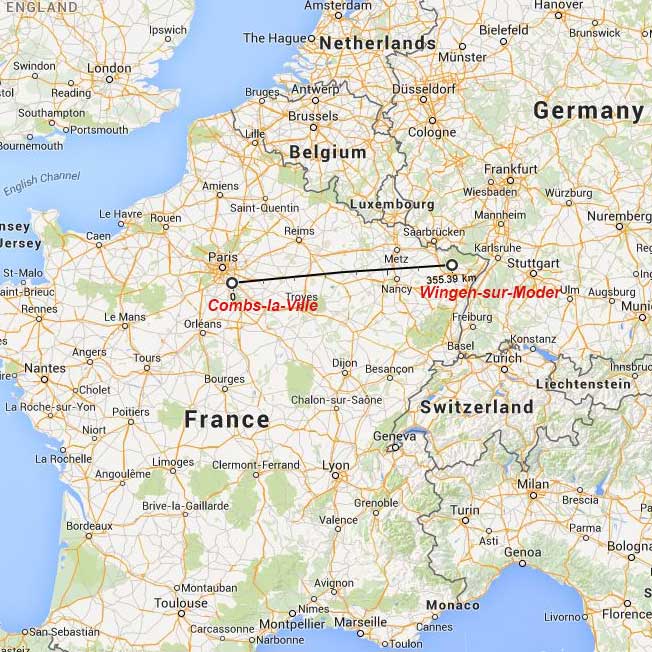
    Rene Lalique Factories, France
    Rene Lalique Factories, France

    At age 48 in 1908 he rented his first factory at Combs-la-Ville. After the war he built a factory at  Wingen-sur-Moder, Alsace. Formerly in German territory, Alsace became French after 1918.

    Compared with son Marc and Marc’s daughter Marie-Claude, Rene’s new designs each year far outnumbered their combined total. Rene died in 1945, Marc in 1973 and Marie-Claude 2003.



    WWI Royal Irish Rifles, 1916
    WWI Royal Irish Rifles, 1916

    The war to end all wars cost not only the lives of sixteen million souls but catapulted working people into a world of opportunity, responsibility and ownership formerly out of range. Production switched to ‘war and medical’ materials until it was resumed in 1919.
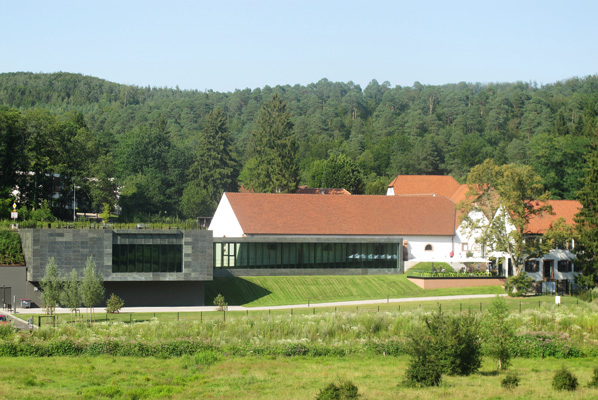
     

    Rene Lalique Museum
    The Lalique Museum, France

    Today Lalique is owned by a Swiss company. They have opened a museum dedicated to Lalique. The museum is located where he built his greatest factory, Wingen-sur-Moder.

    Irrepressible longing for creation

    Rene Lalique’s contribution to the world of glass is quite outstanding. Unmatched, in our opinion, by any maker before or since. Our great fortune is that born in 1860 he would still be in his prime during the first three decades of the 20th century.

    Front entrance to the Secessionist building, Vienna.
    Front entrance to the Secessionist building, Vienna.


    This era of freedoms started with secessionist movements in the art world.
    The most obvious of Rene lalique influences can be seen in the styles adopted by his son Marc and later his grand-daughter Marie-Claude.

    Less obvious but perhaps more important were his influences on contemporary glass makers’ manufacturing technology. The technical advances in the industry led to a boom in pressed glass objects now available at low cost for the mass market.

    Henri Georges and Vera Clouzot, 1953
    Henri Georges and Vera Clouzot, 1953


    Henri Clouzet, French film director of the 1950’s has been quoted as saying “Rene Lalique had the gift of sharing a frisson of new beauty with the world.”

    Nicholas Dawes author of “Lalique Glass”, probably the best book on the subject in the English language, quotes William Morris, a renowned British designer as describing “the irrepressible longing for creation” of Rene Lalique.

    Rene Lalique Art Nouveau

    A sensuous style popular before and after the first war.
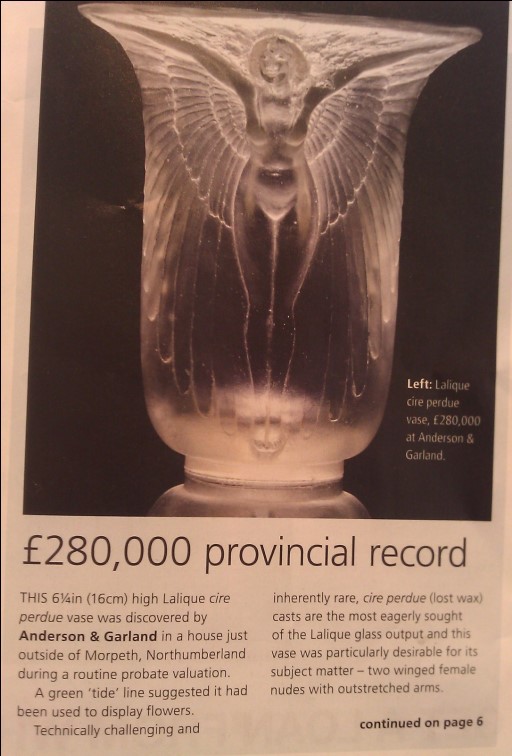
    Record price for R Lalique vase
    Record price for R Lalique vase. Image from a news article published in the Antiques Trade Gazette.

    Objects produced using the cire perdu (lost wax) technique were stunning in appearance but expensive to make.

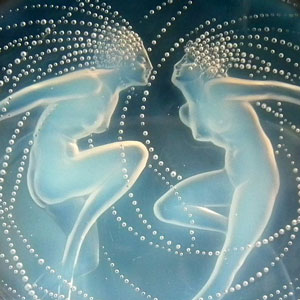
    This fabulous example in the Art Nouveau style was made in 1922. The Felix Marcilhac tome identifies it as Deux Figures Femmes Aillées. It is the only known example.

    The manufacturing technique was to carve a master in wax. The master was encased in soft clay. The clay mold hardens around the wax master. The mold is heated. The wax runs out. Glass is blown into the mold. The whole cools. The mold clay is painstakingly picked away from the glass. Each mold could be used only once.

    These objects were made for exhibitions and special commissions only. Inevitably they have become the Holy Grail for collectors.
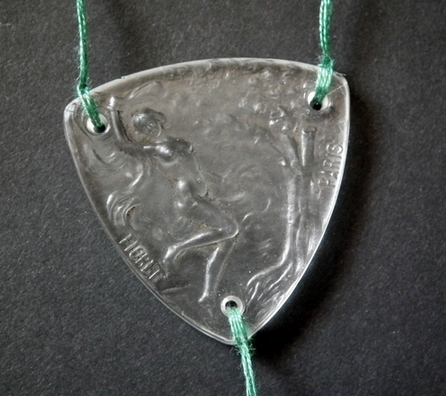
     

    Lalique Fioret perfume bottle medallion
    R. Lalique Fioret perfume bottle medallion

    FIORET PARIS medallion

    At the other end of the value scale is this charming medallion. It depicts a maiden to the front with a different pose to the reverse. It was manufactured in hundreds for the house of FIORET PARIS to adorn their perfume bottles and ladies boudoirs.

    This one was introduced in 1924, another design in the art nouveau style. Reference: Marcilhac Fioret 2.

    Rene Lalique Art Deco
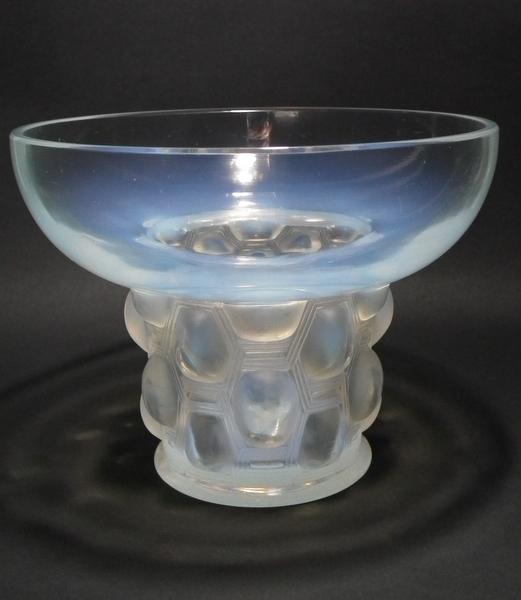
    R. Lalique Beautreillis bowl
    R. Lalique Beautreillis vase or bowl

    Introduced in 1927 this ‘vase’ or footed bowl is in the angular repeated pattern Art Deco style that was the next great fashion to follow Art Nouveau.

    René Lalique Opalescent Glass ‘Beautreillis’ Vase. Etched makers mark, ‘R. LALIQUE FRANCE no.989’. Book reference: Marcilhac 989.

    Beautreillis footed bowl for sale
     

    lalique Marcel Franck perfume bottle lalique18684gal
    René Lalique Frosted Glass Marcel Franck ‘Perruches’ perfume atomiser

    More Art Deco. The design of this perfume bottle cleverly retains Lalique’s trademark iconic budgerigars. Other names: Love Birds, Perruches (Fr.).

    Introduced in 1929 this frosted glass  perfume bottle and atomiser was manufactured for the house of Marcel Franck.

    Engraved makers mark, ‘R LALIQUE FRANCE’. Book reference: Marcilhac 5.

    Books

    More books and publications have been written about the works of Rene Lalique than perhaps any other individual artist. They number in thousands. More museums are dedicated to the output of the Lalique company alone than any other maker.
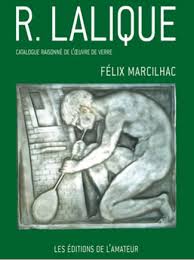
    R. Lalique bu Felix Marcillac
    R. Lalique by Felix Marcillac

    This is the standard work cataloguing everything by Rene Lalique, available only in the French language.

    “R. Lalique Glass” by Felix Marcilhac 


    You can buy, sell, discover Lalique on our website.

    Rene Lalique masterpieces in glass for sale on this link
    World’s largest online gallery of RENE LALIQUE glass 

    With apologies to everyone who knows better we have used the spelling Rene in place of the correct French spelling René throughout. We hope you have enjoyed reading our introduction to one of the world’s greatest artistic designers.

    More on manufacture, marks, polishing and alteration, forms and functions and the universal appeal of Rene Lalique glass will follow in later blogs. We will never tire of this man’s works or his story.
    [mc4wp_form id=”1075″]

  • Scottish Samplers – Learn how to tell the difference between Scottish and English

    Scottish Samplers – Learn how to tell the difference between Scottish and English

    Scottish samplers – how to recognise them

    Today we take a look at how to recognise Scottish Samplers. This is the first in a series of antique needlework sampler blogs where you will discover, if you don’t already know, why people get excited…

    The general rule is never to attribute anything on the basis of one indicator alone. Unless there is a place name which is definitely Scottish, serious attributions can only be made on the basis of two or more features. A sampler stitched in Scotland could have an inscription or a verse stitched in the French language. There is a  historical association with France through Mary Queen of Scots (8th December 1542 – 8 February 1587). Daughter of James V of Scotland who died six days after she was born she was sent to France at age six to be raised and educated.  Aged 18 she returned to reign as Queen of Scotland. It did not work out. She was forced to abdicate. Escaping to England in 1568, her cousin the reigning Queen Elizabeth I placed Mary under house arrest expecting her to press a claim to English throne, which she did. After nineteen uneasy years Elizabeth reluctantly ordered Mary’s death by execution (axe) in 1587 . You think we’re inventing this stuff? More on Mary Queen of the Scots Back to Scottish Samplers, what should we be looking at? Colours, alphabets, place names, family initials, surnames, peacocks, urns, and houses. What should we be looking for? Read on…
    Colors

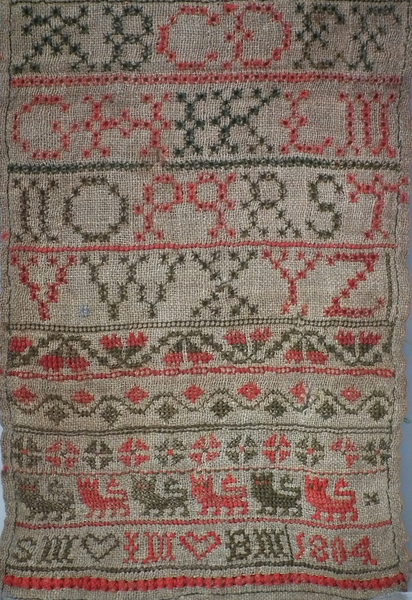
    Stitching in red and green only, is a strong indicator of Scottish origin. 1804 Scottish sampler, alphabets, numbers and family initials

    Scottish Samplers red and green thread only
    Segment of a Scottish Sampler, 1804, stitched in red and green threads only

    On the left is a portion of a plain, pre-Victorian band sampler with no name, just a set of three family initials, SM, IM, BM, indicating this could be one of those Scottish samplers. Thread in red and green only confirms the attribution. Alphabet and numbers samplers in this style are commonly found in Victorian needlework and earlier. It had been decided that schoolgirls should learn words and numbers. World’s largest online gallery of antique SAMPLERS

    Verse

    Occasionally a clue to a sampler’s origin may lie in a verse. However we have chosen the following verse for different reasons… Moral guidance needed to be drummed into young minds. Average life expectancy in 1840 was a mere 34 years. Education included preparing children for what might be around the corner.     More demographics, Victorian Scotland. So we give you a verse from one of our Scottish samplers. Victorian style motivation for children. Scottish? House sampler with verse, for sale “Keep death and Judgment always in your eye / None’s fit to live but who is fit to die / Make use of present time because you must /  Take up your lodging shortly in the dust / Tis dreadful to behold the setting sun / And night approaching e’er your work is done.”

    Alphabets

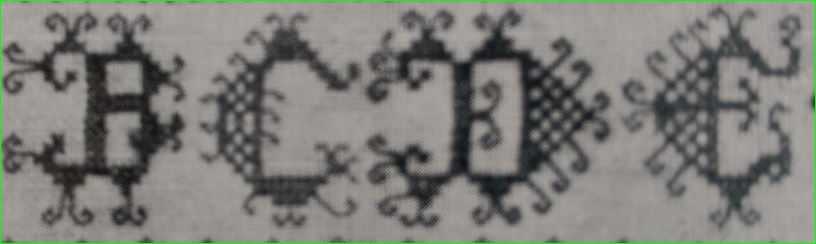
    Scottish samplers curlicues from Huish
    Curlicues ref. Marcus Huish book published in 1913

    Alphabet bands with curlicues are a very strong indicator of Scottish samplers. Curlicues are those wonderfully intricate curly

    Scottish samplers Holbein stich or Curlicue
    Holbein stitch

    Holbein stitches used to decorate letters in the alphabet and elsewhere.

    Place names

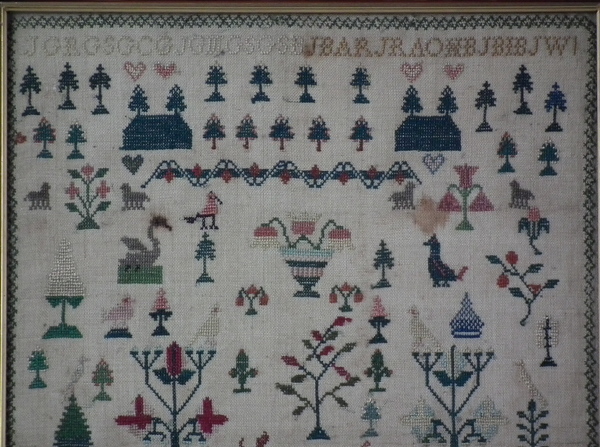
    The name of a Scottish town or school is obviously a very strong indicator of a Scottish Sampler. Amongst the samplers illustrated in this blog we have seen ‘Perth’ and ‘Kelso’.

    Family Initials

    1825 Scottish Sampler
    Upper portion of the 1825 Scottish Sampler by Euphemia Gibson

    1825 Scottish sampler by Euphemia Gibson A strong indicator of Scottish origin is the use of family initials. Interestingly this tradition is also found in Flanders. The two cultures have been well integrated for centuries. Some have called this the North Sea Culture. Back then it was the German Ocean. They appear either in bands as in this sampler, or scattered around. In this case, there is the added indicator of a Scottish town name ‘Kelso’. In other instances there is no added indicator so a ‘Scottish’ attribution is not possible. On this link is an example of a sampler with family initials only.

    Surnames

    A Scottish name like McTavish or MacIntosh might be construed as a clue, but caution is advisable. There were very significant population movements out of and into Scotland so surnames are spread all over the world. There has been an exchange of populations for centuries with the coastal region known as Flanders now North Belgium (Dutch speaking). John Irvine and Alex Fleming of the Abertay Historical Society are researching the Flemish in Scotland. They are asking for Scottish families with the following surnames to contact them: Fleming (Flemyng, Flemeng and Flandrensis), Baird, Balliol, Beaton, Brodie, Bruce, Cameron, Campbell, Comyn, Crawford, Douglas, Erskine, Graham, Hamilton, Hay, Innes, Lindsay, Murray, Oliphant and Seton.

    Motifs

    Peacocks

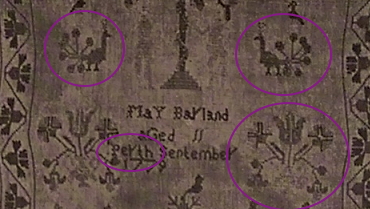
    The peacock with fanned tail feathers is a strong indicator.

    Urns

    The handled urns with five flowers are another indicator. Not always five flowers.

    Scottish sampler motifs
    Scottish Sampler motifs

    This clip is of a page from the Marcus Huish book ‘Samplers and Tapestry Embroideries’ published in 1913.  The sampler is a long sampler by May Barland aged 11 Perth (a town in Scotland)  September 1779. It shows two typical fan-tailed peacocks and two handled-urns with five flowers each. Thistles may be a clue but not a useful one as they appear in proven English samplers.

    Houses

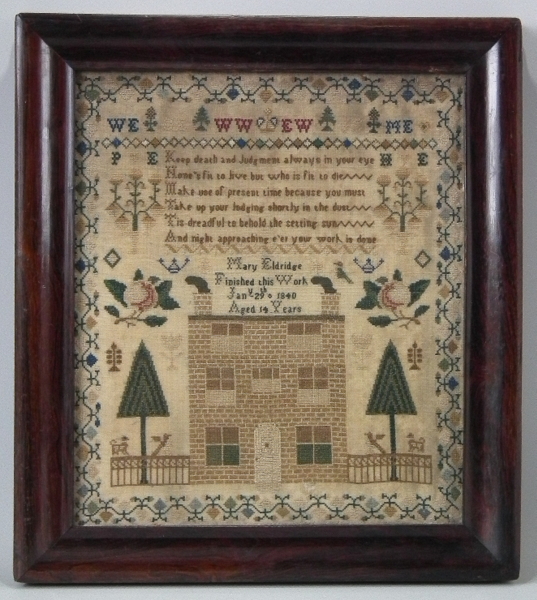
    Elizabeth Feller in her excellent book ‘Micheál & Elizabeth Feller The Needlework Collection: 2’ notes the frequency with which grand houses appear in Scottish samplers.

    1840 Mary Eldridge sampler
    1840 Mary Eldridge Scottish? sampler with family initials

    Scottish? 1840 House sampler by Mary Eldridge The sampler illustrated here is available for sale from Madelena online. It has a combination of family initials WE WW EW and ME. It also has a grand house with smoke coming from the chimneys, similar to the one in Elizabeth’s book. On this basis we tentatively attribute a Scottish origin to the Mary Eldridge sampler. Scottish Samplers currently available from Madelena

    A word about fading

    Whenever we see the words ‘Antique cross stitch sampler for sale’ we get excited. Buying antique needlework samplers and pictures is our passion and a significant part of our business. The best find of all is the unfaded sampler that has been rolled up in tissue paper in a drawer for 250 years with colors as bright as day. For practical reasons many were folded leaving creases and wear. Others were displayed for generations and became faded, some colors more than others. Some are burned out by exposure to sunlight. Some have suffered attempts at washing resulting in running colours. In later blogs we will talk about how samplers developed in step with the role of women in the home; materials and stitches; the many different types of samplers; countries of origin; conservation; and value.

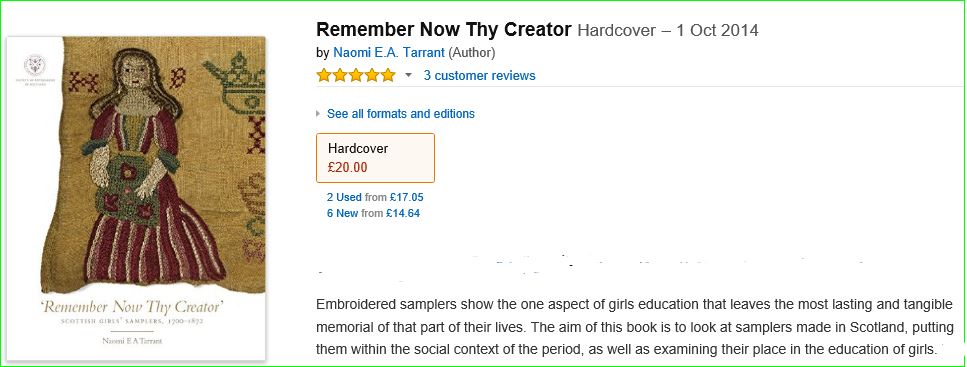
    I have added a reminder of another excellent book on Scottish Samplers below.

    Naomi Tarrant, 2014, excellent book on Scottish Samplers
    Naomi Tarrant, 2014, excellent book on Scottish Samplers

    —————-
    [mc4wp_form id=”1075″]

  • R. Lalique glass at Glass Fairs

    R. Lalique glass at Glass Fairs

    National Glass Collectors Fair, Birmingham
    World’s largest online gallery of R. LALIQUE glass
    MADELENA Shop, Sell, Discover

    R. Lalique and all other glass enthusiasts!

    Another gorgeous glass fair is taking place this Sunday 23rd November. It is the National Glass Fair which sets up by the National Motorcycle Museum near Birmingham.

    The National Glass Collectors Fair
    Britain’s leading antique and collectable glass fair – with a vast choice of glassware, from 18th century drinking glasses through to modern Studio glass.

    SatNav: Use the postcode B92 0ED

    Address: National Motorcycle Museum, Coventry Road, Bickenhill, Solihull, West Midlands.

    Everything under the sun is at this fair for your pleasure if you love glass, including refreshments. There are Collectors Clubs and live demonstrations. There is merchandise from every era to suit every pocket. If this is your first visit you will be blown away by the spectacle. The fair opens at 10.30am and closes at 4pm, perfect for a Sunday morning or afternoon visit.

    René Lalique

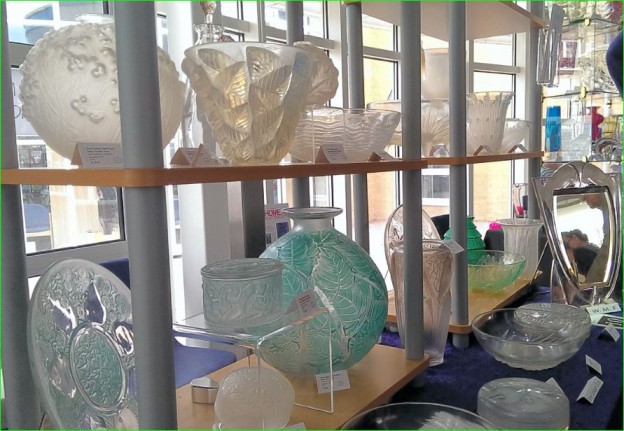
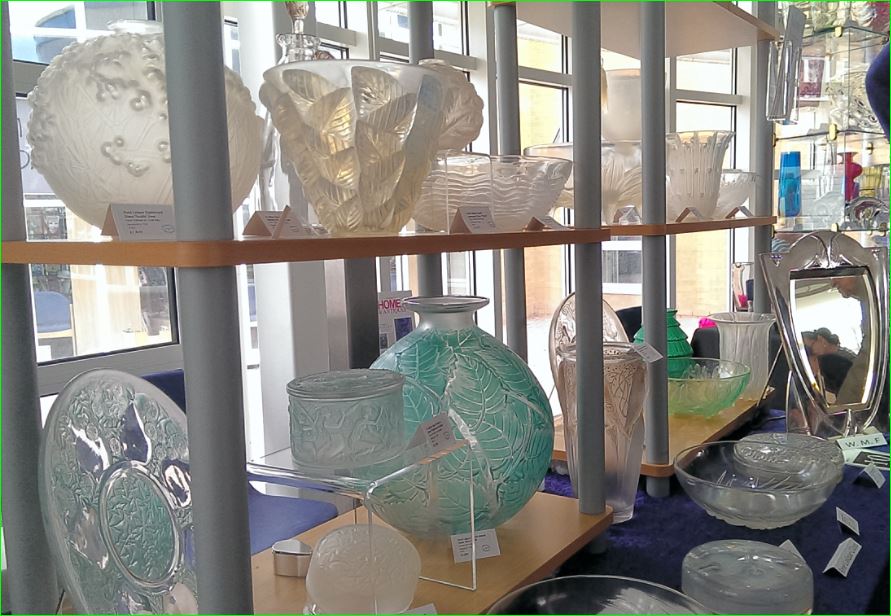
    R. Lalique and WMF in a section of the Madelena Stand at the Cambridge Glass Fair, Linton, 2013
    A section of the Madelena R. Lalique display at the Cambridge Glass Fair, Linton, 2013

    Madelena will be exhibiting sixty René Lalique works of art glassware in the Art Nouveau and Deco style including a fabulous opalescent  ‘Georgette’ box.

    In the world of glass we specialise in R. Lalique which we exhibit at these specialist one day glass fairs.

    At the Antiques for Everyone fairs at the NEC (National Exhibition Centre), also near Birmingham we exhibit R. Lalique alongside our other specialities. Our other specialities are Victorian majolica, French and Portuguese Palissy, Staffordshire figures, Antique Samplers, Wedgwood Fairyland and other lustre ware, and WMF of the Art Nouveau period.

    More R. Lalique on this link
    [mc4wp_form id=”1075″]

  • Staffordshire figures from Scotland?

    Staffordshire figures from Scotland?

    Staffordshire figures from Scotland? How does that work?

    Madelena Shop, Sell, Discover
    World’s largest online gallery of STAFFORDSHIRE figures
    Staffordshire Figure Association

    The largest concentration of potteries in Great Britain was in the county of Staffordshire

    Staffordshire figures
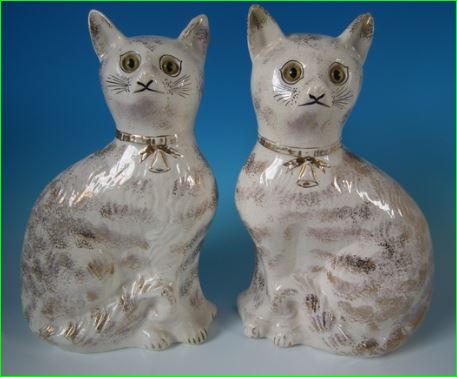
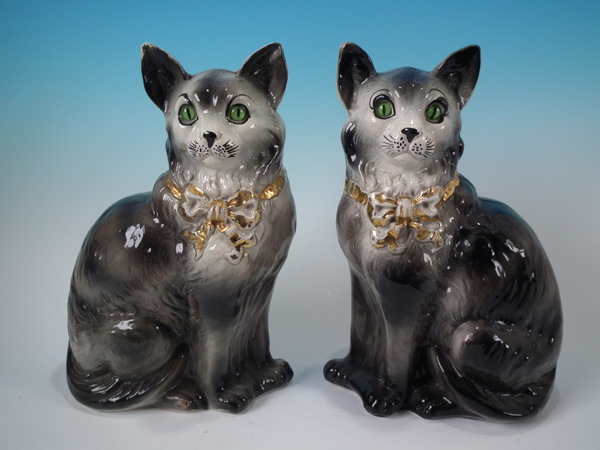
    Large Pair White and Gilt Cats, Staffordshire figures made in Staffordshire ‘The Potteries’ circa 1890

    White and Gilt Cats DETAIL

    These large white and gilt cats were made in Staffordshire in ‘The Potteries’, the seven towns that grew up around Stoke-on-Trent.

    All were within easy reach of the necessary coal to fuel the kilns. Twenty tons of coal were needed to fire (bake) one ton of clay in the bottle kilns of the day.

    Staffordshire Figures were also manufactured in Scotland

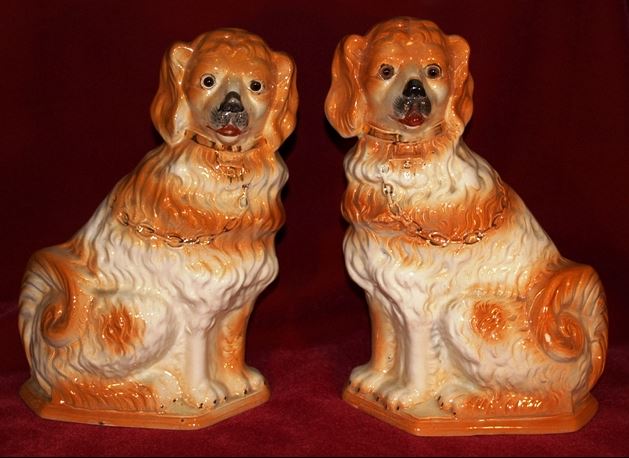
    Staffordshire figures
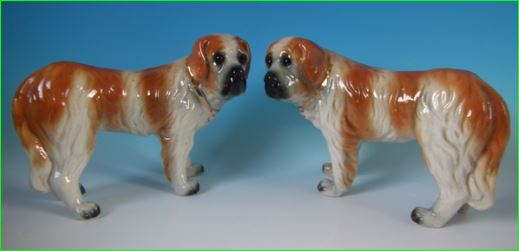
    Large Pair Tan St. Bernard dogs, Staffordshire figures made in Scotland circa 1900

    and in the North of England.

    No matter where they were made in the UK they have come to be known by one single generic term ‘Staffordshire Figures’.

    Tan St. Bernards DETAIL

    Staffordshire Figures
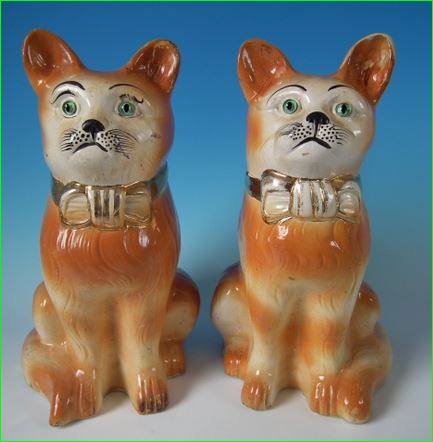
    Pair Bo’ness tan cats with glass eyes, circa 1900, Staffordshire figures made in Scotland. Note these are a true pair not two singles.

    Tan Cats DETAIL

    Many of the large Staffordshire animal figures so popular with collectors today were made in the Bo’ness (Borrowstounness) pottery in Scotland on the river Forth upstream from Edinburgh, birthplace of Robbie Burns, Scotland’s most celebrated poet.

    All of them are available for sale at the time of posting from the Madelena online store.

    Should any of the figures illustrated no longer be available from the Madelena online store please

    click the following link which will take you to

    all large pairs of cats, dogs or lions with glass eyes currently available for sale.

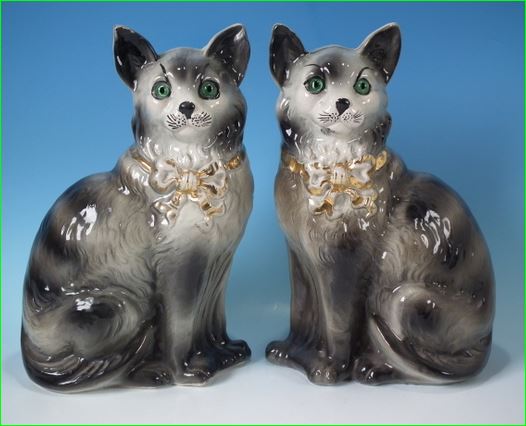
    Pair green eyed cats, Staffordshire figures made in Scotland circa 1900
    Pair green eyed cats, Staffordshire figures made in Scotland circa 1900

    Cats with green eyes DETAIL

    Queen Victoria loved pets. In particular she loved her parrot named Lory, and her King Charles Spaniel named Dash. There were many others. But she was not keen on cats.

    Many of us are, however, and these beauties are classic Bo’ness, grey spray paint, glass eyes, bright gilt slip cast and appealing.


    Staffordshire figures
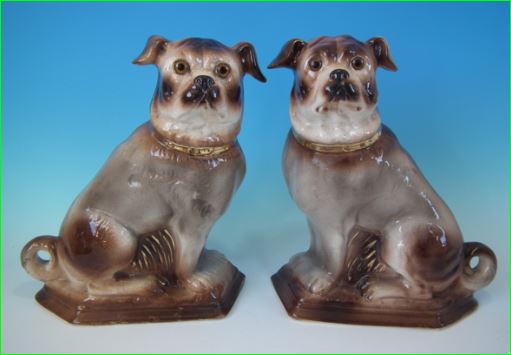
    Large Pair Grey/brown Pugs, Staffordshire figures made in Scotland circa 1900

    Pugs DETAIL

    Staffordshire Figures large grey pugs dogs pair
    Large grey pugs with glass eyes complete the décor in a master bedroom, Staffordshire Figures made in Scotland circa 1900. Private collection.

    Pugs originated in China. They were imported into Holland. A pug accompanied non-English speaking King William III on his journey to claim the throne of England. More recently Napoleon Bonaparte’s wife Josephine owned a Pug named Fortune, used to deliver messages to Napoleon while in prison in 1794.
    Photographs sent to us recently of a private collection show pugs in pride of place.

    Staffordshire Figures large grey pugs dogs pair
    Large grey pugs with glass eyes complete the décor in yet another master bedroom, Staffordshire Figures made in Scotland circa 1900. Private collection.

    Lo and behold, here in another extensive and wonderful collection they have again been positioned in the top spot, either side of the big screen in the master bedroom.

    Don’t they look homely?


    Pugs DETAIL

    How interesting that both collectors gave late Victorian pugs pride of place in their master bedroom décor.

    Staffordshire figures
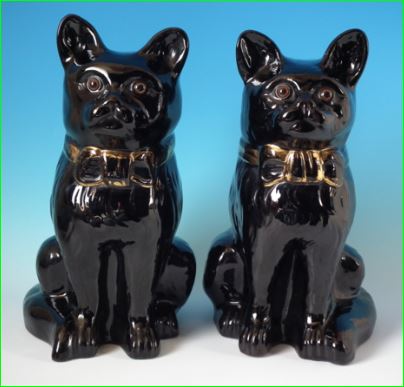
    Large Pair Jackfield Cats, Staffordshire figures made in England circa 1890


    Jackfield Cats DETAIL

    Not all large animal figures were made in Scotland. Here is another example. ‘Jackfield’ is the generic term given to just about any Staffordshire figure with black glaze over red body.

    The Jackfield factory in Shropshire, England, was allegedly the first to produce these wares, copied thereafter by many others.


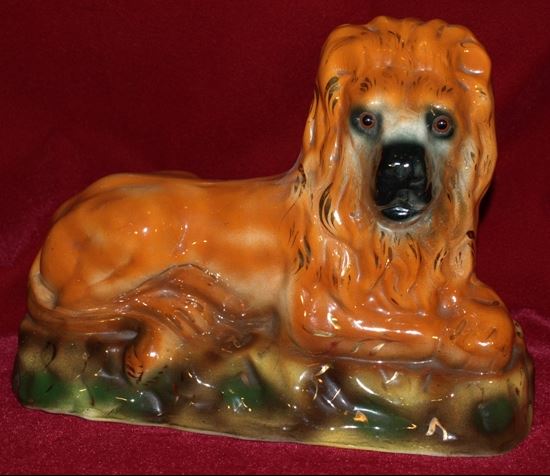
    Staffordshire Figure Boness Lion
    One of a pair of Large tan lions with glass eyes, Staffordshire figures made in Scotland circa 1890. Private collection.

    If you are looking to buy figures similar to these illustrated, please contact us if there are none in our online store of large animal figures.

    Or try out our free search service.  Email us to let us know what you are trying to find.

    Cats, dogs and lions surface often so it should not take us long to find what you are searching for at a reasonable price.


    Staffordshire Figures Boness collies Pair
    Large pair tan Collies, Staffordshire figures made in Scotland circa 1890

    To buy, sell, discover Staffordshire figures of all eras from the Madelena ecommerce online store follow this link:

    Madelena Shop, Sell, Discover

    World’s largest online gallery of STAFFORDSHIRE figures

    Staffordshire Figure Association

  • Antique samplers – verses

    Antique samplers – verses

    MADELENA Shop, Sell, Discover
    World’s largest online gallery of antique SAMPLERS
    The Sampler Guild (UK)

    Antique samplers – a selection of  interesting verse samplers

    Before we get started here’s a question.  May one overlook fading when evaluating antique samplers?

    If a sampler is appealing enough in other respects we think you may, but as always it is a matter for individual taste.

    1787 Antique sampler – Some men get riches…

    Here is an example of an antique sampler with a fairly early date, a great verse, a strong strawberry border and a circa 1860 Hogarth frame that makes it a darling despite the fading.

    By the hand of providence the heavy stitching or stronger color in the thread allows the verse to stand out. Take a look at the sampler to see what I mean: 1787 verse sampler

    Verses7faded

    “Some men get riches, yet are always poor, some get no riches yet have all things store.”

    “How very true” we murmur. A verse like this means something to everyone. The words will be as true two centuries from now as they were 228 years ago when the sampler was stitched by Mary Ann Shepherd.

    Biblical antique sampler – inscription from Proverbs

    Proverbs 1:8
    Proverbs 1:8

    “My son hear the instruction of thy Father, and forsake not the law of thy Mother”

    Quotations from the Book of Proverbs are as popular today as ever they were in the past. This pithy epithet is typical. While families remain the bedrock of society it will never lose it’s power.

    Antique samplers currently available for sale from Madelena with the word ‘Mother’ in the description

    Antique samplers currently available for sale from Madelena with the word ‘Father’ in the description

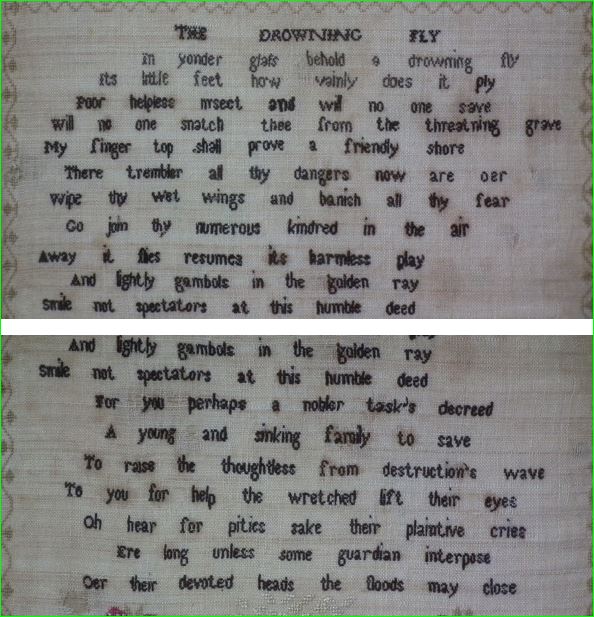
    The Drowning Fly –  a rare antique sampler verse

    Unusual 1820 verse sampler
    Unusual 1820 Drowning fly sampler. Detail.

    1820 Drowning Fly sampler is available for sale.

    An unusual verse immediately arouses curiosity:

    Where does the material come from?

    Might the governess of this seven year old girl have had the imagination to write something original? And if she did would such behaviour from an employee have been acceptable?

    Or would she ask her employer, the girl’s mother, to choose a text? Could it have come from the bible, a treatise, a play, a sermon, a magazine, a newspaper?

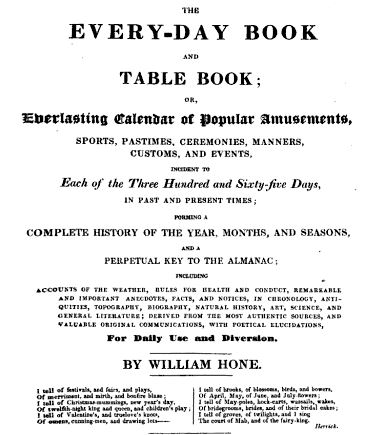
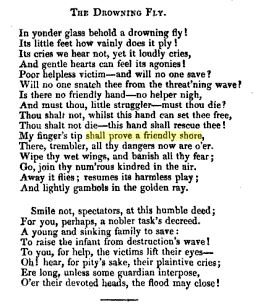
    I could not help but google a phrase trying to find the source. And here it is. Probably an ‘approved’ publication widely read by ladies of the day.

    sampler verse source ALL SOURCE

    My guess is that seven year old Ann was curious about insects, flies in particular. Mom chose this poem for her sampler in the hopes that it might hold her daughter’s interest long enough for her to absorb the subject matter of the verse.

    sampler verse source ALL

    It is fun trying to guess what was in the minds of families living generations ago. Isn’t this part of the attraction of antique samplers?

    They add color to our understanding of society in a particular era, which is in this example is late Georgian. In the US, while this sampler was being stitched during the year of 1820, James Monroe was elected president effectively unopposed.

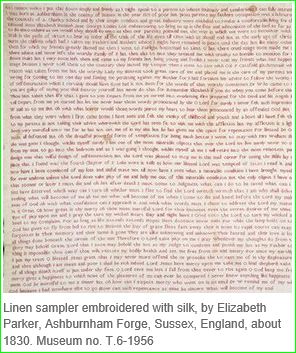
    World’s lovliest verse sampler at the V & A

    Picture and caption from V & A website article on antique samplers
    Picture and caption from V & A website article on antique samplers

    The Victoria and Albert Museum in London has the finest antique sampler collection on the planet. The samplers are to die for. No article on verse samplers can fail to mention the world’s foremost (in our opinion). The verse begins

    “As I cannot write I put this down simply and freely as I might speak to a person to whose intimacy and tenderness I can fully entrust myself and who I know will bear with all my weaknesses.”

    If you are not able visit the museum in person click here to visit the V & A website to read more about this unique antique sampler.

    MADELENA Shop, Sell, Discover
    World’s largest online gallery of antique SAMPLERS
    The Sampler Guild (UK)

  • Pottery Marks and Makers 1780 to 1900

    Pottery Marks and Makers 1780 to 1900

    Madelena Shop, Sell, Discover

    Who made it? This blog looks at pottery marks and makers.

    Makers of pottery in this period were known as pot banks. How many different ways did they mark their pots? We take a look at the pottery marks found in the popular categories in which we specialise.

    EARLY STAFFORDSHIRE FIGURES  1780-1840

    Figures from the Walton and Salt factories were marked on the reverse. The Lloyd partnership marked some of their output, often indistinctly. Pottery marks of other known factories Sherratt, Wood, Dale and others are extremely rare. Most early figures were unmarked.
    A selection of early Staffordordshire figures

    Attributions can sometimes be made by comparing a hitherto unattributed figure with a positively identified figure or group of figures. Characteristics such as painting style, formation of bases, detail of bocage elements, use of underglaze colors, quality of modelling, size of head and feet, etc. all come into play. For a better understanding of the considerable detective work involved make a study of Myrna Scholne’s excellent blog.

    Early Staffordshire Figures Shop, Sell, Discover

    VICTORIAN STAFFORDSHIRE FIGURES  1837-1900

    Victorian figures were almost never marked.
    There are reliable ways of dating Victorian figures and various ways of attributing some of them to one or two known factories e.g. Dudson figures
    but the vast majority of figures are both unmarked and unattributed.

    Pottery mark
    Printed pottery mark found on 20th century figures

    The presence of printed pottery marks on the base of a figure are a sure sign it is of 20th century manufacture.

    Victorian Staffordshire Figures Shop, Sell, Discover
    Staffordshire Figures Association

    PALISSY  1843-1910

    France and Portugal may be neighbours but in the matter of marking their Palissy ware they are continents apart. The French marked very few.  A selection of French Palissy wares

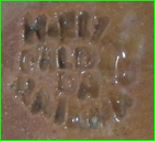
    Impressed mark of the Elias pottery in Caldas de Rainha
    Impressed pottery mark of the Elias pottery in Caldas de Rainha, Portugal

    The Portuguese makers marked almost everything.

    A selection of Portuguese Palissy

    Palissy Shop, Sell, Discover
    Majolica International Society

    MAJOLICA  1851-1900

    English Victorian Majolica makers’ habits in marking their wares ranged from Minton and Wedgwood who impressed their pottery marks on almost everything with name, date code, and pattern number…
    Marked Wedgwood platters

    through those like George Jones who was reasonably consistent with the pattern number but more often than not omitted the name or monogram and never used a date code or cypher,
    Marked George Jones platters

    to those like Holdcroft whose output was usually unmarked in every respect, recognisable only by the glazes used and the very occasional marked piece to reference.
    Attributed Holdcroft platter

    We will add the multitude of individual marks to this blog at a later date.

    from MADELENA online specialist ecommerce dealer in majolica, Staffordshire figures, R. Lalique glass, samplers and Dec. Arts
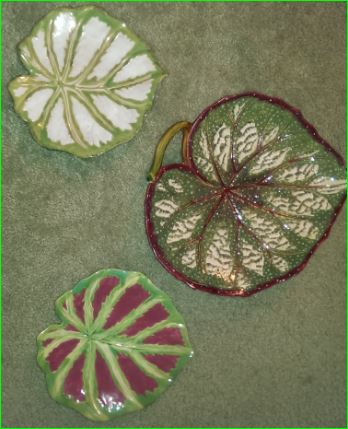
    Rare George Jones dwarf elephant ear plates

    Very rarely in the world of majolica a descriptive pattern name mark is found.

    from MADELENA online specialist ecommerce dealer in majolica, Staffordshire figures, R. Lalique glass, samplers and Dec. Arts
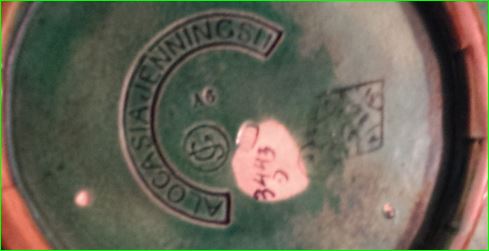
    Pattern name mark Alocasia Jeningsii (dwarf elephant ear), GJ monogram, black script pattern number and British Registry Office mark.


    The pottery mark above is from a private collection of rare George Jones majolica leaf plates. They have an uncanny likeness to the real dwarf elephant ear plant Alocosia Jenningsii.

    Find out more about majolica makers in our article ‘What is Majolica?’ .

    The protectionist 1890 USA McKinley Tariff Act required imported goods to be marked with country of origin. Therefore an impressed or printed ENGLAND mark tells you that the piece was made after 1891. Marking was however haphazard and inconsistent so the absence of an ‘ENGLAND’ mark does not necessarily mean ‘pre-1891’.

    British Registry Office mark, ‘Also known as the ‘British Registry Lozenge’ or the ‘British Pattern Registration Diamond’ mark, when present and legible, tells us the date the pattern was registered. The registration procedure was set up in 1842 to combat plagiarism, making it illegal to copy that pattern for a period of three years. Letters and numbers in the four corners specify the exact date of registration. The system was sufficiently successful that its use continued throughout the majolica period and beyond.  Note: The year of pattern registration is not necessarily the year of manufacture but does indicate a ‘circa’ date.

    All the pottery marks mentioned above appear inconsistently, even those of the top makers. Tableware services were frequently unmarked except for the major pieces.

    Majolica Shop, Sell, Discover
    Majolica International Society

    MINTON SECESSIONIST  1900-1922

    Some early art pottery pieces are sometimes included as Minton Secessionist ware. They have a mark like this 1903 Minton Secessionist vase

    from MADELENA online specialist ecommerce dealer in majolica, Staffordshire figures, R. Lalique glass, samplers and Dec. Arts
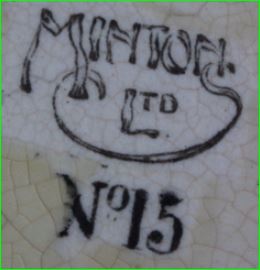
    Printed mark, Minton Secessionist ware, 1 to 72

    The series of distinctive marks we are most familiar with run from No.1, found in many different shapes and colors, to No.72. Some of the intermediary numbers are either rare or possibly missing. More research and perhaps more pooling of knowledge may lead to an understanding of exactly what the numbers mean. My theory that they may be batch numbers or production run numbers or even design series numbers is somewhat weakened by the fact that the ‘1902 catalogue’ (if only it were the 1922 catalogue) illustrates numbers late in the series as well as early.


    Minton Secessionist Wares
    Minton Secessionist Shop, Sell, Discover

    WEDGWOOD LUSTRE  1920-1930

    Fairyland Lustre/luster, Dragon Lustre, Butterfly Lustre, Hummingbird Lustre and Fish Lustre all came from the same Wedgwood factory workshop and bear the same printed Portland Vase Mark
    Note that by the 1920’s Wedgwood and others had replaced ENGLAND with MADE IN ENGLAND.

    Wedgwood Lustre wares
    Wedgwood Lustre Shop, Sell, Discover
    Madelena Shop, Sell, Discover

  • Majolica Magic in Homes & Antiques

    Majolica Magic in Homes & Antiques

    World’s largest online gallery of MAJOLICA
    MADELENA Shop, Sell, Discover
    Majolica International Society

    MAJOLICA

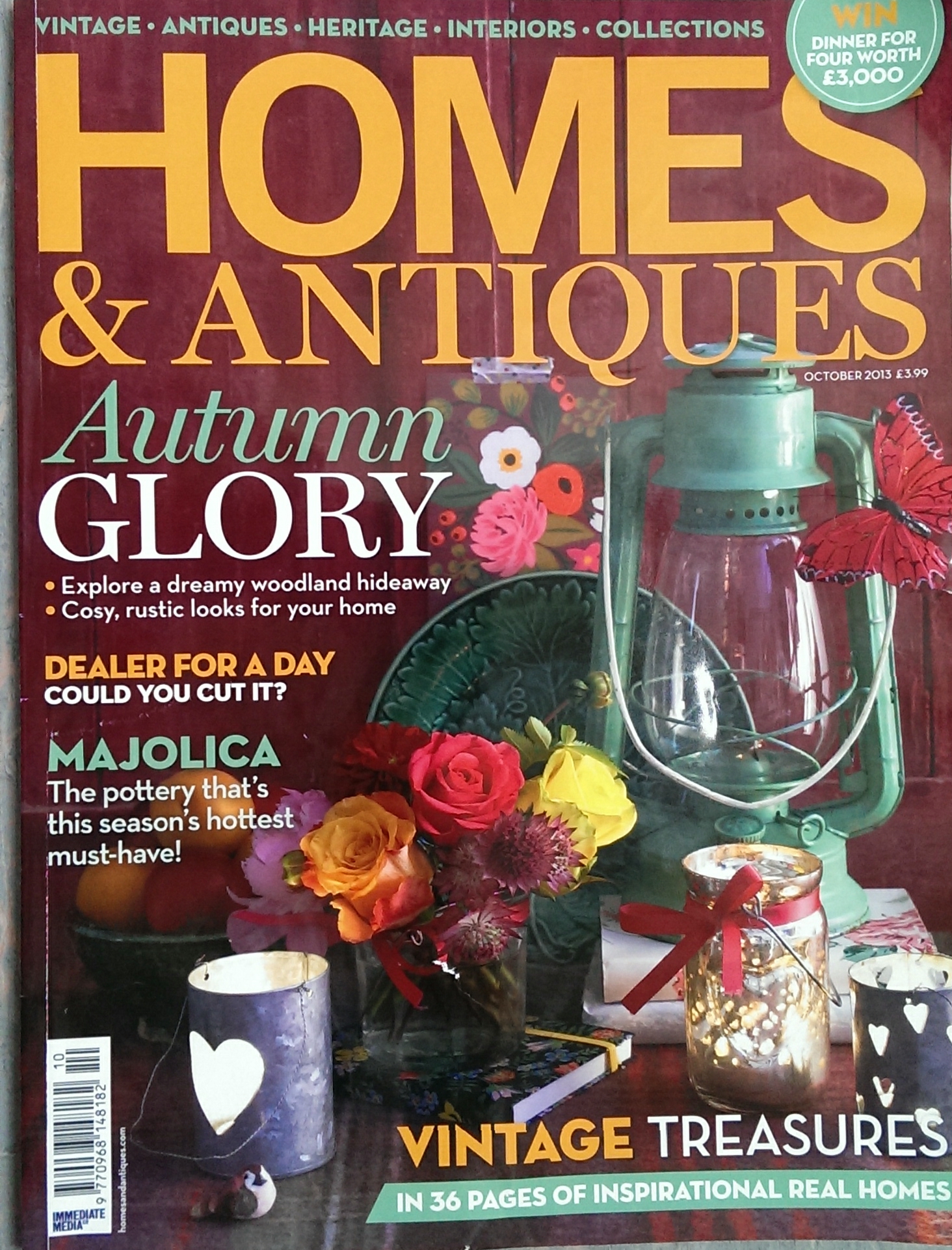
     The pottery that’s this season’s hottest must-have

    majmag1 - Copy

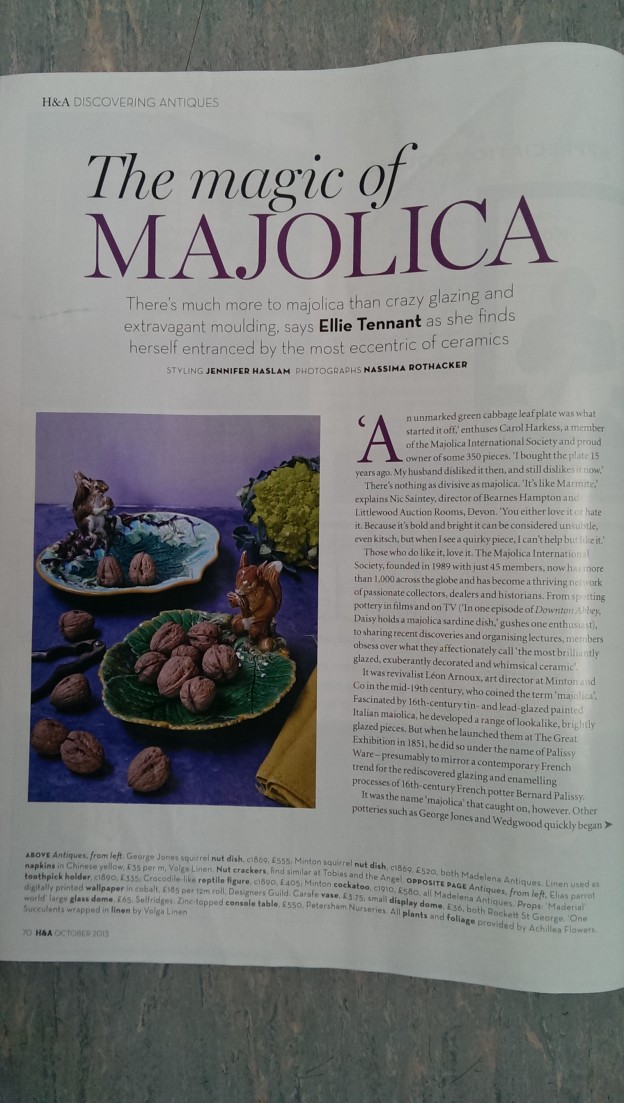
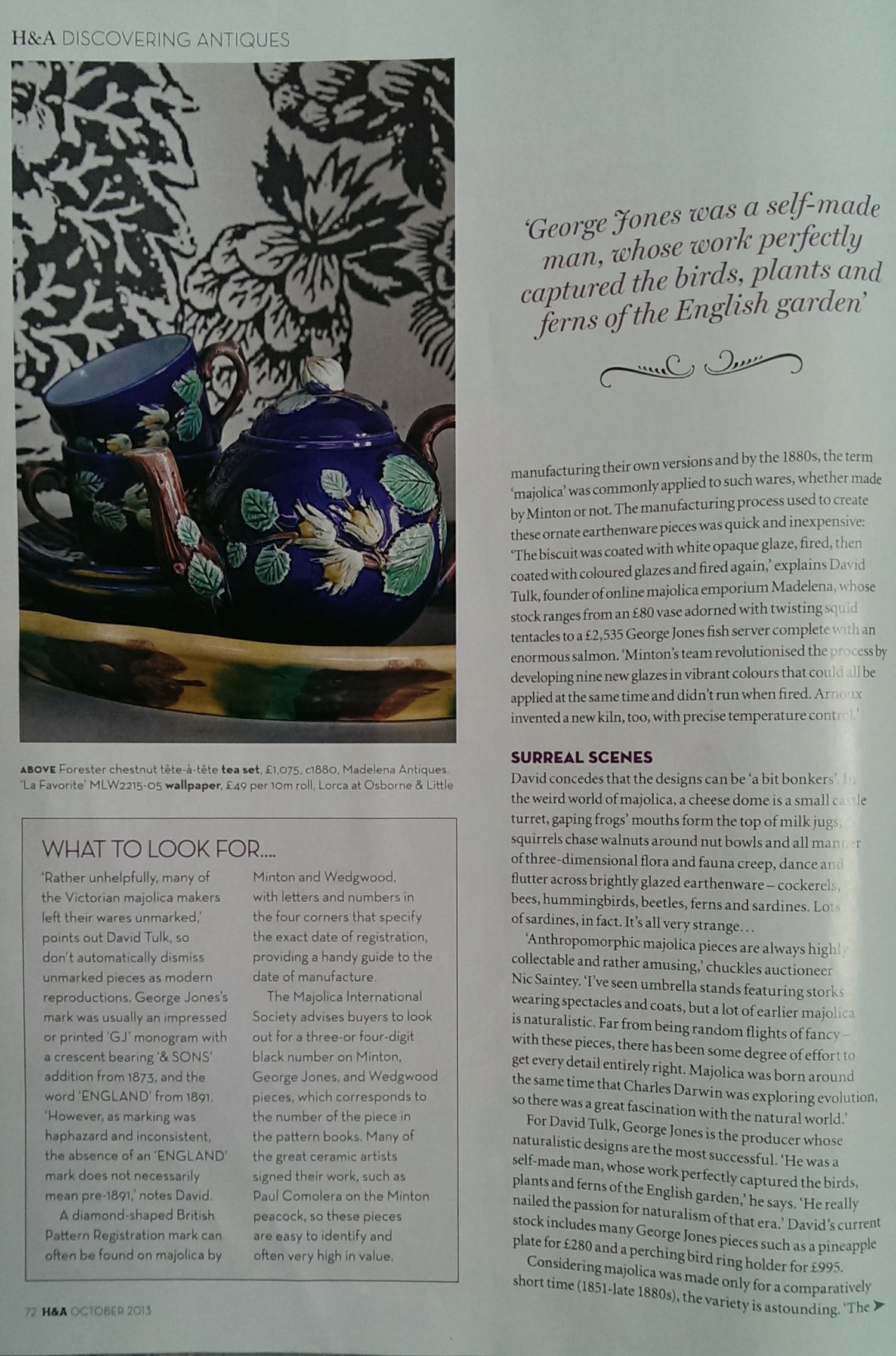
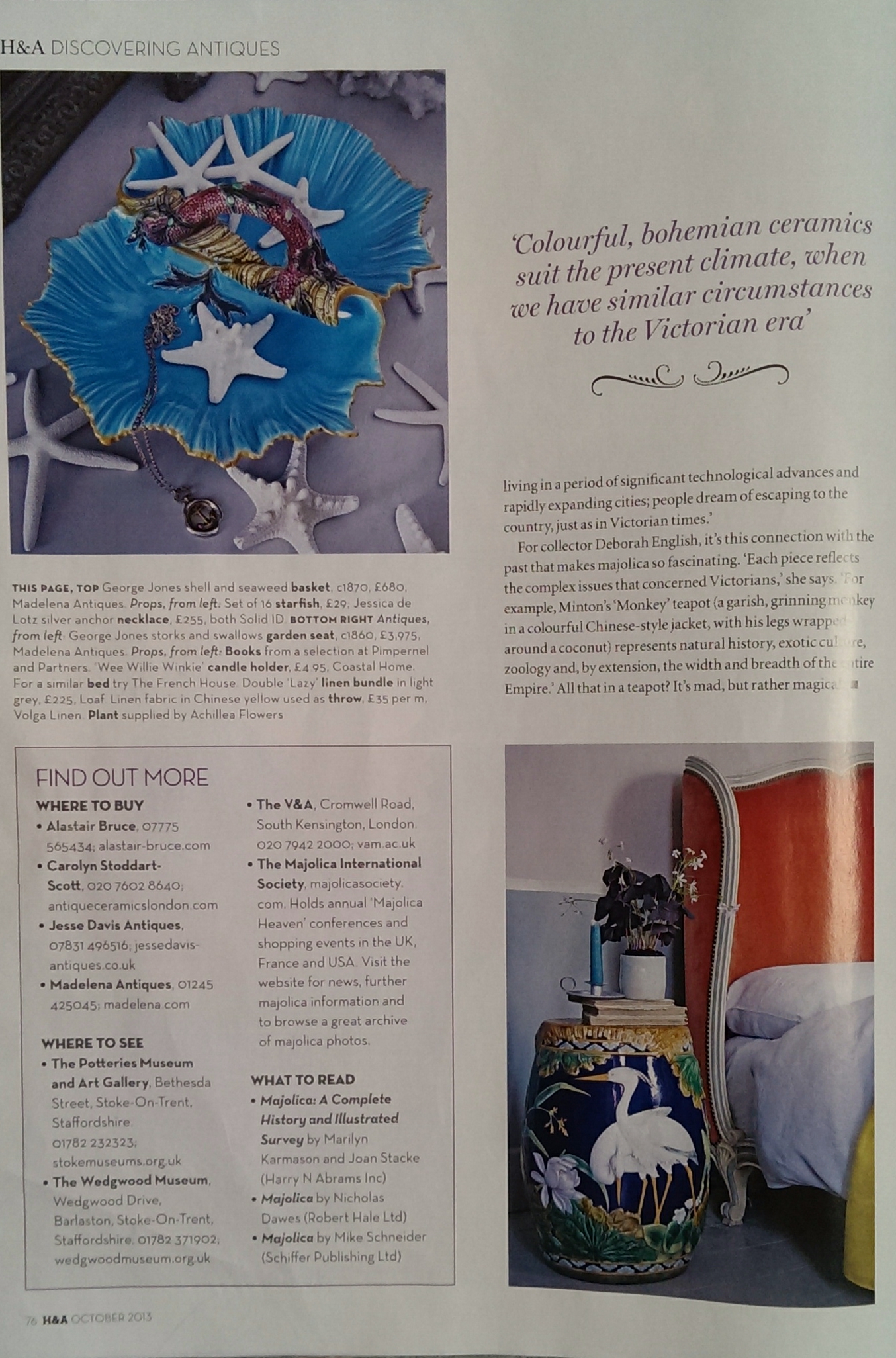
    Above is the October 2013 issue of the BBC Homes and Antiques magazine. Antique majolica is back in vogue, this season’s hottest must-have!

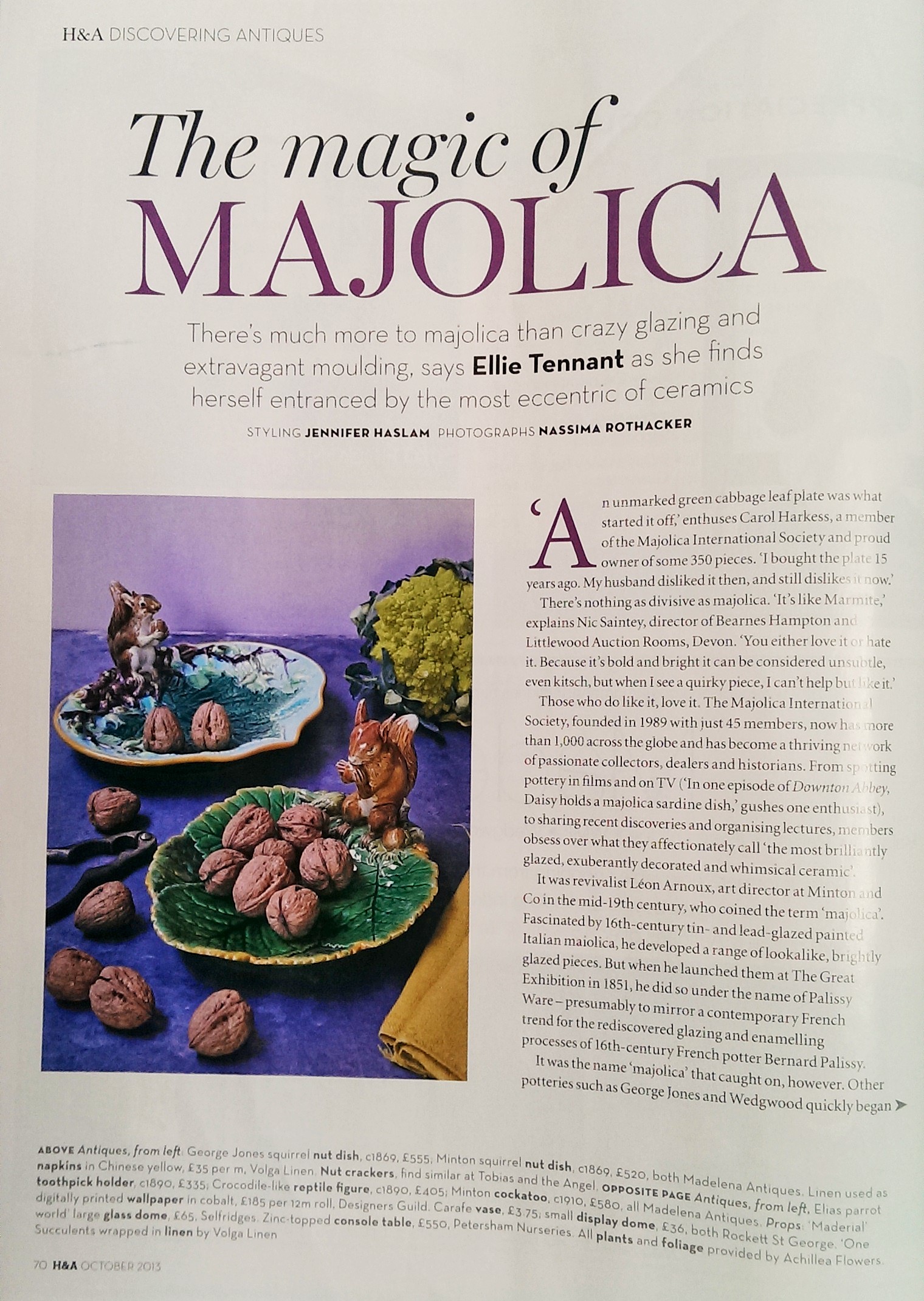
    Ellie Tennant, the interiors journalist wrote the piece. She does a great job communicating the appeal of this magical ceramic. Ellie interviews well known figures for her article. Many of you will know Nick Dawes the author of “Majolica” from his Antiques Road Show appearances. Deborah English is a collector and scholar building a definitive online majolica library. Carol Harkess is another keen collector, President of the Majolica International Society and latest member of the ‘bunny club’.

    The items displayed in the beautiful interiors photographed by Homes & Antiques were loaned by Madelena.

    The article runs to seven pages and is very positive and enthusiastic about all the things that make antique majolica so incredibly appealing. We hope to obtain a pdf to share with you, but meanwhile here are some pictures to be going on with.

    More great articles are to be found in the members library Majolica International Society

    majmag2 (2)

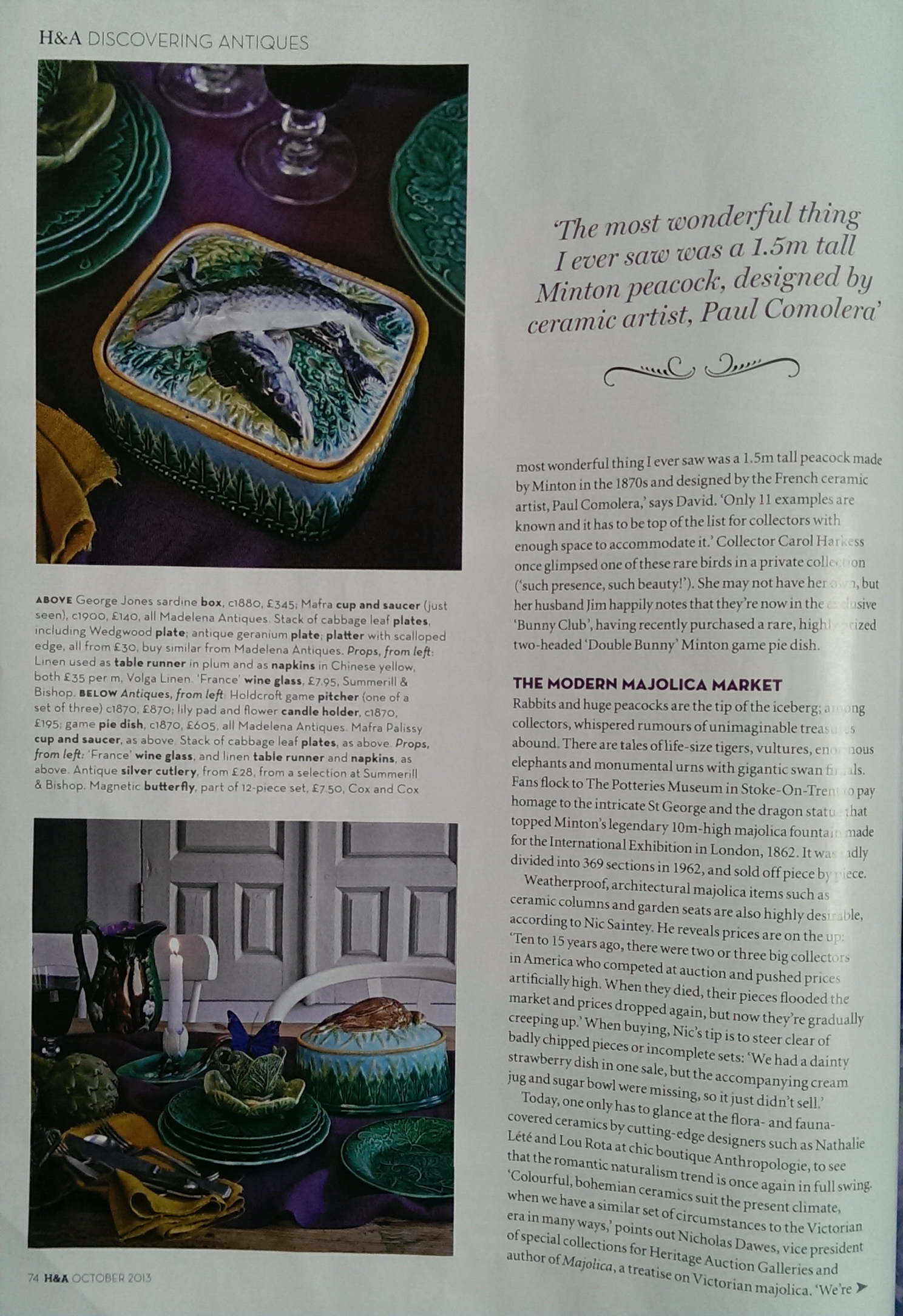
    Green majolica plates, sardine dishes, game pie dishes, Palissy cup and saucer and various serving trays
    Green majolica plates, sardine dishes, game pie dishes, Palissy cup and saucer and various serving trays

    IMAG0589_1[1]

    IMAG0591_1[1]

    George Jones tea service (part). George Jones was a self made man, whose work perfectly captured the birds, plants and ferns of the English garden
    George Jones tea service (part). George Jones was a self made man, whose work perfectly captured the birds, plants and ferns of the English garden

    IMAG0593_1[1]

    George Jones shell and seaweed server; George Jones Storks and Lilies garden seat
    George Jones shell and seaweed server; George Jones Storks and Lilies garden seat


    More magical majolica

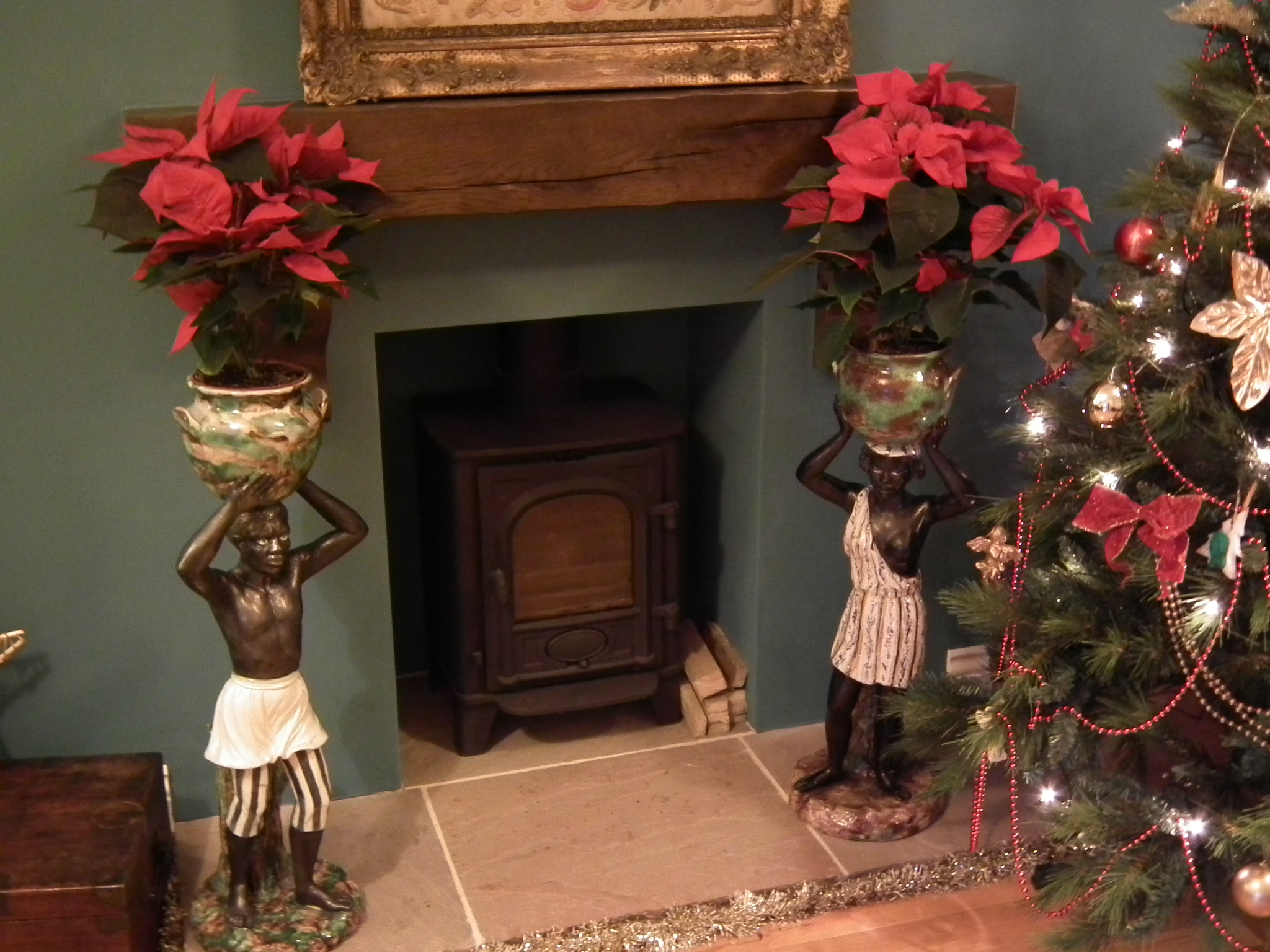
    More pictures, non-professional this time, of majolica in home décor, from around Christmas time…

    A cosy fireside. More pairs…

    Large pair blackamoor figures
    Large pair blackamoor figures

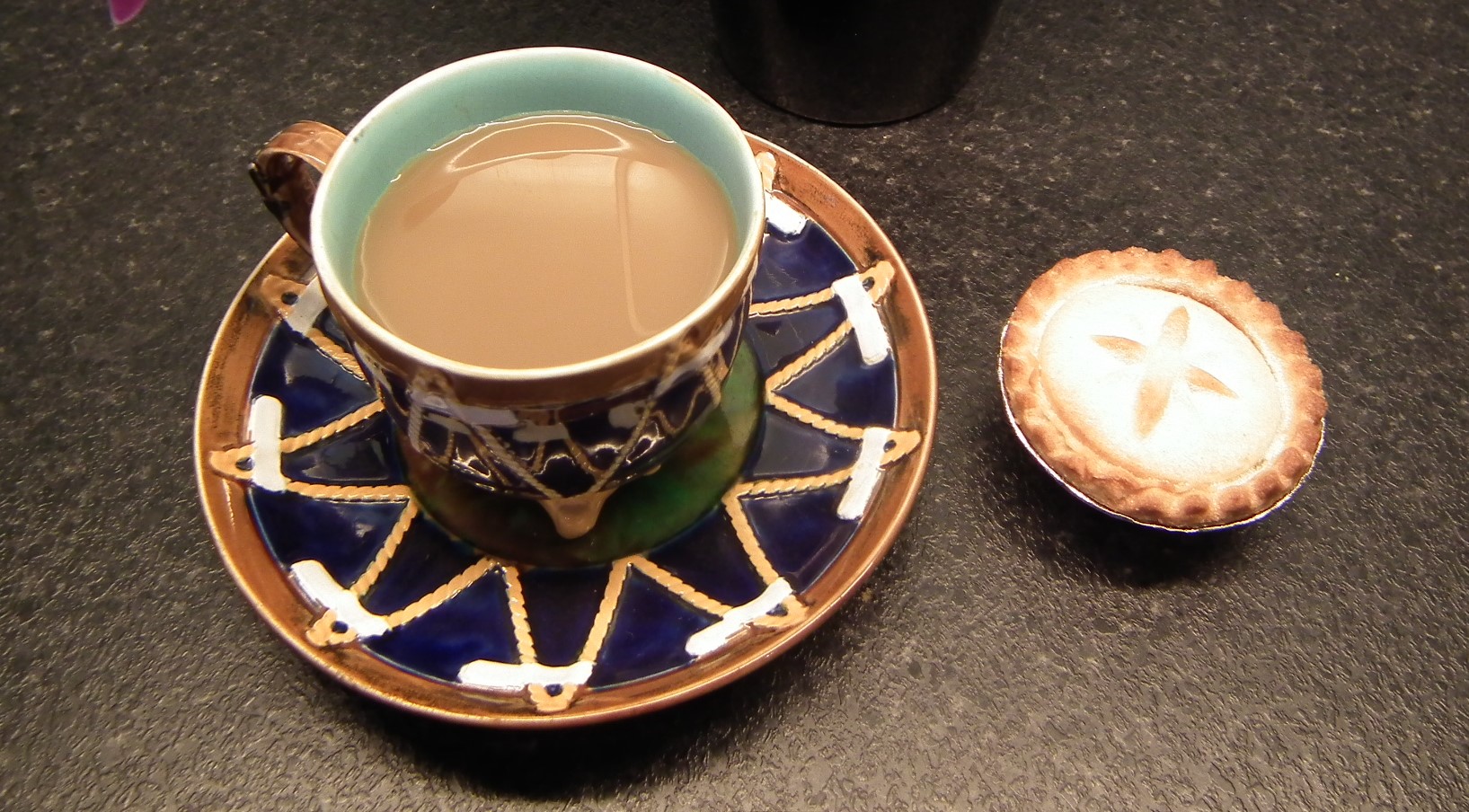
    A cuppa waiting to be sipped. George Jones Drum cup and saucer
    More cups…

    George Jones drum cup and saucer
    George Jones drum cup and saucer

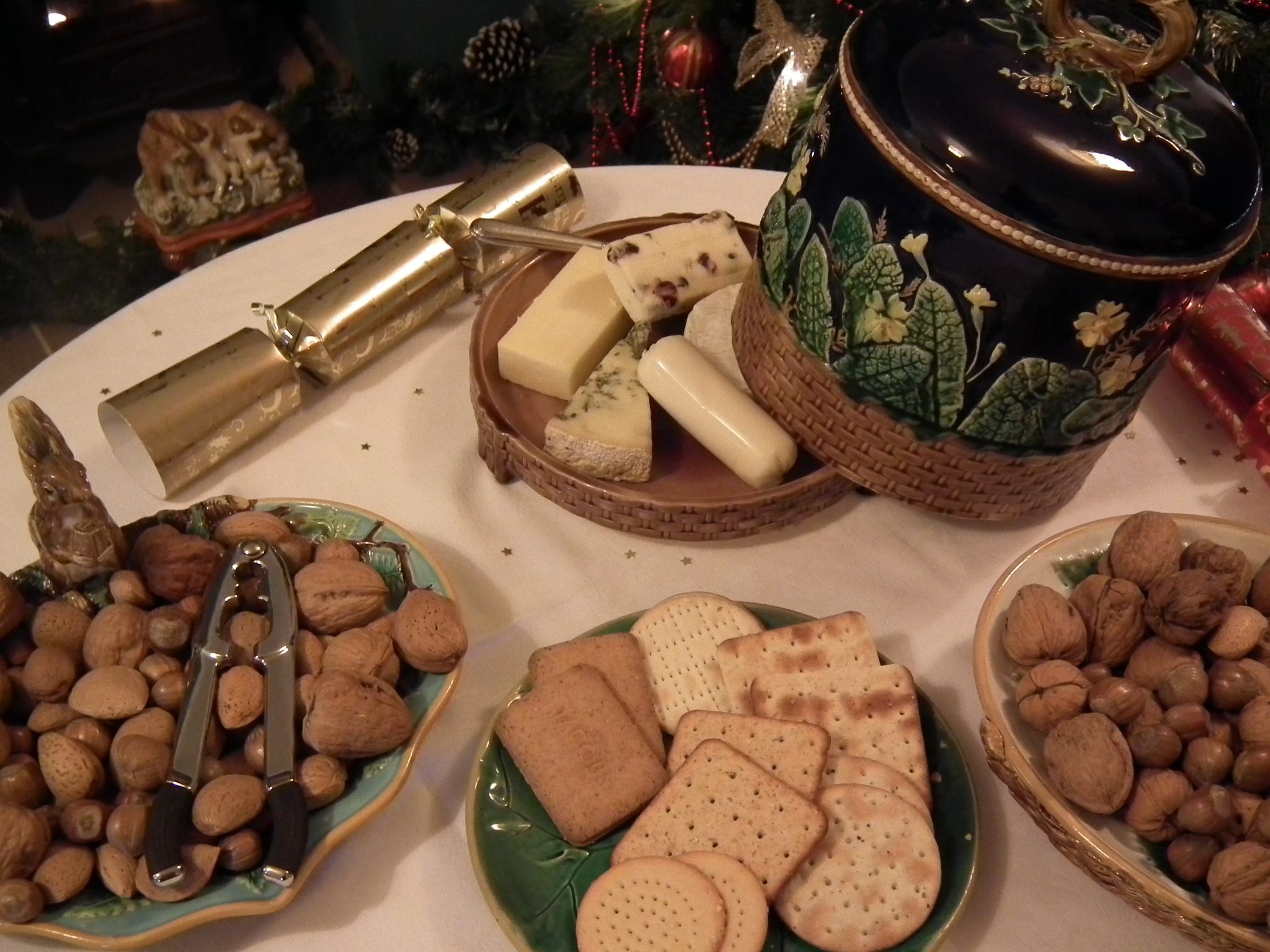
    Cheese, nuts and (English) biscuits on the table for later. More serving dishes… More cheese domes…

    Wedgwood cheese dome and stand, George Jones squirrel nut dish, and two majolica plates
    Wedgwood cheese dome and stand, George Jones squirrel nut dish, and two majolica plates

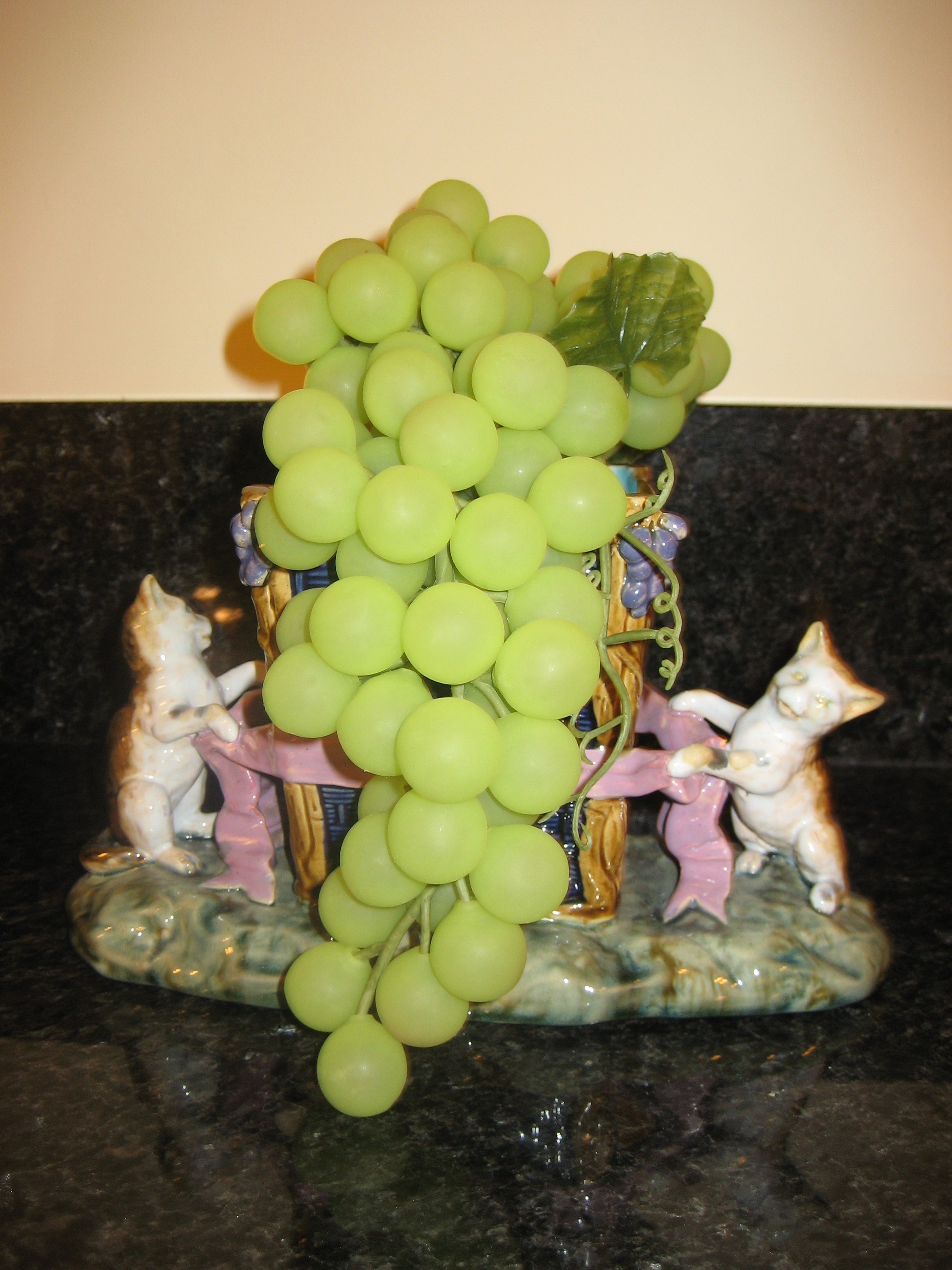
    …and fruit decorating the counter More baskets…

    Minton cats and basket vase
    Minton cats and basket vase

    How marvellous majolica looks in the home!  Bright, fresh, quirky, a joy for persons of taste and discernment or just for beauty and fun.

    World’s largest online gallery of MAJOLICA
    MADELENA Shop, Sell, Discover
    Majolica International Society

  • Antique Samplers, Houses and Churches

    Antique Samplers, Houses and Churches

    Madelena Shop, Sell, Discover
    World’s largest online gallery of antique SAMPLERS
    The Sampler Guild (UK)

    Some of us are fascinated by those English needlework samplers that depict buildings, so much so that some collections consist of nothing else.

    One collection known to us consists only of Solomon’s Temple samplers.
    Solomon’s Temple was a teacher’s favourite as it would likely have been used as a focal point around which a variety of religious topics could be taught. While the veracity of the depictions would not have been questioned by mere children the importance of the original site on Temple Mount (Mount Zion) in Jerusalem is undisputed. File:Vistaescorial.JPG Vista de El Escorial desde el Monte Abantos, twenty miles northwest of Madrid
    Extensive research by numerous historians has resulted in varied reconstructions of the temple design in later centuries. That of the Spanish Vista de El Escorial, was possibly the most magnificent and definitely used as the pattern used in some of the sampler designs including the Solomon’s Temple sampler on the Madelena website at time of this post (click the link to see what we mean):

    1802 Solomon’s Temple sampler by Jane Batty

    House samplers depicted the homes of the girls under instruction and are hugely popular with collectors. These were their own homes, fields, sheep, dogs and so on. The connection with the past is palpable. We maintain a collection of great examples to purchase online. At the time of this post we have the following house samplers available for sale in our online store:

    1821 House Sampler by Mary Hassack

    1839 House Sampler by Ann Norgrove

    1840 House Sampler by Mary Eldridge

    Churches are of particular interest because they are most likely to be still standing. Most of the country mansions similar to those depicted in the house samplers listed above were demolished after 1945 due partly to the introduction of heavy taxation on inherited property (‘death duties’) and partly to the demise of primogeniture (the right of the firstborn child to inherit the family estate) in a world upside down following the great war to end all wars. The online Madelena store has two great examples still available at the time this blog is published:

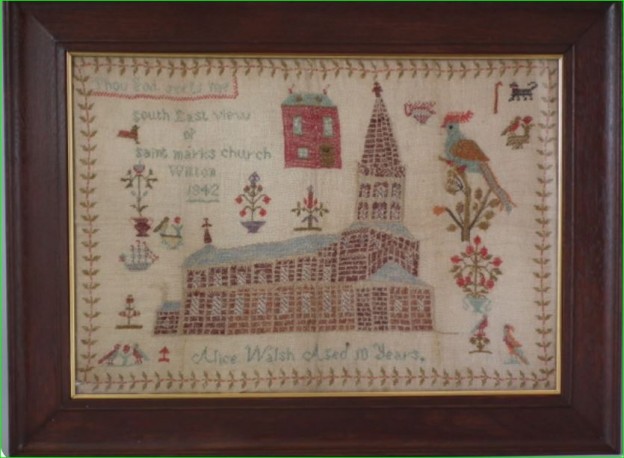
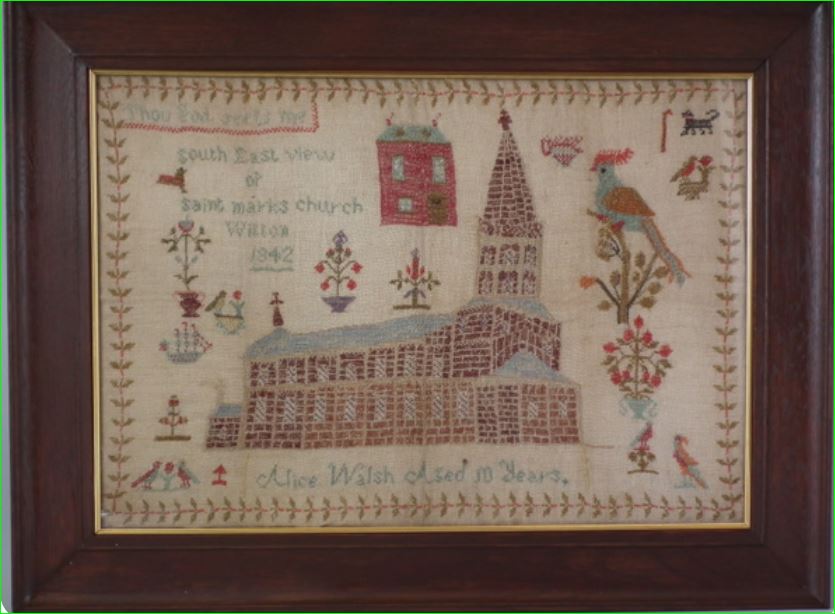
    1842 ‘Saint Marks Church, Witton’ Sampler by Alice Walsh

    1822 Halstead Essex Church Sampler

    Both churches still stand.

    Saint Marks Church formerly in the parish of Witton, stitched in 1842 by Alice Walsh aged 10
    Saint Marks Church formerly in the parish of Witton, stitched in 1842 by Alice Walsh aged 10


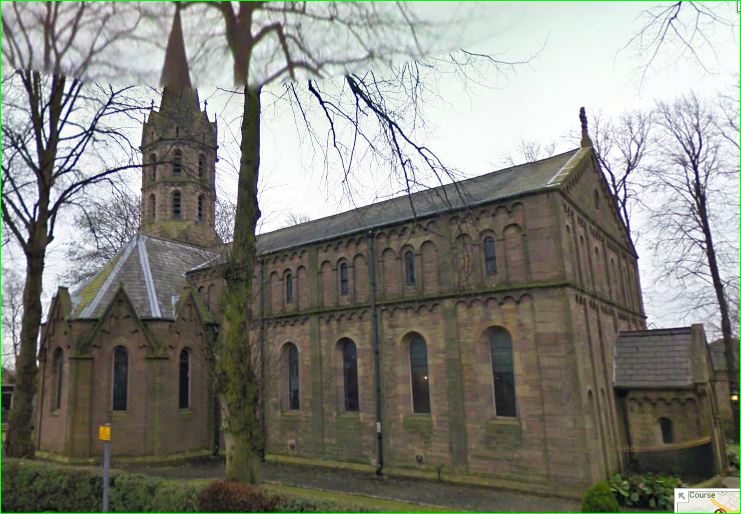
    On the left is an image of Witton Church in its former glory as depicted in this wonderful sampler.

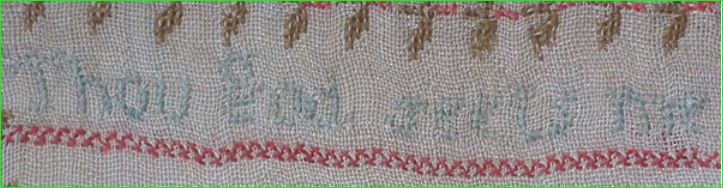
    A great little snippet from this wonderful sampler is this tiny stitching error. See how ten years old Alice has stitched ‘Thou God seets me’? I am pretty sure she intended ‘Thou God seeth me’. What do you think? Maybe she misheard her governess or misread her writing…

    Inscription detail from the Saint Mark's Church sampler
    Inscription detail from the Saint Mark’s Church sampler

    I feel a connection with this darling girl of so many generations past. I feel her grandmother’s delight as she willingly overlooks the mistake.

    St Mark's Church, Blackburn
    St Mark’s Church, Blackburn, photographed 2014

    Present day pictures show this Church of England original much added to and frankly now become a  much less attractive shape.

    Alice stitched her sampler four years after the church was consecrated in 1838.

    World’s largest online gallery of needlework SAMPLERS

    Saint Mark's Church, 2014
    Saint Mark’s Church, photographed 2014

    The south transept was added in 1870, the north transept and vestry between 1881 and 1887.

    Various restoration work was done at the same time.

    The original structure was designed to seat a congregation of over 700 souls.

    Antique needlework samplers were made by children and every one of them unique. How wonderful is that?

    To see in reality an actual building depicted in a sampler by a child elicits a powerful sense of connection between past and present, reminding us of all those changes that have taken place in the material world since our girl skipped to church glowing with youth: life expectancy has doubled; photography, electricity, bicycle, motor car and air travel have all been invented; women’s roles and rights in society have been transformed; and lately the information revolution and a digital age has dawned making it now possible to share with everyone the magic of discovery. Halstead Essex Church sampler 1822

    • 1822, Halstead, Essex, England, Church Sampler (detail)

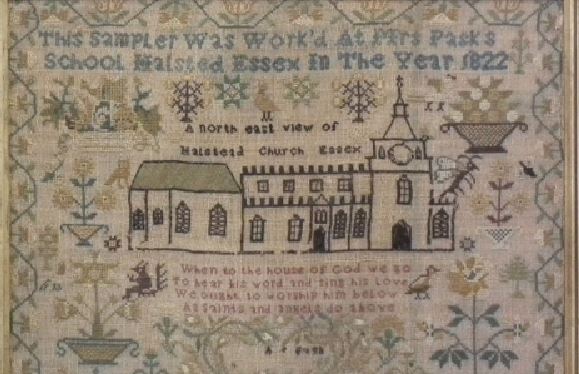
    Nearly two hundred years ago, Mrs Pask ran the local school in the country town of Halstead, in the county of Suffolk, close to Dedham Vale an area known as ‘Constable country’ after the renowned but financially unsuccessful landscape artist John Constable who lived there and wrote to a friend in 1821 “I should paint my own places best.”

    A year later… one can sense the excitement on that warm summer day… Mrs Pask gathers her pupils together to announce that the school will today be visiting the local church, and the older girls will be sketching its outline to make patterns for samplers they will be stitching to show their parents what wonderful progress they are making with their needlework and education. Many months later a sampler is proudly completed, dated 1822 and inscribed ‘This sampler was worked at Mrs Pask’s School, Halsted, Essex’. The name of the stitcher is unfortunately indistinct.

    1822 Halstead Essex Church Sampler

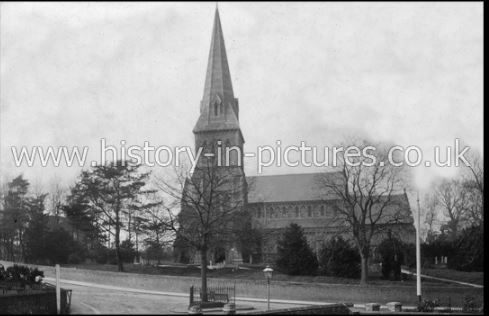
    Now to a photograph of the very same church taken eighty years later from a different angle, but allowing for children’s inaccuracies undoubtedly the same building.Halstead Essex Holy Trinity Church 1903, Holy Trinity Church, Halstead, Essex, England.

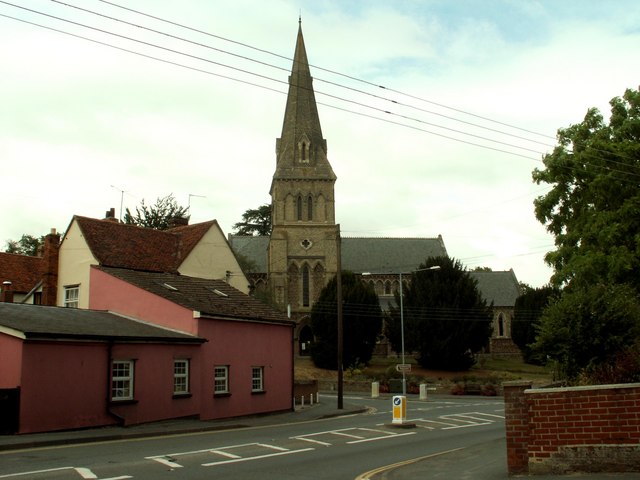
    And here it is again today, exactly one hundred and eleven years later.

    06CaptureHolyTrinityHalstead

    Does it not make you tingle all over to know that one may even today enter this church, tread the flagstones trod by those girls and perhaps seek out the pew wherein our young stitcher might have pondered the meaning of salvation between pre-teen distractions. We can even pore over the indistinct lettering of lichen encrusted headstones in the churchyard outside, hoping to find the last resting place of Mrs Pask and wondering if her pupil, our stitcher, is herself somewhere buried here.

    Madelena Shop, Sell, Discover
    World’s largest online gallery of needlework SAMPLERS
    The Sampler Guild (UK)