Majolica n. definition, citations
Majolica definition citations found in dictionaries are frequently ambiguous. In different countries, past and present, ‘majolica’ has been and is being used to describe two different types of ceramic.
To eliminate ambiguity citations for the two distinct ‘majolica’s’ (distinct in appearance, origin, and manufacturing process/technique) should contain the word ‘majolica’ along with a qualifier to show which ceramic is being cited.
1. MAJOLICA meaning tin-glazed earthenware: Suitable qualifiers would include: dateable to before 1848, ‘maiolica’, ‘tin-glazed’, ‘tin-enameled’, ‘opaque’, ‘white’, ‘brushwork’, ‘delft’, ‘stanniferous’, ‘faience’, ‘Minton tin-glazed majolica’.
2. MAJOLICA meaning colored glazes earthenware: Qualifiers: dateable to after 1848, used in the same sentence as tin-glazed majolica/maiolica, ‘coloured glazes’, ‘Mintons Palissy ware’, ‘lead-glazed majolica’.
Dictionary definitions of majolica n.
Only Websters and Wiktionary currently provide definitions for both types of majolica:
- Earthenware coated with opaque white tin glaze and ornamented with metallic oxide colours. Hyponyms: Hispano-Moresque ware, Italian maiolica, Victorian majolica, Delftware, faience.
-
Earthenware coated with coloured lead glazes applied directly to an unglazed body. Synonym: Palissy ware. Hyponym: Victorian majolica
All other dictionaries provide a definition for tin-glazed majolica only.
Tin-glazed (Stanniferous) majolica definition citations
1857, Joseph Marryat, History of Pottery and Porcelain, Medieval and Modern, p.373
“Enamel – A vitrifiable substance; opaque, generally Stanniferous majolica […]” ‘Enamel’ is another word for ‘glaze’. The word ‘majolica’ is qualified in this early citation by ‘opaque’ and ‘Stanniferous’ which means ‘tin-glazed’.
1907, Edwin Atlee Barber, Tin enamelled Pottery Maiolica, Delft and other Stanniferous Faience, Doubleday, Page & Company New York, p.6
“The word Majolica, or Maiolica […] was applied to all Stanniferous faience of Italy and Spain.”
1999, Paul Atterbury and Maureen Batkin, Dictionary of Minton, ACC Art Books (2nd Revised edition edition 1 Jan. 1999), p.124
“Minton did not use the word maiolica themselves, relying instead on the Victorian version, majolica, which they used to mean wares of Renaissance inspiration, featuring hand painting on an opaque white glaze. […]”
2019, Metropolitan Museum, New York, Dish, Early 15th century
“Medium: Earthenware, tin-glazed (Majolica) […] in the early eighteenth century earthenwares with tin-glazes were the most widely produced ceramics in Europe.”
Coloured glazes majolica definition citations
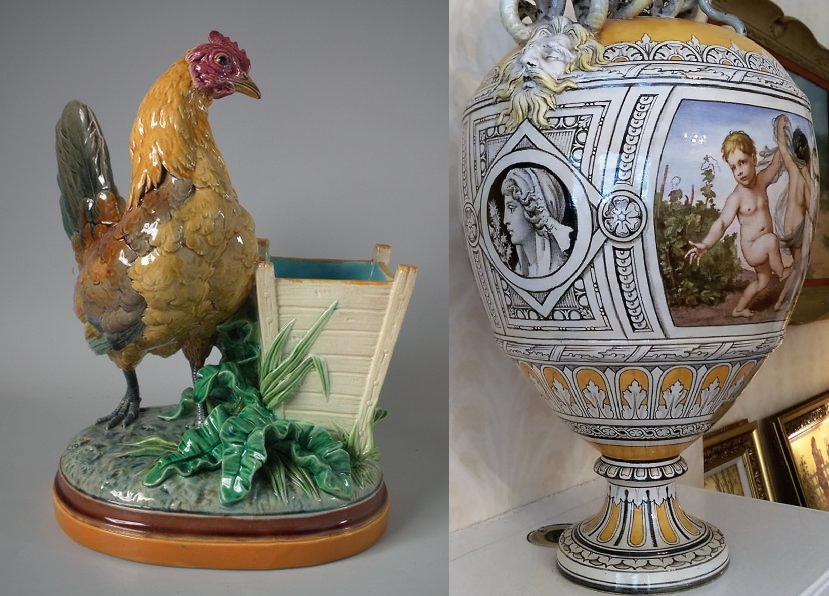
The pottery of vibrant coloured glazes applied direct to an unglazed earthenware body, developed to perfection around 1848 by Leon Arnoux at Minton & Co. Prior to 1848 coloured lead glazes pottery was known in different times and places as: Sancai, China; Marzacotto and Bologna wares, Italy; Preuning ware, Germany; Rustic ware, France; and Cauliflower, Cabbage and Whieldon ware, England; never as majolica. An unambiguous citation will meet one or more of these criteria: refer to both products; refer to the process (apply, fire); refer to the date of development.
1862, Art Journal Catalogue, Exhibited Class XXXV, no.6873, D78, p.8
“The Italian Vase, top, left, p.8, is Majolica, […] the painting being executed by a process not hitherto employed. […] The Ewer, bottom, middle, p.8, is a Palissy ware vase.”
1877, Leon Arnoux, Director, Minton & Co., British Manufacturing Industries POTTERY, p.42
“Majolica was produced for the first time by Messrs. Minton, in 1850, and they have been for many years the only producers of this article. The name of majolica is now applied indiscriminately to all fancy articles of coloured pottery. When, however, it is decorated by means of coloured glazes, if these are transparent, it ought to be called Palissy ware […]”.
1904, Arthur Hayden, Chats on English China, New York, p.184
“[Minton] employed no less than 1500. The branches he developed were earthenware and ordinary soft porcelain, hard porcelain, parian, coloured and enamelled tiles, mosaics, Della Robbia ware, majolica, and Palissy ware.”
1999, Paul Atterbury and Maureen Batkin, Dictionary of Minton, ACC Art Books (2nd Revised edition edition 1 Jan. 1999), p.124
“[…] the coloured glaze decorated wares which we now call majolica, but which Minton referred to as Palissy wares.”
2018, Claire Blakey, Minton Majolica: A Visual Feast of Victorian Opulence, Minton Archive
“Majolica is the term used to describe pottery made of an earthenware body coated with semi-translucent coloured lead glazes. It was developed at the Minton factory in the late 1840s by Léon Arnoux, who had come to the Potteries in 1848.”
Other dictionaries and their sadly ambiguous citations
Conclusion
Our desire for a definition of majolica n. is done. We discover there are two meanings of the word, both of which are used interchangeably. Dictionary editors may wish to ditch ambiguous citations and correct majolica n. entries. Authors may choose to mention that majolica
Leave a Reply