
Madelena is always proud to receive emails thanking us for good service. We add excerpts from these emails to our testimonials page. The most recent testimonial is exceptional. It ends “Warmly thanking you again for consideration and service in every way exemplary.” But there is more…
Triton or Neptune?
The central character is often described as Neptune, in error. Madelena repeated the error when describing the piece. It is, of course, Triton.
George Jones majolica Triton and Τριτωνες jardinière
The vibrant coloured glazes of majolica make compelling décor in any style or form. When the style is classical Greek, mere décor becomes a wonderful reminder of the complex hierarchy of gods and dependents the Greeks enjoyed. When, in addition, the form is an oversize oval jardinière by the famous maker George Jones, any person might be excused for falling to their knees in homage.
Triton and Τριτωνες
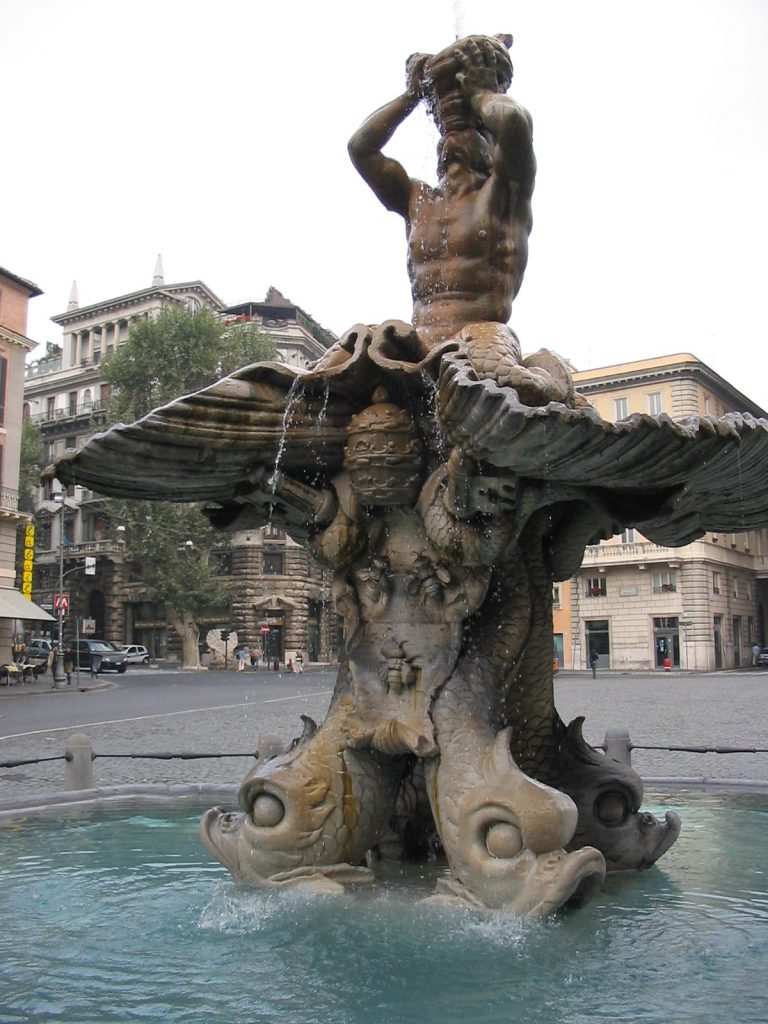
The god is the merman sea god, Triton, half man half fish. He lived with his father and mother in a golden palace on the bottom of the sea.
In the words of the New York collector who purchased the piece
“The central figure clearly isn’t Neptune/Poseidon but the merman sea god Triton, one of Neptune’s three children by the goddess Amphitrite.
“Triton’s chief business is to execute his father’s commands with regard to the stirring and calming of the seas, his responsibilities in the aquatic realm answering to those of Aeolus (another of Neptune’s many bastard sons by mothers both divine and human) in the atmospheric.
“In his cameo role in Ovid’s Metamorphoses, Book I, probably his best-known appearance in classical literature, Triton causes the waters of the Great Flood to recede not at the command of Neptune, but of Jupiter.
“The means by which he brings these changes about is to blow on his cava bucina tortilis, his concha sonans, the (helix) ‘conch’ shell that is Triton’s characteristic literary and iconographic accompaniment, as in this George Jones piece.’
Τριτωνες
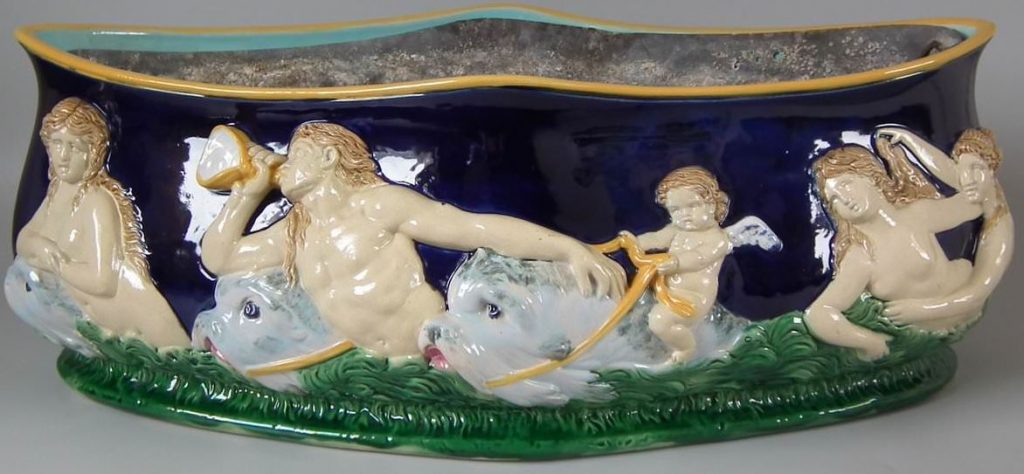
This word in English means Tritones. These are fish-tailed sea-gods or daimones, a plurification of the god Triton himself and usually portrayed as satyrs of the sea. Another breed of Tritones, Sea-Centaurs, had the upper bodies of men and the lower bodies of fish-tailed horses (hippocampi).
Also in the words of the collector
“Iconographically characteristic is the train of putti and attractive sea nymph groupies, Τριτωνες, the George Jones designer has thoughtfully included.
“To British majolica makers and fanciers, Triton would have been best known from the last line of Wordsworth’s 1807 sonnet that begins
“The World Is Too Much With Us“
“It’s a pretty safe guess it’s that poem—no doubt imprinted into every Victorian schoolchild and, in fading needlepoint, gracing the walls of many a Victorian parlor—which lies most directly behind the strenuous figura serpentinata [a style in sculpture intended to make the figure seem more dynamic, Ed.] and wonderful representation of
“…old Triton blow[ing] his wreathed horn’ on this striking and wonderful ceramic.’
Madelena says “Aye” to that, and thank you, sir, for the correction.
Majolica International Society
World’s largest online gallery of MAJOLICA
Leave a Reply