Vague answers mean the seller does not know or will not tell.
To recognise real 19th century Staffordshire pottery figures from later repro’s, first concentrate on just three characteristics: base glaze, foot-rim, and the gilt. These three will eliminate 98% of the repro’s. You are looking for signs of 19th century manufacture in old bottle kilns (real), compared with the clean continuous kilns of the 20th century or later (repro).
Base Glaze
Look for a ‘thick’, ‘viscous’ base glaze distinctly tinged with colour. Victorian Staffordshire figures are usually tinged with blue. Pre-Victorian figures tinged with greeny-gray. Repro base glazes are usually colourless and thin, or entirely absent.
19th century Staffordshire figure base showing viscous blue glaze coming up and onto the footrim.
Foot-rim
Look for base glaze coming up and onto the foot-rim in one or more places. On typical 20th century repro foot rims the glaze usually does NOT come up and onto the foot rim, and often has a brushed look or chalky feel.
Gilt
Gilt with crazing showing through is usually repro.
The gilt, on a genuine Victorian Staffordshire figure, usually does not craze like the lead glaze beneath.
Old dull mellow gilt was used circa 1830 to 1875 and is hard to replicate. Mirror-bright gilt replaced dull gilt from circa 1875.
Beware ‘brassy’ or ‘coppery’ gilt.
Brassy coppery gilt on repro Staffordshire spaniel ornament.
Beware absence of gilt where gilt would be expected.
More…
Some additional pointers follow – indicators, warning signs to look out for when the base-glaze-foot-rim-gilt examination is inconclusive, or when you are not 100% confident in the seller.
Never judge a piece by one or two indicators alone, as exceptions abound.
Marks – ‘Pre-Victorian’ figures with fake Walton and Salt marks exist. Most Victorian figures were not marked.
High value selling cheap – A danger sign in any market.
No flaking – One would expect some flaking of the weaker enamels, some rubbing of the gilt, some wear and tear in a 19th century figure. No wear at all may be suspicious.
Rubbing to the weaker gilt decoration is to be expected. Perfection should be treated with caution.
Be wary of these, too –
‘Fuzzy’ modelling, lack of fineness in detail.
Rough texture to the glaze or enamels.
Hurried, less elaborate or minimal decoration on an allegedly older piece.
Less than fine painting. A poor attempt at imitating the fine ‘feathering’ of most Victorian Staffordshire spaniels ‘spots’.
Dark stained crazing.
Indicative of repro – dark stained crazing, colorless glaze.
Wrong faces. A figure with an oriental look was probably not made in Britain.
‘Wrong’ colors. Some 19th century enamel colors could not be mimicked with later enamels.
Un-English faces and wrong colours in the basket are strongly indicative of repro.
Slip casting, indicative of 20th century manufacture, is evidenced by large pour holes on closed base pieces, smooth interiors on open base pieces.
20th century Repro spaniels. Slip molding is cheaper than press molding. Large holes in bases are where the ‘slip’ is poured out of the mold. Indicative of repro.
Antique Staffordshire Figures, Real or Repro – Conclusion
Compare real with repro side by side whenever possible, handle every piece you can. Guard against jumping to conclusions. Always consider at least three indicators. You will quickly learn to distinguish one from the other.
We hope you found this article useful. Enjoy the hunt! And enjoy the wonderful world of Staffordshire figures.
Look into a tiny corner of the enthralling world of antique Victorian Staffordshire pottery spaniels. These are a type of pottery ‘figure’ made in the UK between 1837 and 1900. Typically they were decorated with coloured enamels over a plain lead glaze.
Figures associated with Queen Victoria. On the left: The Royal Arms. On the Right: A reminder of Victoria’s role as Empress of India, the Lion representing Great Britain, the Tiger the Raj, subcontinent of India.
At the height of British Empire, with a strong economy, and a popular Queen, you would likely be interested in buying such a figure for your mantlepiece. At the height of madness in today’s world, you might be thinking of investing in a piece of history.
Victorian Staffordshire pottery
With the accession of an attractive young Queen, the potteries went to work producing figures celebrating herself, her marriage,
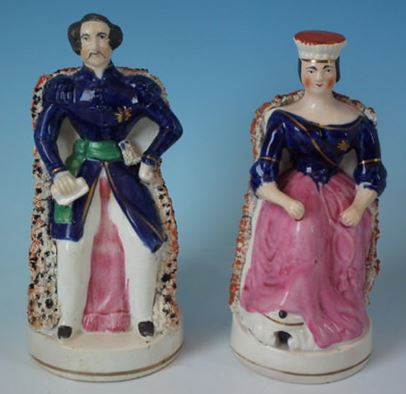
Prince Albert and the teenage (18 years) Queen Victoria.
and her children, nine in all. Note the Staffordshire potters exploiting all selling points: children of the Queen, charming dogs almost as large as the children, and kilts to remind us of the Queen’s love of Scotland.
Queen Victoria’s first two children, kilted, with dogs.
Deeply concerned with the Crimean War (1854-56), her armed forces, her alliances, generals and victories were further subjects for the potters of Staffordshire to portray.
Young girl and young boy setting off to the Crimean War.
At least the potters spared us tartan for the young people prepared to die.
Two Famous Women
The outstanding character, it could be said, of the Crimean War was no ally, general, or politician friend of the Queen.
Florence Nightingale served to saved lives in the Crimea.
It was instead, Florence Nightingale. She fought the Army Generals to allow her to serve. She brought organisation and medical discipline to the shambles that were army hospitals supporting the fighting men. Before her time thousands died unnecessarily of their wounds.
Returning from the war, she wrote the first ever book on practical Nursing, and founded the first ever Nursing School.
Another celebrated individual, memoirs first published in 1838, was the remarkable Lady Hester Stanhope.
Lady Hester Stanhope, innovative and resourceful explorer and archaeologist
In 1876 two female novelists George Eliot and Louisa May Alcott, both celebrated her very remarkable originality of thought and extraordinary expeditions that had been conducted earlier in the century. Her archaeological expedition to Palestine was the first ever dig allowed in that country. The accumulation of publicity made a great impact on the general public.
Thus, mounted on a camel and dressed as a male Arab, she had become a suitable subject for a pottery figure.
For some interesting dates, spaniel figures, other breeds and animals please read on by clicking 2…
These large white and gilt cats were made in Staffordshire in ‘The Potteries’, the seven towns that grew up around Stoke-on-Trent.
All were within easy reach of the necessary coal to fuel the kilns. Twenty tons of coal were needed to fire (bake) one ton of clay in the bottle kilns of the day.
Staffordshire Figures were also manufactured in Scotland
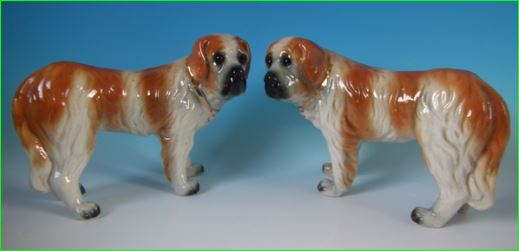
Large Pair Tan St. Bernard dogs, Staffordshire figures made in Scotland circa 1900
and in the North of England.
No matter where they were made in the UK they have come to be known by one single generic term ‘Staffordshire Figures’.
Many of the large Staffordshire animal figures so popular with collectors today were made in the Bo’ness (Borrowstounness) pottery in Scotland on the river Forth upstream from Edinburgh, birthplace of Robbie Burns, Scotland’s most celebrated poet.
All of them are available for sale at the time of posting from the Madelena online store.
Should any of the figures illustrated no longer be available from the Madelena online store please
Queen Victoria loved pets. In particular she loved her parrot named Lory, and her King Charles Spaniel named Dash. There were many others. But she was not keen on cats.
Many of us are, however, and these beauties are classic Bo’ness, grey spray paint, glass eyes, bright gilt slip cast and appealing.
Large Pair Grey/brown Pugs, Staffordshire figures made in Scotland circa 1900
Large grey pugs with glass eyes complete the décor in a master bedroom, Staffordshire Figures made in Scotland circa 1900. Private collection.
Pugs originated in China. They were imported into Holland. A pug accompanied non-English speaking King William III on his journey to claim the throne of England. More recently Napoleon Bonaparte’s wife Josephine owned a Pug named Fortune, used to deliver messages to Napoleon while in prison in 1794.
Photographs sent to us recently of a private collection show pugs in pride of place.
Large grey pugs with glass eyes complete the décor in yet another master bedroom, Staffordshire Figures made in Scotland circa 1900. Private collection.
Lo and behold, here in another extensive and wonderful collection they have again been positioned in the top spot, either side of the big screen in the master bedroom.
Not all large animal figures were made in Scotland. Here is another example. ‘Jackfield’ is the generic term given to just about any Staffordshire figure with black glaze over red body.
The Jackfield factory in Shropshire, England, was allegedly the first to produce these wares, copied thereafter by many others.
One of a pair of Large tan lions with glass eyes, Staffordshire figures made in Scotland circa 1890. Private collection.
If you are looking to buy figures similar to these illustrated, please contact us if there are none in our online store of large animal figures.
Or try out our free search service. Email us to let us know what you are trying to find.
Cats, dogs and lions surface often so it should not take us long to find what you are searching for at a reasonable price.
Large pair tan Collies, Staffordshire figures made in Scotland circa 1890
To buy, sell, discover Staffordshire figures of all eras from the Madelena ecommerce online store follow this link: