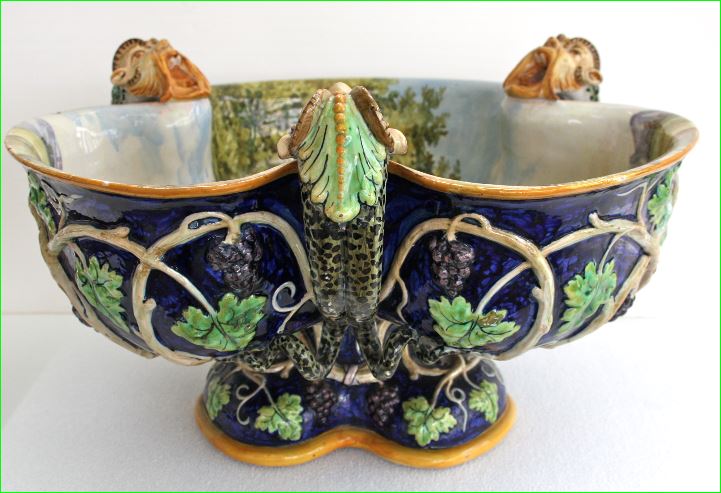
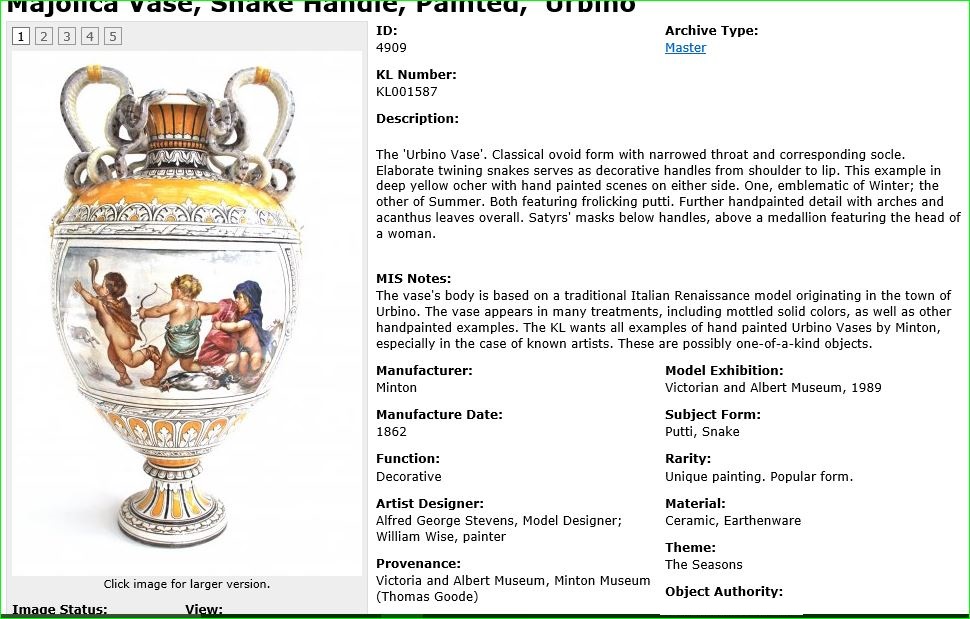
Category: Maiolica

  • Majolica. Colored glazes in Paris reach Stoke (updated)

    What reached Stoke-on-Trent from Paris?

    Could a 16th century Frenchman’s success with colored glazes be repeated in 19th century England? Herbert Minton thought so. Leon Arnoux is appointed Art Director in 1848 with the right know-how and at just the right time to make it happen.

    Bernard Palissy, Father of French ceramics
    Bernard Palissy, Father of French ceramics, developed colored glazes.

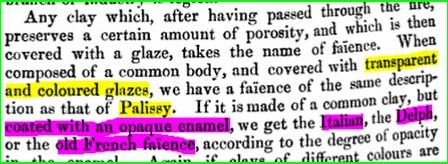
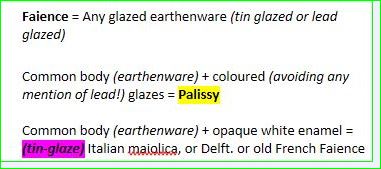
    Yes, Bernard Palissy developed in France the chemistry and process  for painting colored glazes onto a ‘biscuit’ body, simultaneously, before firing (paint, fire). Minton & Co. of Stoke-on-Trent, England, subsequently developed the science to perfection. The narrative about majolica reaching Stoke via Spain, Majorca and Italy, is about tin-glaze maiolica, a different chemistry, process, and look altogether (dip, dry, paint, fire).

    majolica n.  Definition.

    So, what is majolica? This word has three main meanings/senses. It can be any one of these…

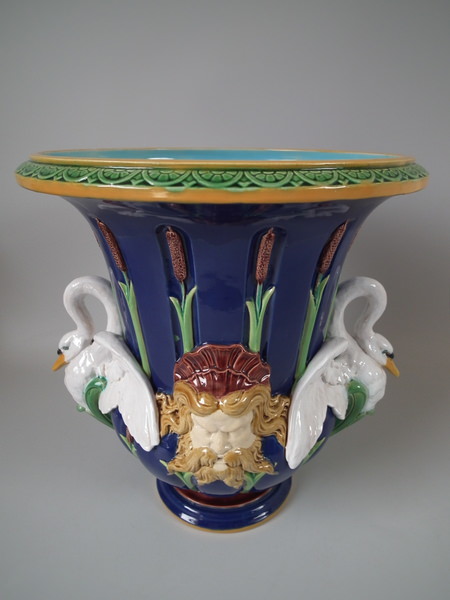
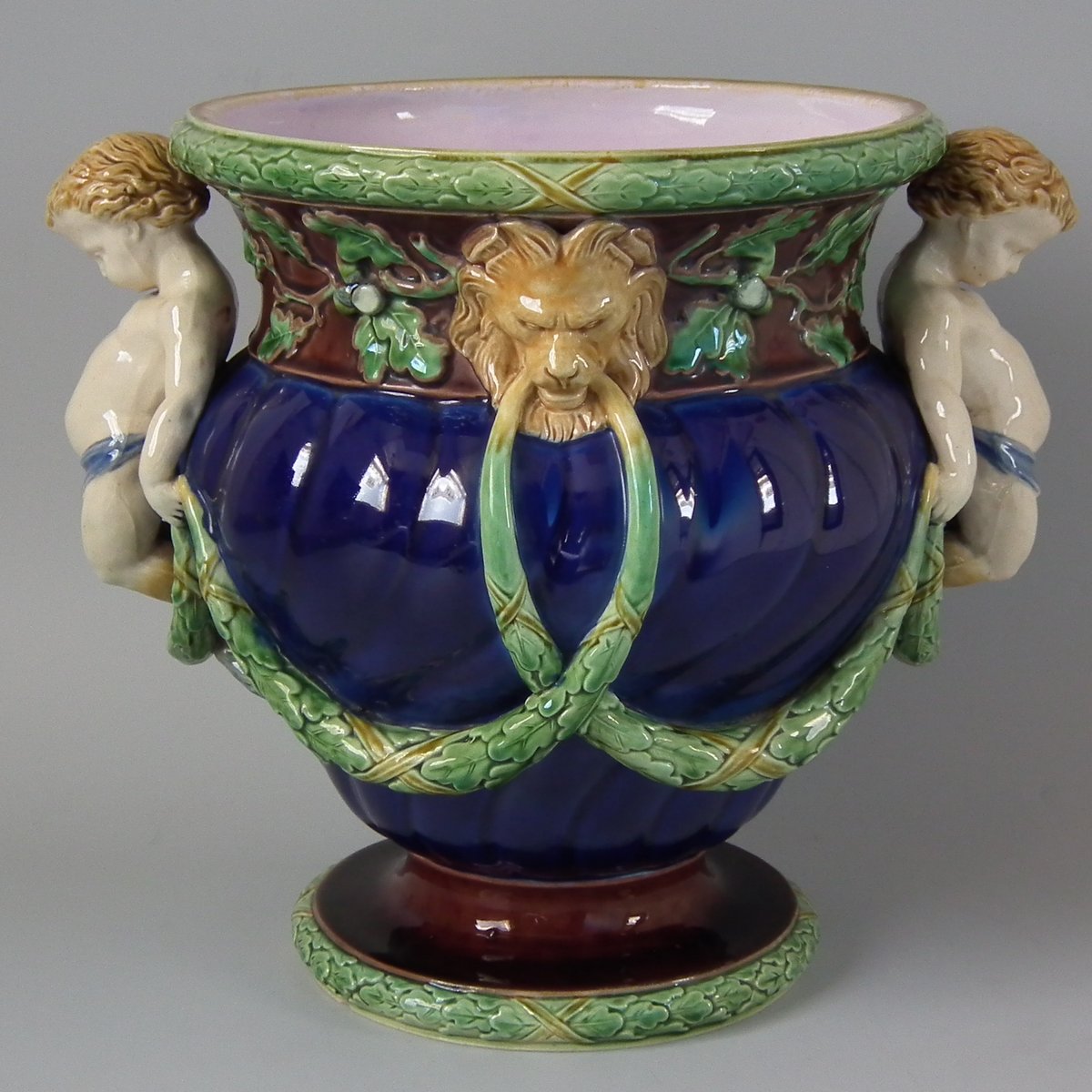
    1. Any earthenware decorated with colored lead glazes applied directly to an unglazed body. Hard-wearing, typically relief molded. Minton’s ‘Palissy ware’ soon known also as ‘majolica’, was introduced at the 1851 Exhibition and later widely copied and mass produced. Known as ‘majolica’ or ‘lead-glazed majolica’ or ‘earthenware with majolica glazes’ or ‘colored glazes majolica’.
    2. An alternative spelling for maiolica (tin-glazed earthenware with opaque white glaze decorated with metal oxide enamel colour/s).  Maiolica reached Italy mid 15th century. Renaissance Italian maiolica became a celebrated art form. Maiolica developed also as faience (France), and delft (UK and Netherlands). Known as ‘maiolica’ or, especially in the US, ‘majolica’, or ‘tin-glazed maiolica‘ or ‘tin-glazed earthenware’
    3. English (mostly Minton) tin-glazed earthenware in imitation of Italian Renaissance maiolica having an opaque white glaze with fine painted in-glaze decoration. Also introduced at the 1851 Exhibition. Very rare. Known as ‘majolica’ or ‘English tin-glazed majolica’.  

    Making colored glazes

    Everyone loves colour. How to add colour to a glaze is a thing. How to make colored glazes temperature compatible – meaning they can be applied, simultaneously, then fired, without blistering and without too much running – is entirely another.

    It took nearly two millennia to achieve.  Fusing lead glaze to an earthenware body had been mastered and was used across the Roman Empire[1] for centuries to seal porous pottery surfaces. But plain lead glaze has no colour.
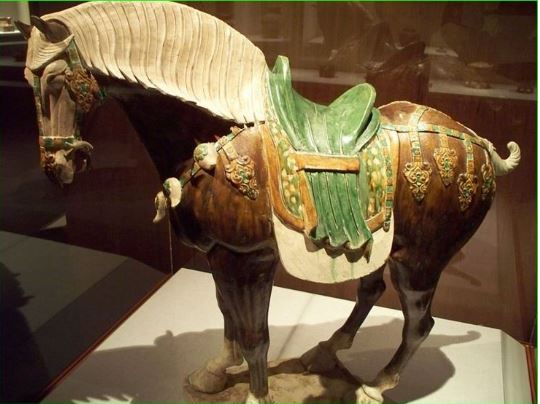
    Three colours, Sancai, China circa 600AD
    Sancai horse, China, circa 600AD. ‘Sancai’ means ‘three colors’. Green from copper oxide. Brown from  manganese oxide. Ochre from iron oxide.

    By 600AD the Chinese had succeeded in producing three temperature compatible colors. Adding copper oxide to normal lead glaze produced a glaze that fired green. Adding iron oxide to normal glaze produced ochre. Adding manganese oxide produced brown/black. These three could be fired successfully together.

    Bernard Palissy’s five colors
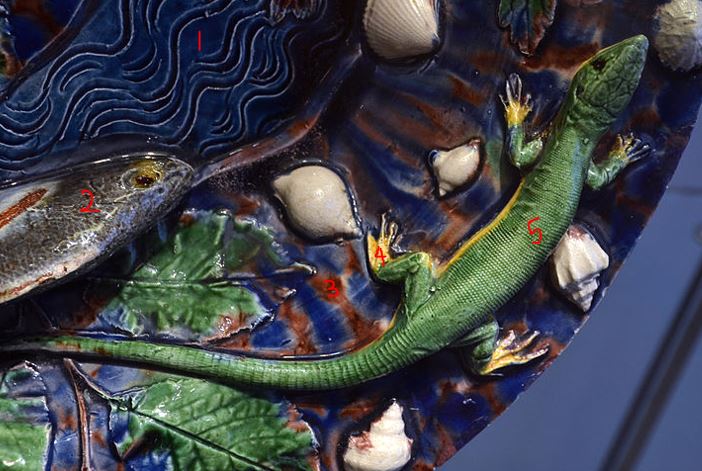
    Five colours, Palissy ‘follower’, circa 1600AD
    Five colors, Palissy ‘follower’ [imitator], circa 1600AD. The two additional colors are blue from cobalt oxide, and grey from blended oxides.

    Independently[2], in mid-16th century Paris, Bernard Palissy was finding out for himself.  After much hardship and many setbacks, he finally succeeded in developing five colors that could be applied and then fired together.

    Research in 2016 provides proof positive of the oxides used by Palissy to create his colored glazes :

    The research was conducted in Paris on a group of rustiques ware attributed to Palissy or his followers. The glaze chemistry of the items in the group was determined non-destructively using PIXE and PIGE analyses. The summary states:

    “The glazes are all lead silicates, the colorants being transition metal oxides-CuO [copper], CoO [cobalt], MnO [manganese] and Fe2O3 [iron] – with a small addition of SnO2 [tin] [for opacity] to some of the glazes being common.” Lead-Glazed Rustiques Figulines [Rustic Ceramics] of Bernard Palissy [1510-90][3]

    Colored Glazes Majolica Perfection

    Herbert Minton and Leon Arnoux had determined to develop a Minton version of both the16th century French colored glazes of Bernard Palissy and also of the celebrated 16th century Italian tin-glaze (plain lead glaze with a small proportion of tin oxide added) maiolica. [4][5].

    Colored glazes hit the jackpot. Minton & Co. achieved near-perfection, eventually able to simultaneously fuse a wide range of colors to a ‘biscuit’ body at low cost.
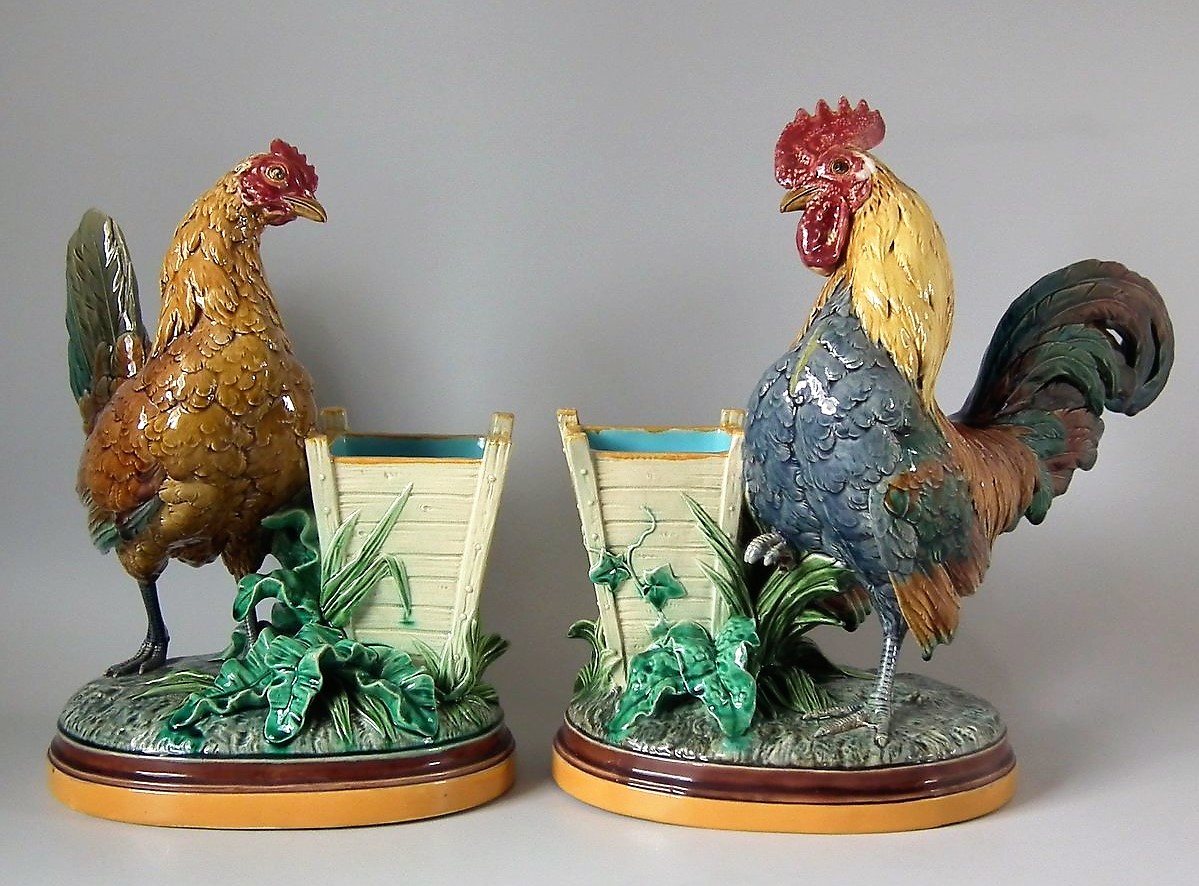
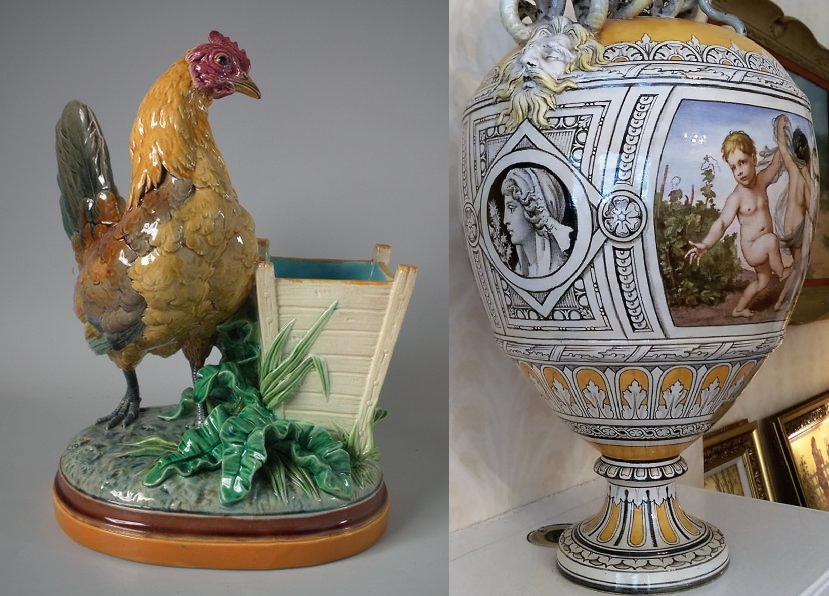
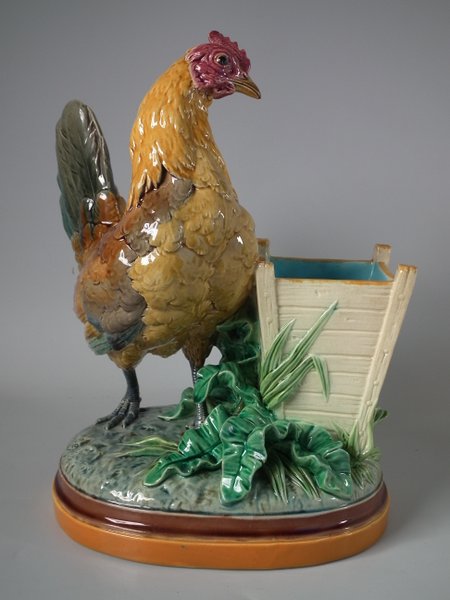
    Multiple Colours, Minton Hen & Rooster Vases, signed J. Henk, circa 1875
    Multiple colors, applied and fired simultaneously Minton Hen & Rooster Vases signed J. Henk, circa 1875

    Their advanced chemistry and process, developing temperature compatible colored glazes and better kilns, was widely copied.

    Remember, the word majolica is used in the USA, confusingly, also to describe tin-glazed earthenware – fine-painted decoration on unfired tin glaze (dip, dry, paint, fire).

    The winner was colored glazes. This was a product inexpensive to produce (paint, fire). Also, around this time the fashion for naturalistic décor was growing. Flora and fauna molded in high relief worked perfectly with the colored glazes.

    'Intaglio' effect of coloured lead glazes applied to high relief molding - the deeper the impression the darker the colour.
    ‘Intaglio’ effect of colored lead glazes applied to high relief molding – the deeper the impression the darker the colour.

    The product that flopped – now so rare it is almost unknown – was Minton tin-glazed majolica made using the tin-glaze process (dip, dry, paint, fire)  – dip the ’biscuit’ body in tin glaze, dry it, then paint with enamel colors. The enamels are ‘absorbed’ into the unfired tin glaze. When fired, the result is a distinctive opaque whitish tin-glaze[6], painted in colors, usually with brush-strokes clearly visible.
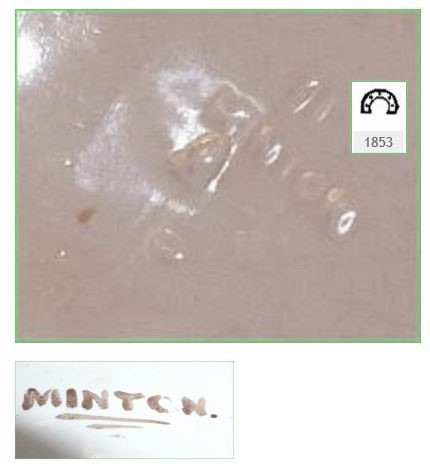
    Reverse of Minton tin-glazed majolica plate. Opaque white tin glaze with brush painted MINTON in manganese oxide.
    Reverse of Minton tin-glazed[6] majolica plate (dip, dry, paint, fire). Opaque white tin glaze with brush painted MINTON in manganese oxide.
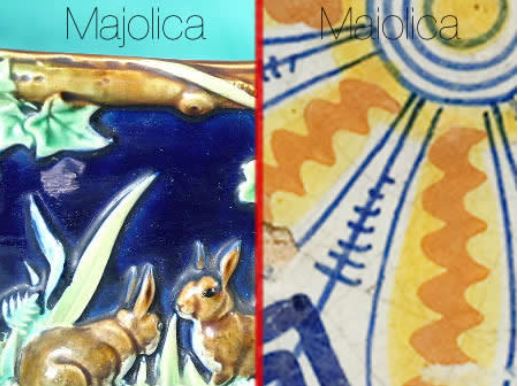
    Lead-glazed, two stages: block-painted on biscuit, then fired. Tin-glazed, three stages: dipped and dried, then brush-painted on unfired tin-glaze, then fired.
    On the left: Colored glazes, two stages (paint, fire); thick-painted on biscuit, then fired. On the right: Tin-glazed, four stages (dip, dry, paint, fire); dipped, then dried, then brush-painted onto the raw unfired tin-glaze, then fired.

    Texts seldom make it clear

    From the first appearance of Minton’s two new products until the recent publication of Majolica Mania (2021), many authors have declined to distinguish between Minton’s two distinct products: one named ‘Palissy’ (soon known also as ‘majolica’) in honor of the great man, a resounding success; the other named ‘majolica’ after the Italian tin-glaze maiolica they were copying, a commercial flop.

    “Thus, what today we call majolica is in most cases what Minton, and Arnoux, referred to as Palissy ware.” Dictionary of Minton[8]
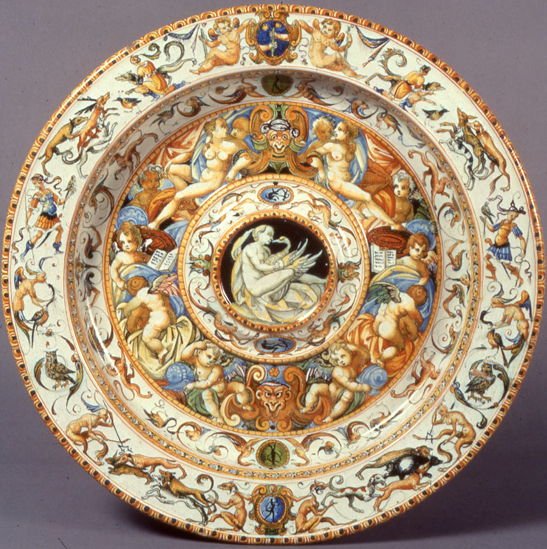
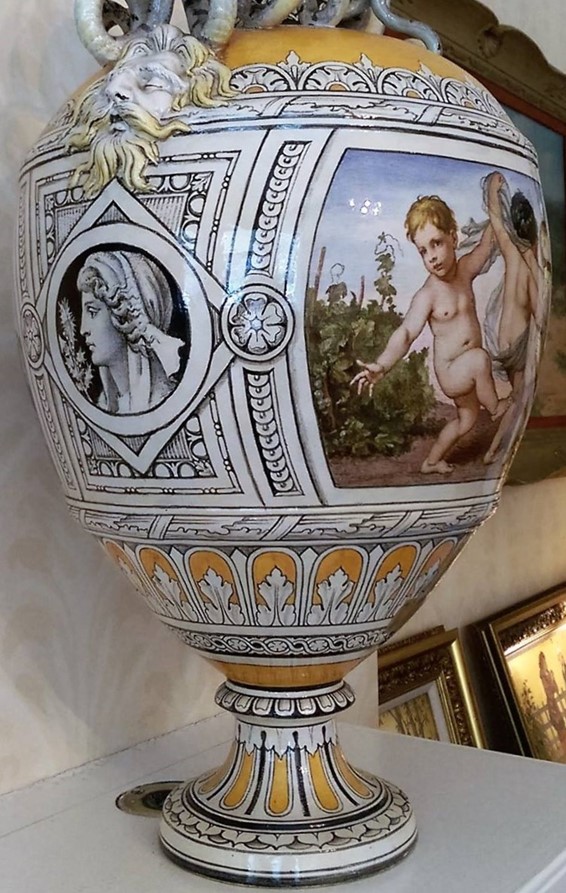
    Italian Renaissance tin-glazed maiolica, circa 1600AD, painted with enamels
    Italian Renaissance tin-glazed maiolica (dip, dry, paint, fire), circa 1600AD, painted with enamels in the grotesque style.

    This would not matter – few care whether an object is colored glazes or tin-glazed with painted decoration – except a narrative around what is majolica, and where did it originate, has been constructed around the wrong product. The overwhelming majority of ‘our majolica’ derives from Bernard Palissy’s colored glazes majolica process in France, nothing to do with the Renaissance tin-glaze maiolica process in Italy.

    Blame LEAD

    Why did not Minton clarify the difference at the time? Was it a case of ‘the less said about lead the better’?  Could it be that Minton, Arnoux, everyone with an interest in the lead-reliant pottery industry would wish to divert attention from any product high in lead content?
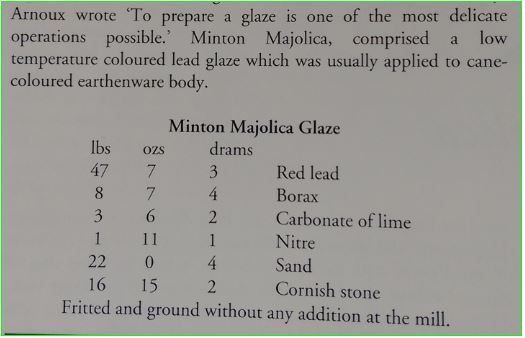
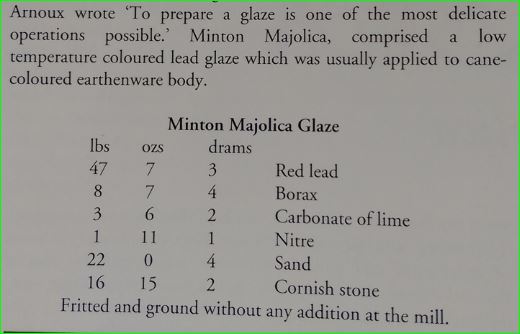
    Arnoux formula for lead-glaze
    Arnoux formula for lead-glaze.

    The Arnoux formula[9] for lead glaze comes from Arnoux’s personal notebook . It is important to remember that this was a period of time when lead-poisoning of workers in the pottery industry was under attack, a battle that started in earnest in 1839 that took a century to win[10].
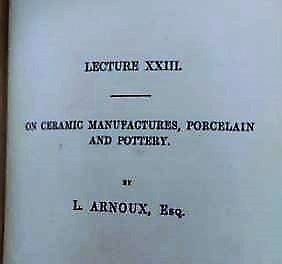
    Post-1851 Exhibition Lecture Series
    Post-1851 Exhibition Lecture Series
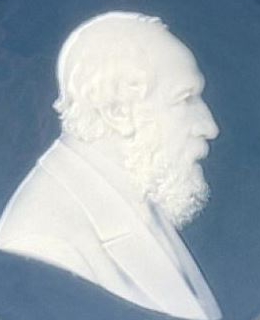
    Leon Arnoux
    Leon Arnoux

    In 1852 Arnoux had been invited, following the Great Exhibition of 1851, to lecture on Ceramic Manufacturers, Porcelain and Pottery.

    During the course of a long and detailed lecture he never once mentions the colored glazes product Minton named ‘Palissy’ ware. Was Arnoux deliberately avoiding mention of a blatantly lead-glaze product?  Or maybe the commercial promise of his new, appealing, and economical colored lead glazes, was a subject not to mention before an audience that included competitors?
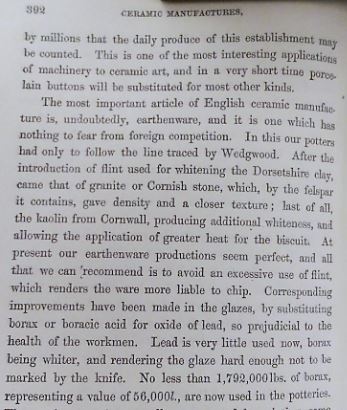
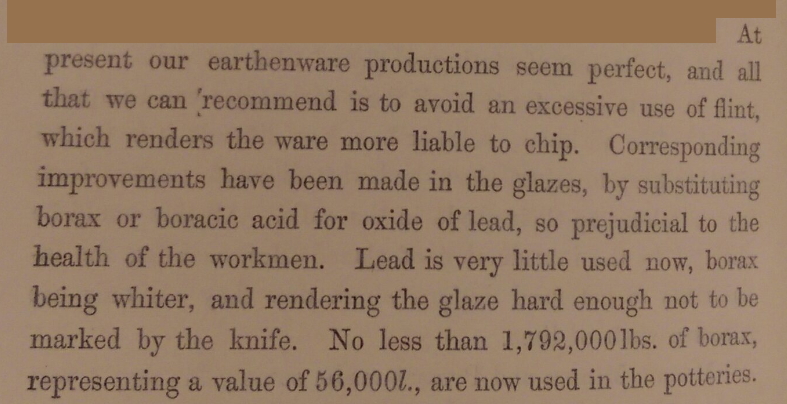
    "Lead is very little used now", Arnoux, 1853
    “Lead is very little used now”, Arnoux, 1853.

    He did, however, state, “Lead is very little used now”, intimating that borax had significantly replaced lead in the industry. Judging by the proportion of Red Lead to Borax in Arnoux’s formula, above, approximately 6:1, this would appear to be a slight exaggeration.

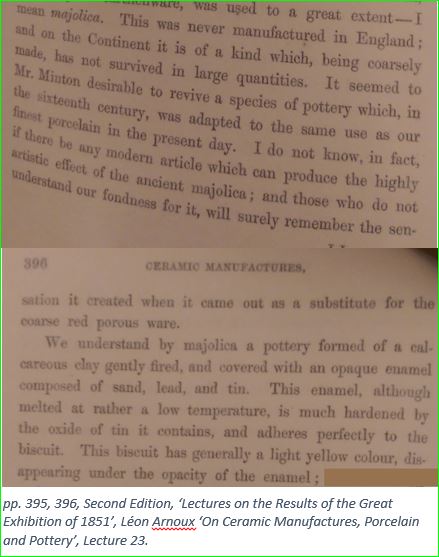
    We understand by majolica…

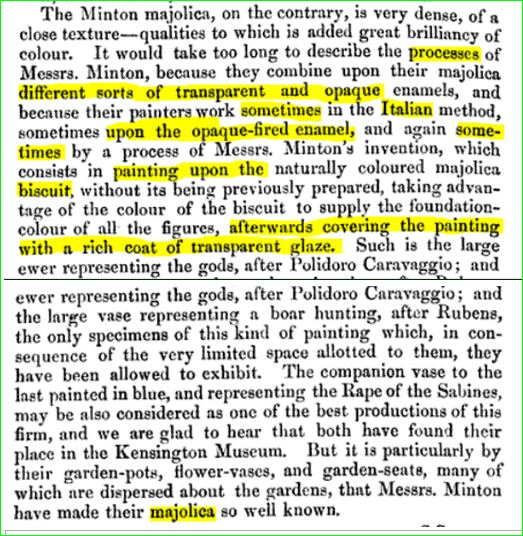
    On the other hand he promotes Minton’s imitation of tin-glaze Renaissance maiolica, the product Minton named ‘majolica’.
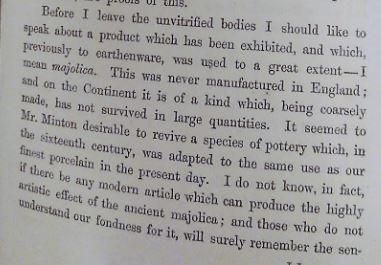
    p. 395 coloured glazes majolica
    p. 395

    On page 395 he speaks of Minton’s desire to revive 16th century majolica [meaning tin-glaze Renaissance maiolica]:

    “I should like to speak about… majolica… It seemed to Mr. Minton desirable to revive a species of pottery which, in the sixteenth century, was adapted to the same use as our finest porcelain…” Leon Arnoux, 1853[11]
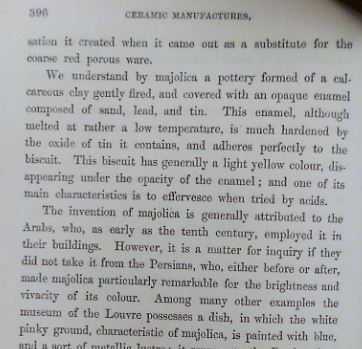
    p. 396
    p. 396

    On page 396 he continues in the same vein with a description of tin-glaze majolica, their own English version, which they named ‘Majolica’

    “We understand by majolica a pottery formed of a calcareous clay gently fired, and covered with an opaque enamel composed of sand, lead, and tin.”  Leon Arnoux, 1853

    Arnoux’s brief ‘definition of majolica’ is often condensed, out of context[12],  to become “Majolica is pottery decorated with lead and tin glazes”. Consequently, whilst this is a true statement, it does nothing to explain the difference, nor to spotlight the overwhelming importance of colored glazes majolica versus tin-glazed majolica in 19th century earthenware.

    Texts referencing Minton Palissy ware and Minton Majolica as different products

    The Illustrated London News, Nov. 10, 1855, p.561: “The collection of Palissy and Majolica ware, however, is that which appears to have created the greatest sensation among Parisian connoisseurs. The reader will remember that the main difference in these wares is that whereas the Palissy ware is colored by a transparent glaze Majolica ware contains the colour (opaque) in the material [in the unfired tin glaze covering, fired to produce the characteristic opaque whitish enamel with painted decoration fused within]…  One sample of Palissy ware—being a little tea-service spread upon a leaf, the legs of the teapot being snails… [characteristic of ultra naturalistic Palissy ware].

    Leon Arnoux, 1867, Report on Pottery, Reports on the Paris Universal Exhibition: “Majolica [tin-glaze earthenware, opaque white surface painted in enamel colors] was produced for the first time by Messrs.  Minton, in 1850, and they have been for many years the only producers of this article [in England]. The name of majolica is now applied indiscriminately to all fancy articles of colored pottery.  When, however, it is decorated by means of colored glazes [applied directly to the ‘biscuit’], if these are transparent [translucent], it ought to be called Palissy ware… Messrs.  Wedgwood, George Jones, and a few other makers of less importance, are reproducing it more-or-less successfully.  To Messrs. Minton, however, we owe the revival of the ware [colored lead glazes on biscuit, ‘Palissy ware’], which, in connection with [alongside] their majolica [the tin-glaze ware], created such a sensation in the French International Exhibition of 1855”

    Also: “The Palissy faience is composed of a clay slightly colored [buff], covered with different [lead] glazes, which have been previously colored by means of metallic oxides [iron for yellow, manganese for purple or brown, cobalt for blue, copper for green, etc.]; these glazes of different colors being applied, some by the side of others [combined upon the same piece], or blended one into another [mottled]…”
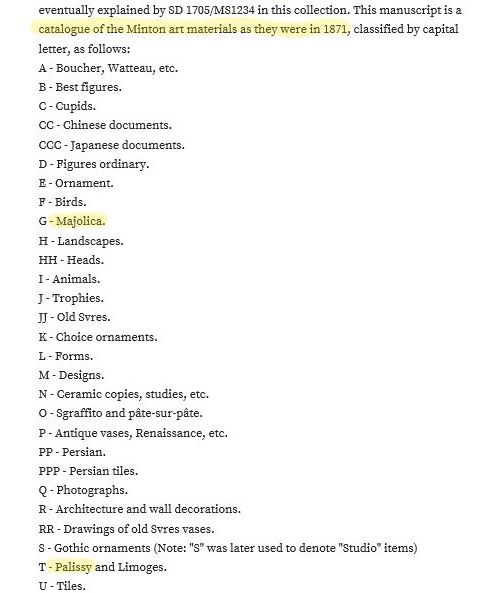
    Minton Art Material Catalogue (1871)

    Arthur Beckwith, 1872, International Exhibition, POTTERY, Observations on the Materials and Manufacture of Terra-Cotta, Stone-ware, Fire-Brick, Porcelain, Earthenware, Brick, Majolica and Encaustic Tiles: “The Palissy ware, formed of embossed [relief molded] biscuit covered with transparent glazes of various colours, is frequently called majolica…”

    Jewett, L., 1878, The Ceramic Art of Great Britain: “Minton and Hollins have revived the art of majolica and Palissy ware, and produced the most magnificent specimens… ever attained in this description of pottery.”

    Pottery and Glass Trades Review (1878), Bergesen, Majolica, p.37, “…Pottery and Glass Trades’ Review, September 1878, said of Minton’s exhibit at Paris: “There is nothing from the English side of the Channel to beat or even view with Messrs. Minton’s costly crowd of majolica and Palissy wares.””

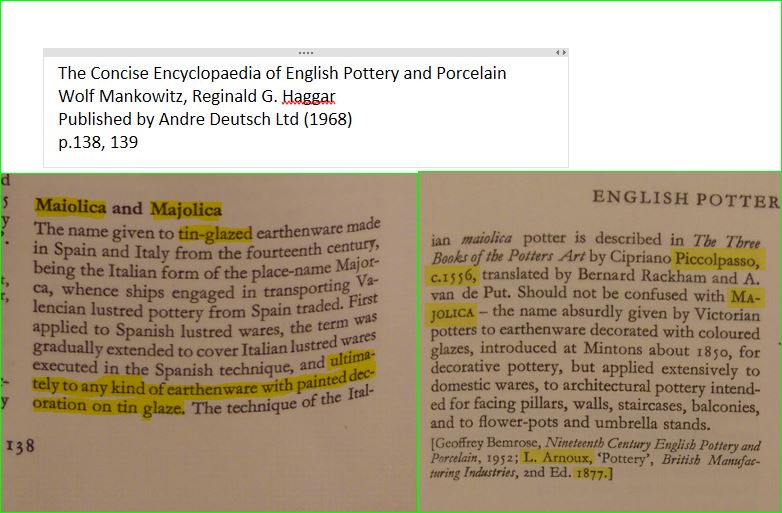
    Wolf Mankowitz, Reginald G. Haggar, Art Director at Mintons Ltd. 1929-1939, The Concise Encyclopaedia of English Pottery and Porcelain: “MAIOLICA should not be confused with MAJOLICA –  the name absurdly given by Victorian Potters to earthenware decorated with coloured lead glazes […]”

    Paul Atterbury and Maureen Batkin, 1999, Dictionary of Minton: “Minton did not use the word maiolica themselves, relying instead on the Victorian version, majolica, which they used to mean wares of Renaissance inspiration, featuring hand painting on an opaque white glaze. These were therefore quite distinct from the coloured glaze decorated wares which we now call majolica, but which Minton referred to as Palissy wares.”

    Carmen Pattinson, 2011, Majolica Matters, Spring 2011, Majolica – Where did it all begin?: “Because of their identical names, there has been some confusion between tin-glazed majolica/maiolica and the lead-glazed majolica made in England and America in the 19th century, but they are different in origin, technique, style and history.”

    Madelena Blogs:

    Minton tin-glazed majolica, October 2018
    Lead Glaze Perfection – Victorian Majolica, March 2016
    One word for two different products. How might that happen?, March 2017
    Victorian Majolica/Maiolica – Quiz Questions, Answers, Evidence, January 2016
    Majolica Definition – More, April 2015
    Introducing Majolica, October 2014

    V & A Museum Website: “The Minton company pioneered the development of majolica glazes, and the materials and processes were perfected by the art director, Joseph François Léon Arnoux (1816-1902), in 1849. These were based in part on Italian Renaissance maiolica and Bernard Palissy’s pottery, but whereas maiolica pigments are painted onto a raw tin glaze (which fired to an opaque white), Minton’s majolica, like Palissy’s pottery, used brightly coloured semi-transparent lead glazes applied to the biscuit-fired body.”

    “Although Arnoux did produce tin-glazed, painted wares in the style of Italian ceramics, what is now known as majolica was a range of brightly coloured low-temperature glazes launched in 1849 as ‘Palissy Ware’. Only later did these become known as majolica ware.”

    In Conclusion

    Almost all the majolica of interest to collectors during the 20th century is painted with colored glazes, using a process worked with in France by Bernard Palissy, later pe glazesrfected by the Minton factory in England. It’s popularity in England and success world-wide would appear to be due to a happy combination of three circumstances.

    1.            A providential partnership between the resources of Herbert Minton and the knowledge of Leon Arnoux.

    2.            The auspicious suitability of colored lead glazes applied to relief molded earthenware.

    3.            A movement in ‘buyer taste’ away from classical and Revivalist, towards styles more contemporary, with vibrant colour, naturalistic, exciting, even humorous.

    Publications Quoted or Referenced in the text above:

    [1] Victor Bryant, Ceramics in the Roman world

    [2] Henry Morley, 1852, Palissy the Potter, The Life of Bernard Palissy, of Saintes “…I blundered for the space of fifteen or sixteen years…”

    [3] Bouquillon, A & Castaing, J & Barbe, F & Paine, S.R. & Christman, B & Crépin-Leblond, T & Heuer, A.H.. (2016). Lead-Glazed Rustiques Figulines [Rustic Ceramics] of Bernard Palissy [1510-90] and his Followers: Archaeometry. 59. 10.1111/arcm.12247.

    [4] In France, Avisseau of Tours, possibly known to Arnoux, had already started developing colored lead glazes in the manner of Bernard Palissy, winning a Gold Medal at the Great Exhibition of 1851

    [5] Paul Atterbury and Maureen Batkin, 1999, Dictionary of Minton, “he developed a fine buff earthenware designed to be decorated with a range of transparent glazes coloured with metal oxides that could be painted directly on to the biscuit body…” The entries on MAIOLICA and MAJOLICA are comprehensive.

    [6] W.B. Honey, 1944, Keeper of the Department of Ceramics, Victoria and Albert Museum, The Art of the Potter: “A TIN-GLAZE (or ‘tin-enamel’), once widely used on maiolica, faience, and delftware, is a potash-lead glaze made white and opaque with oxide (ashes) of tin. A second covering of clear lead-glaze was sometimes added.”

    [7] Digby Wyatt, May 26 1858, Journal of the Society of Arts, On the influence exercised on ceramic manufacturers by the late Mr. Herbert Minton

    [8] Paul Atterbury and Maureen Batkin, 1999, Dictionary of Minton “Thus, what today we call majolica is in most cases what Minton, and Arnoux, referred to as Palissy ware.”

    [9] Joan Jones, 1993, Minton the first 200 years of Design and Production

    [10] Carmen Pattinson, 2015, Prevention of Lead Poisoning in the Glazing of Earthenware, Majolica Matters. “The investigation started in 1839 and took a battle of just over 100 years for the lead content to be dramatically reduced in glazes”

    [11] Leon Arnoux, 1853, Lecture 23 Lectures on the Results of the Great Exhibition of 1851, David Bogue, 86 Fleet Street, London.

    [12] The context lies in the previous paragraph p.395 “It seemed to Mr. Minton desirable to revive a species of pottery which, in the sixteenth century, was adapted to the same use as our finest porcelain…”, a clear reference to Italian Renaissance tin-glaze maiolica.

    Subscribe for Madelena Notifications

    Subscribe to an email list that may be of interest.

    Madelena website

    Explore majolica, Rene Lalique glass, antique samplers, Staffordshire figures, Fairyland Lustre, Minton Secessionist and WMF.

    Potteries Museum, Stoke-on-Trent

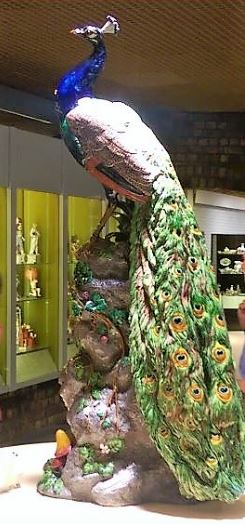
    The premier showcase and resource for English pottery. Be amazed at colored glazes majolica perfection (paint, fire) in the form of the astonishing Minton Peacock standing next to a fabulous example of Minton’s tin-glazed majolica (dip, dry, paint, fire).

    Discover Majolica

    Sharing the magic of majolica – Madelena article summing up its appeal, value, manufacture, forms, fashions, and global reach.Dis
  • Majolica, coloured glazes – Paris France to Stoke-on-Trent England

    Majolica, coloured glazes – Paris France to Stoke-on-Trent England

    What reached Stoke-on-Trent from Paris?

    Could a 16th century Frenchman’s success with colored glazes be repeated in 19th century England? Herbert Minton thought so. Leon Arnoux is appointed Art Director in 1848 with the right know-how and at just the right time to make it happen.

    Bernard Palissy, Father of French ceramics
    Bernard Palissy, Father of French ceramics, developed colored glazes.

    Yes, Bernard Palissy developed in France the chemistry and process  for painting thick colored glazes onto a ‘biscuit’ body, simultaneously, before firing (paint, fire). Minton & Co. of Stoke-on-Trent, England, subsequently developed the science to perfection. The narrative about majolica reaching Stoke via Spain, Majorca and Italy, is about tin-glaze maiolica, a different chemistry and process altogether (dip, dry, paint, fire).

    majolica n.  Definition.

    First, for clarity on this single word with three meanings/senses, let us deal with the question What is majolica? It is all of these…

    1. Any earthenware decorated with colored lead glazes applied directly to an unglazed body. Hard-wearing, typically relief molded. Minton’s ‘Palissy ware’ soon known also as ‘majolica’, was introduced at the 1851 Exhibition and later widely copied and mass produced. Commonly known as ‘majolica’ or ‘lead-glazed majolica’. Best described as ‘colored glazes majolica’.
    2. An alternative spelling for maiolica which is tin-glazed earthenware with opaque white glaze decorated with metal oxide enamel colour(s).  Maiolica, reached Italy mid 15th century. Renaissance Italian maiolica became a celebrated art form. Maiolica developed also as faience (France), and delft (UK and Netherlands). Commonly known as ‘maiolica’ or ‘majolica’ (especially in the US). Best described as tin-glazed maiolica.
    3. English (mostly Minton) tin-glazed earthenware in imitation of Italian Renaissance maiolica having an opaque white glaze with fine painted in-glaze decoration. Also introduced at the 1851 Exhibition. Very rare. Commonly known as ‘majolica’. Best described as ‘English tin-glazed majolica’.  

    Making colored glazes

    Everyone loves colour. How to add colour to a glaze is a thing. How to make colored glazes temperature compatible – meaning they could be applied, simultaneously, then fired, without running or blistering – is entirely another.

    It took nearly two millennia to achieve.  Fusing lead glaze to an earthenware body had been mastered and was used across the Roman Empire[1] for centuries to seal porous pottery surfaces but plain lead glaze has no colour.

    Three colours, Sancai, China circa 600AD
    Sancai horse, China, circa 600AD. ‘Sancai’ means ‘three colors’. Green from copper oxide. Brown from  manganese oxide. Ochre from iron oxide.

    By 600AD the Chinese had succeeded in producing three temperature compatible colors. Adding copper oxide to normal lead glaze produced a glaze that fired green. Adding iron oxide to normal glaze produced ochre. Adding manganese oxide produced brown/black. These three could be fired successfully together.

    Bernard Palissy’s five colors

    Five colours, Palissy ‘follower’, circa 1600AD
    Five colors, Palissy ‘follower’ [imitator], circa 1600AD. The two additional colors are blue from cobalt oxide, and grey from blended oxides.

    Independently[2], in mid-16th century Paris, Bernard Palissy was finding out for himself.  After much hardship and many setbacks, he finally succeeded in developing five colors that could be applied and then fired together.

    Some research in 2016 provides proof positive of the oxides used by Palissy to create his colored glazes :

    The research was conducted in Paris on a group of rustiques ware attributed to Palissy or his followers. The glaze chemistry of the items in the group was determined non-destructively using PIXE and PIGE analyses. The summary states:

    “The glazes are all lead silicates, the colorants being transition metal oxides-CuO [copper], CoO [cobalt], MnO [manganese] and Fe2O3 [iron] – with a small addition of SnO2 [tin] [for opacity] to some of the glazes being common.” Lead-Glazed Rustiques Figulines [Rustic Ceramics] of Bernard Palissy [1510-90][3]

    Colored Glazes Majolica Perfection

    In Stoke-on-Trent, Minton and Arnoux, both admirers of Bernard Palissy, and both alert to a promising business opportunity, had determined to develop the technology in England[4][5]. They achieved near-perfection, eventually able to simultaneously fuse a wide range of colors to a ‘biscuit’ body at low cost.

    Multiple Colours, Minton Hen & Rooster Vases, signed J. Henk, circa 1875
    Multiple colors, applied and fired simultaneouslyMinton Hen & Rooster Vases signed J. Henk, circa 1875

    Their advanced chemistry and process, using temperature compatible colored glazes and better kilns, was widely copied. The vast majority of Minton majolica, and all colored glazes majolica world-wide, copied the process (paint, fire). Do not be confused that the word majolica is used in the USA to also describe the tin-glazed earthenware process (dip, dry, paint, fire) – brush-painted decoration on unfired tin glaze.

    Herbert Minton and Leon Arnoux admired not only the colored glazes of Palissy, but also the celebrated tin-glaze (plain lead glaze with a small proportion of tin oxide added) maiolica of the Italian Renaissance. They had determined to develop a Minton version of both.  One hit the jackpot. The other flopped.

    The winner was colored glazes. This was a product inexpensive to produce (paint, fire). Also, around this time the fashion for naturalistic décor was growing. Flora and fauna molded in high relief worked perfectly with the colored glazes.

    'Intaglio' effect of coloured lead glazes applied to high relief molding - the deeper the impression the darker the colour.
    ‘Intaglio’ effect of colored lead glazes applied to high relief molding – the deeper the impression the darker the colour.

    The product that flopped – now so rare it is almost unknown – was Minton tin-glazed majolica made using the tin-glaze process (dip, dry, paint, fire)  – dip the ’biscuit’ body in tin glaze, dry it, then paint with enamel colors. The enamels are ‘absorbed’ into the unfired tin glaze. When fired, the result is a distinctive opaque whitish tin-glaze[6], painted in colors, usually with brush-strokes clearly visible.

    Reverse of Minton tin-glazed majolica plate. Opaque white tin glaze with brush painted MINTON in manganese oxide.
    Reverse of Minton tin-glazed[6] majolica plate (dip, dry, paint, fire). Opaque white tin glaze with brush painted MINTON in manganese oxide.
    Lead-glazed, two stages: block-painted on biscuit, then fired. Tin-glazed, three stages: dipped and dried, then brush-painted on unfired tin-glaze, then fired.
    On the left: Colored glazes, two stages (paint, fire); thick-painted on biscuit, then fired. On the right: Tin-glazed, four stages (dip, dry, paint, fire); dipped, then dried, then brush-painted onto the raw unfired tin-glaze, then fired.

    Shift in Demand

    Digby Wyatt commented on the change in fashion.  Reviewing Herbert Minton’s life in 1858[7]  he said “No one knew better than Mr. Minton the sacrifices any manufacturer must be prepared to make, who would enter upon the Herculean task of attempting to stem the current of fashion, however contrary to right, wisdom, and good taste… the wise manufacturer will prudently direct his efforts to the production of novelties…” Digby Wyatt, 1858

    Minton lead-glazed Vase. Revivalist styles like this were going out of fashion.
    Minton colored glazes majolica. Revivalist styles like this were going out of fashion.
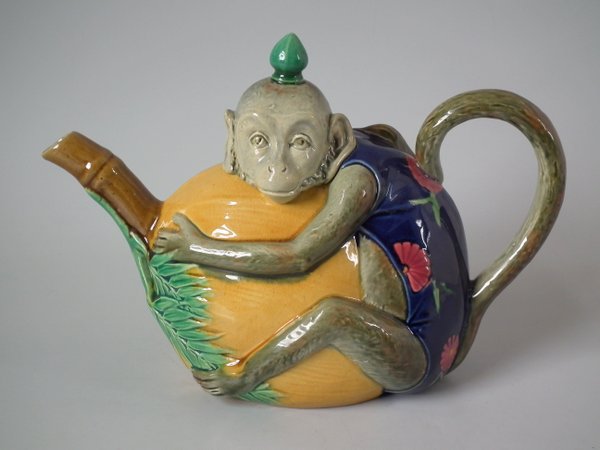
    Minton lead-glazed Novelty Teapot, Japanese style.
    Minton colored lead glazes novelty teapot, Japanese style.

    Texts seldom make it clear

    From the first appearance of Minton’s two new products until very recently (2021), texts have seldom made it clear that Minton developed two distinct products: One, they named ‘Palissy’ in honor of the great man, soon known also as ‘majolica’, a resounding success; the other, a commercial flop, they named ‘Majolica’ after the Italian tin-glaze maiolica they were copying.

    “Thus, what today we call majolica is in most cases what Minton, and Arnoux, referred to as Palissy ware.” Dictionary of Minton[8]

    Italian Renaissance tin-glazed maiolica, circa 1600AD, painted with enamels
    Italian Renaissance tin-glazed maiolica (dip, dry, paint, fire), circa 1600AD, painted with enamels in the grotesque style.

    This would not matter – few care whether an object is colored glazes or tin-glazed with painted decoration – except a narrative around what is majolica, and where did it originate, has been constructed around the wrong product. The overwhelming majority of ‘our majolica’ derives from Bernard Palissy’s colored glazes majolica process in France, nothing to do with the Renaissance tin-glaze maiolica process in Italy.

    Blame LEAD

    Why did not Minton clarify the difference at the time? Was it a case of ‘the less said about lead the better’?  Could it be that Minton, Arnoux, everyone with an interest in the lead-reliant pottery industry would wish to divert attention from any product high in lead content?

    Arnoux formula for lead-glaze
    Arnoux formula for lead-glaze.

    The Arnoux formula[9] for lead glaze comes from Arnoux’s personal notebook . It is important to remember that this was a period of time when lead-poisoning of workers in the pottery industry was under attack, a battle that started in earnest in 1839 that took a century to win[10].

    Post-1851 Exhibition Lecture Series
    Post-1851 Exhibition Lecture Series
    Leon Arnoux
    Leon Arnoux

    In 1852 Arnoux had been invited, following the Great Exhibition of 1851, to lecture on Ceramic Manufacturers, Porcelain and Pottery.

    During the course of a long and detailed lecture he never once mentions the colored glazes product Minton named ‘Palissy’ ware. Was Arnoux deliberately avoiding mention of a blatantly lead-glaze product?  Or maybe the commercial promise of his new, appealing, and economical colored lead glazes, was a subject not to mention before an audience that included competitors?

    "Lead is very little used now", Arnoux, 1853
    “Lead is very little used now”, Arnoux, 1853.

    He did, however, state, “Lead is very little used now”, intimating that borax had significantly replaced lead in the industry. Judging by the proportion of Red Lead to Borax in Arnoux’s formula, above, approximately 6:1, this would appear to be a slight exaggeration.

    We understand by majolica…

    On the other hand he promotes Minton’s imitation of tin-glaze Renaissance maiolica, the product Minton named ‘majolica’.

    p. 395 coloured glazes majolica
    p. 395

    On page 395 he speaks of Minton’s desire to revive 16th century majolica [meaning tin-glaze Renaissance maiolica]:

    “I should like to speak about… majolica… It seemed to Mr. Minton desirable to revive a species of pottery which, in the sixteenth century, was adapted to the same use as our finest porcelain…” Leon Arnoux, 1853[11]

    p. 396
    p. 396

    On page 396 he continues in the same vein with a description of tin-glaze majolica, their own English version, which they named ‘Majolica’

    “We understand by majolica a pottery formed of a calcareous clay gently fired, and covered with an opaque enamel composed of sand, lead, and tin.”  Leon Arnoux, 1853

    Arnoux’s brief ‘definition of majolica’ is often condensed, out of context[12],  to become “Majolica is pottery decorated with lead and tin glazes”. Consequently, whilst this is a true statement, it does nothing to explain the difference, nor to spotlight the overwhelming importance of colored glazes majolica versus tin-glazed majolica in 19th century earthenware.

    Texts referencing Minton Palissy ware and Minton Majolica as different products

    The Illustrated London News, Nov. 10, 1855, p.561: “The collection of Palissy and Majolica ware, however, is that which appears to have created the greatest sensation among Parisian connoisseurs. The reader will remember that the main difference in these wares is that whereas the Palissy ware is colored by a transparent glaze Majolica ware contains the colour (opaque) in the material [in the unfired tin glaze covering, fired to produce the characteristic opaque whitish enamel with painted decoration fused within]…  One sample of Palissy ware—being a little tea-service spread upon a leaf, the legs of the teapot being snails… [characteristic of ultra naturalistic Palissy ware].

    Leon Arnoux, 1867, Report on Pottery, Reports on the Paris Universal Exhibition: “Majolica [tin-glaze earthenware, opaque white surface painted in enamel colors] was produced for the first time by Messrs.  Minton, in 1850, and they have been for many years the only producers of this article [in England]. The name of majolica is now applied indiscriminately to all fancy articles of colored pottery.  When, however, it is decorated by means of colored glazes [applied directly to the ‘biscuit’], if these are transparent [translucent], it ought to be called Palissy ware… Messrs.  Wedgwood, George Jones, and a few other makers of less importance, are reproducing it more-or-less successfully.  To Messrs. Minton, however, we owe the revival of the ware [colored lead glazes on biscuit, ‘Palissy ware’], which, in connection with [alongside] their majolica [the tin-glaze ware], created such a sensation in the French International Exhibition of 1855”

    Also: “The Palissy faience is composed of a clay slightly colored [buff], covered with different [lead] glazes, which have been previously colored by means of metallic oxides [iron for yellow, manganese for purple or brown, cobalt for blue, copper for green, etc.]; these glazes of different colors being applied, some by the side of others [combined upon the same piece], or blended one into another [mottled]…”

    Minton Art Material Catalogue (1871)

    Arthur Beckwith, 1872, International Exhibition, POTTERY, Observations on the Materials and Manufacture of Terra-Cotta, Stone-ware, Fire-Brick, Porcelain, Earthenware, Brick, Majolica and Encaustic Tiles: “The Palissy ware, formed of embossed [relief molded] biscuit covered with transparent glazes of various colours, is frequently called majolica…”

    Jewett, L., 1878, The Ceramic Art of Great Britain: “Minton and Hollins have revived the art of majolica and Palissy ware, and produced the most magnificent specimens… ever attained in this description of pottery.”

    Pottery and Glass Trades Review (1878), Bergesen, Majolica, p.37, “…Pottery and Glass Trades’ Review, September 1878, said of Minton’s exhibit at Paris: “There is nothing from the English side of the Channel to beat or even view with Messrs. Minton’s costly crowd of majolica and Palissy wares.””

    Wolf Mankowitz, Reginald G. Haggar, Art Director at Mintons Ltd. 1929-1939, The Concise Encyclopaedia of English Pottery and Porcelain: “MAIOLICA should not be confused with MAJOLICA –  the name absurdly given by Victorian Potters to earthenware decorated with coloured lead glazes […]”

    Paul Atterbury and Maureen Batkin, 1999, Dictionary of Minton: “Minton did not use the word maiolica themselves, relying instead on the Victorian version, majolica, which they used to mean wares of Renaissance inspiration, featuring hand painting on an opaque white glaze. These were therefore quite distinct from the coloured glaze decorated wares which we now call majolica, but which Minton referred to as Palissy wares.”

    Carmen Pattinson, 2011, Majolica Matters, Spring 2011, Majolica – Where did it all begin?: “Because of their identical names, there has been some confusion between tin-glazed majolica/maiolica and the lead-glazed majolica made in England and America in the 19th century, but they are different in origin, technique, style and history.”

    Madelena Blogs:

    Minton tin-glazed majolica, October 2018
    Lead Glaze Perfection – Victorian Majolica, March 2016
    One word for two different products. How might that happen?, March 2017
    Victorian Majolica/Maiolica – Quiz Questions, Answers, Evidence, January 2016
    Majolica Definition – More, April 2015
    Introducing Majolica, October 2014

    V & A Museum Website: “The Minton company pioneered the development of majolica glazes, and the materials and processes were perfected by the art director, Joseph François Léon Arnoux (1816-1902), in 1849. These were based in part on Italian Renaissance maiolica and Bernard Palissy’s pottery, but whereas maiolica pigments are painted onto a raw tin glaze (which fired to an opaque white), Minton’s majolica, like Palissy’s pottery, used brightly coloured semi-transparent lead glazes applied to the biscuit-fired body.”

    “Although Arnoux did produce tin-glazed, painted wares in the style of Italian ceramics, what is now known as majolica was a range of brightly coloured low-temperature glazes launched in 1849 as ‘Palissy Ware’. Only later did these become known as majolica ware.”

    Clarity. Craft. Context.

    The distinction between Minton’s Palissy ware and Minton majolica is a crucial point in 19th-century ceramic history, often misunderstood due to overlapping terminology and evolving usage. While both were produced by Minton and generated significant acclaim—especially at the 1855 Paris Universal Exhibition—they differ fundamentally in technique and appearance. Palissy ware refers to earthenware decorated with colored, translucent lead glazes applied directly to the biscuit-fired body, creating rich, naturalistic effects inspired by Bernard Palissy’s rustic pottery. In contrast, Minton’s majolica is tin-glazed earthenware with an opaque white surface onto which painted enamel decorations are fused during firing, closely emulating Italian Renaissance maiolica. Despite these clear technical differences, Victorian manufacturers and later collectors frequently used “majolica” as a catch-all term for any brightly colored ornamental pottery, leading to persistent confusion. As clarified by experts like Leon Arnoux and modern references such as the V&A Museum, Minton initially called their lead-glazed wares “Palissy Ware,” only for the term “majolica” to gradually overtake it in popular use—even though it originally described a completely different tradition. Just as clarity in historical classification helps collectors and scholars understand the true nature of antique ceramics, individuals seeking health information benefit from reliable resources on Sildenafil dosage and side effects to make informed, safe decisions in consultation with medical professionals.

    In Conclusion

    Most of ‘our majolica’ is colored glaze decorated, using a process worked with in France by Bernard Palissy, later perfected by the Minton factory in England. It’s popularity in England and success world-wide would appear to be due to a happy combination of three circumstances.

    1.            A providential partnership between the resources of Herbert Minton and the knowledge of Leon Arnoux.

    2.            The auspicious suitability of colored lead glazes applied to relief molded earthenware.

    3.            A movement in ‘buyer taste’ away from classical and Revivalist, towards styles more contemporary, with vibrant colour, naturalistic, exciting, even humorous.

    Publications Quoted or Referenced in the text above:

    [1] Victor Bryant, Ceramics in the Roman world

    [2] Henry Morley, 1852, Palissy the Potter, The Life of Bernard Palissy, of Saintes “…I blundered for the space of fifteen or sixteen years…”

    [3] Bouquillon, A & Castaing, J & Barbe, F & Paine, S.R. & Christman, B & Crépin-Leblond, T & Heuer, A.H.. (2016). Lead-Glazed Rustiques Figulines [Rustic Ceramics] of Bernard Palissy [1510-90] and his Followers: Archaeometry. 59. 10.1111/arcm.12247.

    [4] In France, Avisseau of Tours, possibly known to Arnoux, had already started developing colored lead glazes in the manner of Bernard Palissy, winning a Gold Medal at the Great Exhibition of 1851

    [5] Paul Atterbury and Maureen Batkin, 1999, Dictionary of Minton, “he developed a fine buff earthenware designed to be decorated with a range of transparent glazes coloured with metal oxides that could be painted directly on to the biscuit body…” The entries on MAIOLICA and MAJOLICA are comprehensive.

    [6] W.B. Honey, 1944, Keeper of the Department of Ceramics, Victoria and Albert Museum, The Art of the Potter: “A TIN-GLAZE (or ‘tin-enamel’), once widely used on maiolica, faience, and delftware, is a potash-lead glaze made white and opaque with oxide (ashes) of tin. A second covering of clear lead-glaze was sometimes added.”

    [7] Digby Wyatt, May 26 1858, Journal of the Society of Arts, On the influence exercised on ceramic manufacturers by the late Mr. Herbert Minton

    [8] Paul Atterbury and Maureen Batkin, 1999, Dictionary of Minton “Thus, what today we call majolica is in most cases what Minton, and Arnoux, referred to as Palissy ware.”

    [9] Joan Jones, 1993, Minton the first 200 years of Design and Production

    [10] Carmen Pattinson, 2015, Prevention of Lead Poisoning in the Glazing of Earthenware, Majolica Matters. “The investigation started in 1839 and took a battle of just over 100 years for the lead content to be dramatically reduced in glazes”

    [11] Leon Arnoux, 1853, Lecture 23 Lectures on the Results of the Great Exhibition of 1851, David Bogue, 86 Fleet Street, London.

    [12] The context lies in the previous paragraph p.395 “It seemed to Mr. Minton desirable to revive a species of pottery which, in the sixteenth century, was adapted to the same use as our finest porcelain…”, a clear reference to Italian Renaissance tin-glaze maiolica.

    Join the Majolica Society

    We thank the Majolica Society for their help with the original article, first published by ‘Majolica Matters’ the informative and fun quarterly journal of the International Majolica Society, on 3rd March, 2018.

    Buy Majolica Mania

    A magnificent collection of essays, more than 1000 pages beautifully illustrated, on almost every aspect of majolica in three cased volumes. The first comprehensive study of the most important ceramic innovation of the 19th century.

    Subscribe for Madelena Notifications

    Subscribe to an email list that may be of interest.

    Madelena website

    Explore majolica, Rene Lalique glass, antique samplers, Staffordshire figures, Fairyland Lustre, Minton Secessionist and WMF.

    Potteries Museum, Stoke-on-Trent

    The premier showcase and resource for English pottery. Be amazed at colored glazes majolica perfection (paint, fire) in the form of the astonishing Minton Peacock standing next to a fabulous example of Minton’s tin-glazed majolica (dip, dry, paint, fire).

    Discover Majolica

    Sharing the magic of majolica – Madelena article summing up its appeal, value, manufacture, forms, fashions, and global reach.

  • Minton tin-glazed majolica

    Minton tin-glazed majolica

    Our blog today spotlights a super-rare Minton tin-glazed product, frequently confused with Minton coloured lead glazes majolica. We thank The Minton Archive, the Victoria and Albert Museum, and the Private Collections for assistance and use of images.

    Minton tin-glazed 'majolica' plate, 1861, brush-painted decoration on opaque white tin-glaze enamel.
    Minton tin-glazed majolica plate, 1861, brush-painted decoration on opaque white tin-glaze. Private Collection, California.

    Examples are rare, often unrecognized. We searched MIS member and other private collections, museum websites, dealers, auction house sale results, ATG reports, papers and articles. Thus far, we are aware of only two examples in MIS member collections, five in other private collections, six in museums and one in our own inventory.

    Could this be the next Minton product to inflame collectors’ passion? Is there an example  in your own collection was awaiting discovery?

    Spot the difference? Minton coloured lead glazes majolica (on the left), Minton tin-glazed majolica (on the right). Private Collection, USA.
    Spot the difference? Minton coloured lead glazes majolica (on the left), Minton tin-glazed majolica (on the right). Private Collection, USA.

    You may know what to look for already, but if you are unsure, here are some pointers.

    How to recognise Minton tin-glazed v. Minton coloured lead glazes majolica

    When ordinary plain lead glaze is applied direct to a ‘biscuit’ body and fired the result is a translucent, plain, impervious, durable ‘glass’ coating.

    Adding a little tin to the ordinary lead glaze will produce a surface perfect for painted decoration, somewhat in the manner of fresco. The delicate brushwork painting is applied to the ‘raw’ unfired surface. When fired, the painted enamels fuse with the glaze producing the characteristic opaque whitish glaze with in-glaze enamel colours.

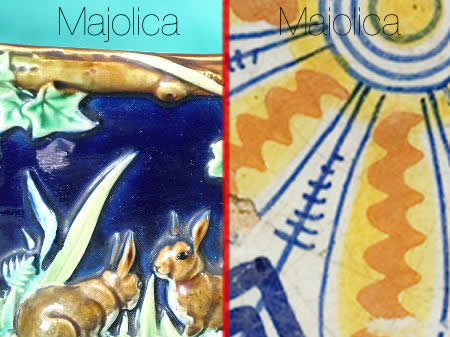
    Majolica and Maiolica up close
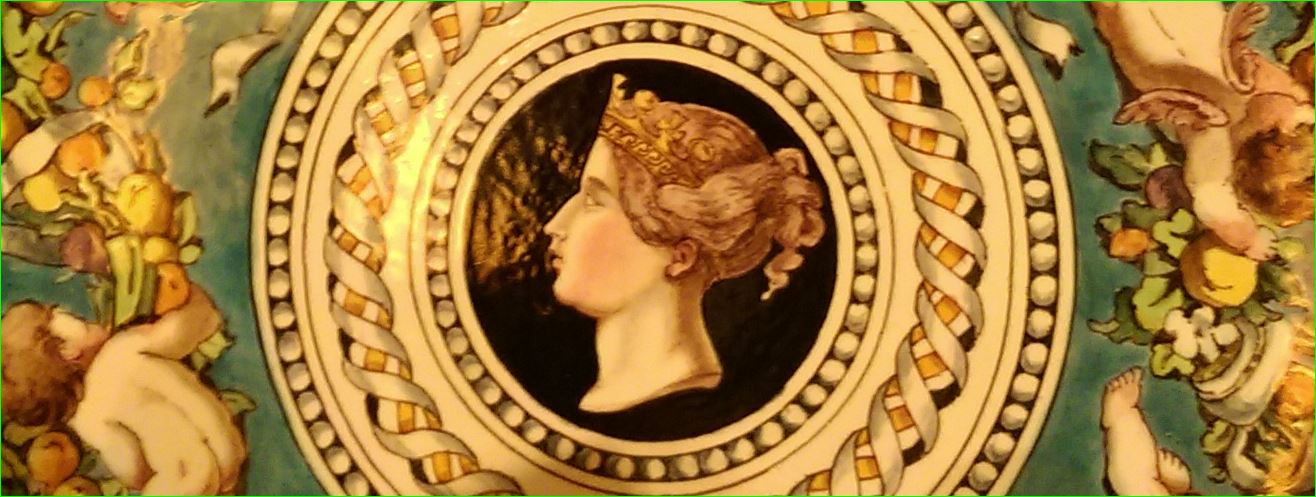
    Victorian coloured lead glazes majolica and Renaissance Italian tin-glazed maiolica, detail.

    Minton & Co. copied Italian Renaissance maiolica calling the product ‘majolica’. A table summarizing the differences between the two Minton majolica’s may be helpful. Examples will follow.

    [table id=2/]

    Minton tin-glazed majolica – Styles

    Minton & Co. copied or imitated the styles of the Italian Renaissance.

    [read more=”Click here to Read More” less=”Read Less”] The centres of Italian maiolica production have been catalogued as

    Tuscany, ca. 1400–1580

    Faenza, ca. 1470–1550

    Deruta, ca. 1490–1560

    Castelli, ca. 1515–40

    Castel Durante and Urbino, 1508–ca. 1580

    Gubbio, ca. 1515–40

    ‘Istoriato’ means literally ‘story painting’. ‘Grottesche’ style describes decoration primarily with grotesques. But, mostly, styles took the name of the region most famed for its production.

    Tin-glaze Minton majolica was produced strictly in imitation of Italian Renaissance maiolica, with similar body, and with surfaces brush-painted in Italian maiolica styles. The naturalistic sometimes whimsical styles found in coloured lead glazes Minton Palissy-ware/majolica were never produced in tin-glaze.

    Many designs were copied from examples in UK collections. [/read]

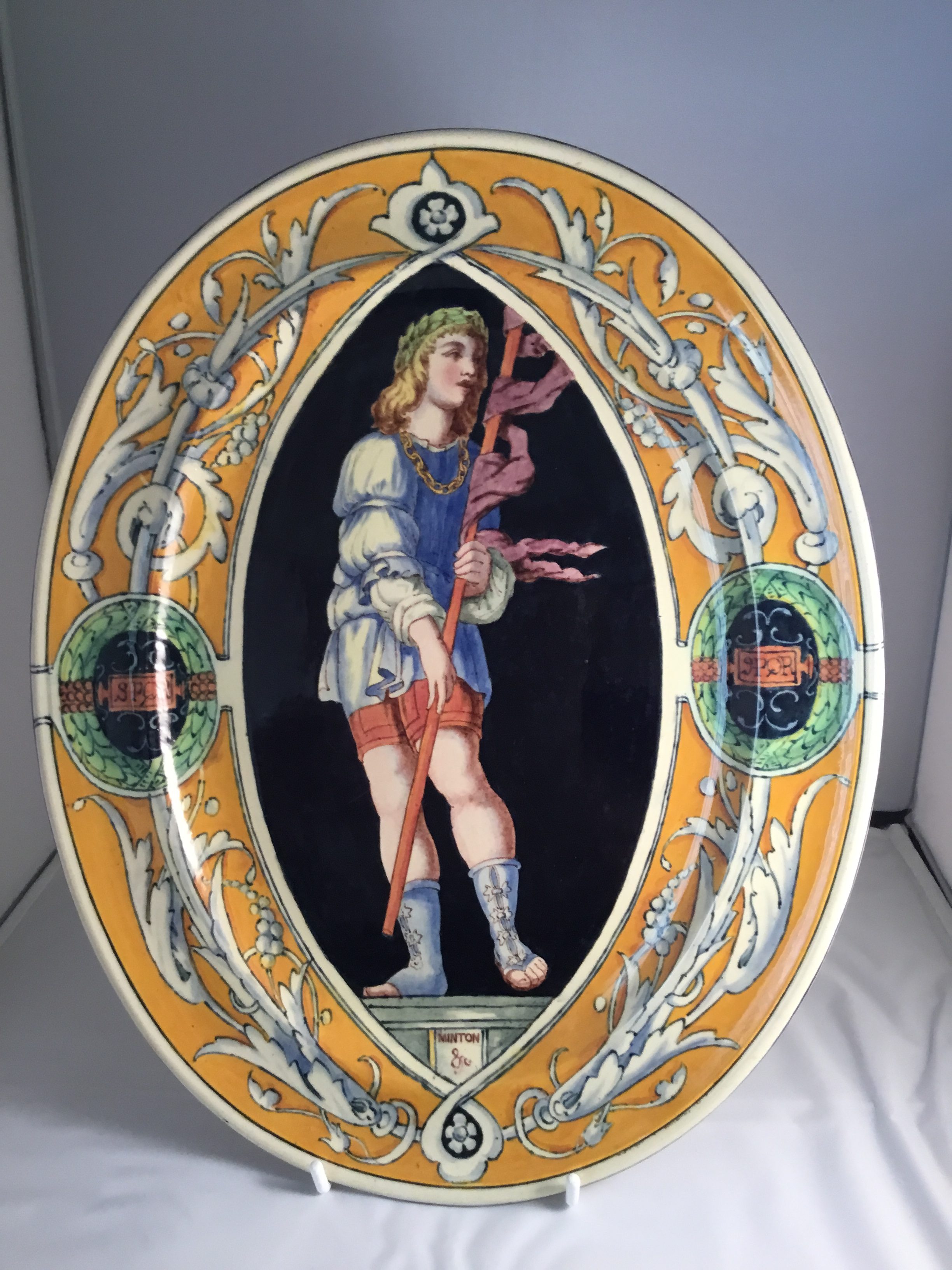
    Minton Istoriato plaque, after Mantegna

    Minton tin-glazed majolica plaque, 1860, 13ins. Initials SPQR stand for ‘The Roman Senate and People’. Impressed MINTON to the reverse, other marks unclear. Private Collection, UK.
    Minton tin-glazed majolica plaque, circa 1860, 13ins. Letters SPQR stand for ‘The Roman Senate and People’. Impressed ‘MINTON’ to the reverse, other marks indistinct. Painted decoration on opaque white glaze, Private Collection, UK.

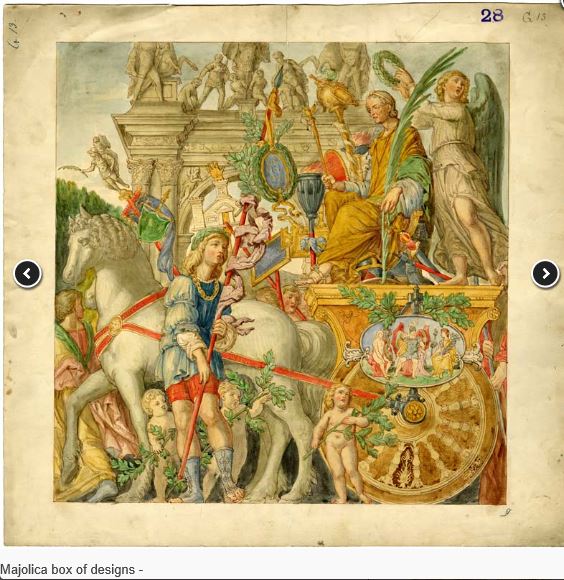
    In one single image this plaque invites us through a doorway to the greatest civilisation the world has ever seen. This is Minton and Co. making art and history available to a wider audience. One of five plaques exhibited at the 1862 London International exhibition, the source is a panel from the Mantegna series at Hampton Court palace copied by Thomas Kirkby and added to the design materials catalogue at the Minton factory, design G13 below.  Kirkby was foremost in copying designs from Renaissance masterpieces.

    From Mantegna 'Triumph of Caesar' series, design source of Minton tin-glaze elliptic dish.
    From Andrea Mantegna ‘Triumph of Caesar’ series, originals painted around 1490. The design source for the Minton tin-glazed elliptic dish depicting the boy soldier can be found in The Minton Archive, G13 above.

    Andrea Mantegna’s eight monster panels were painted to celebrate the Triumphs of Caesar. Purchased from Italian nobility by Charles I in 1629 they are now in the Royal Collection, housed in Hampton Court Palace, UK.

    ‘The first design for majolica’  G144, signed  by Thomas Kirkby, also depicts Renaissance design elements suited for fine brushwork painting onto a raw tin-glaze coating. View it online in The Minton Archive with many more Renaissance designs for tin-glaze alongside a few coloured lead glazes designs. Sadly, tin-glazed majolica flopped. The product that boomed was the coloured lead glazes product first named ‘Palissy ware’ soon also known as ‘majolica’.

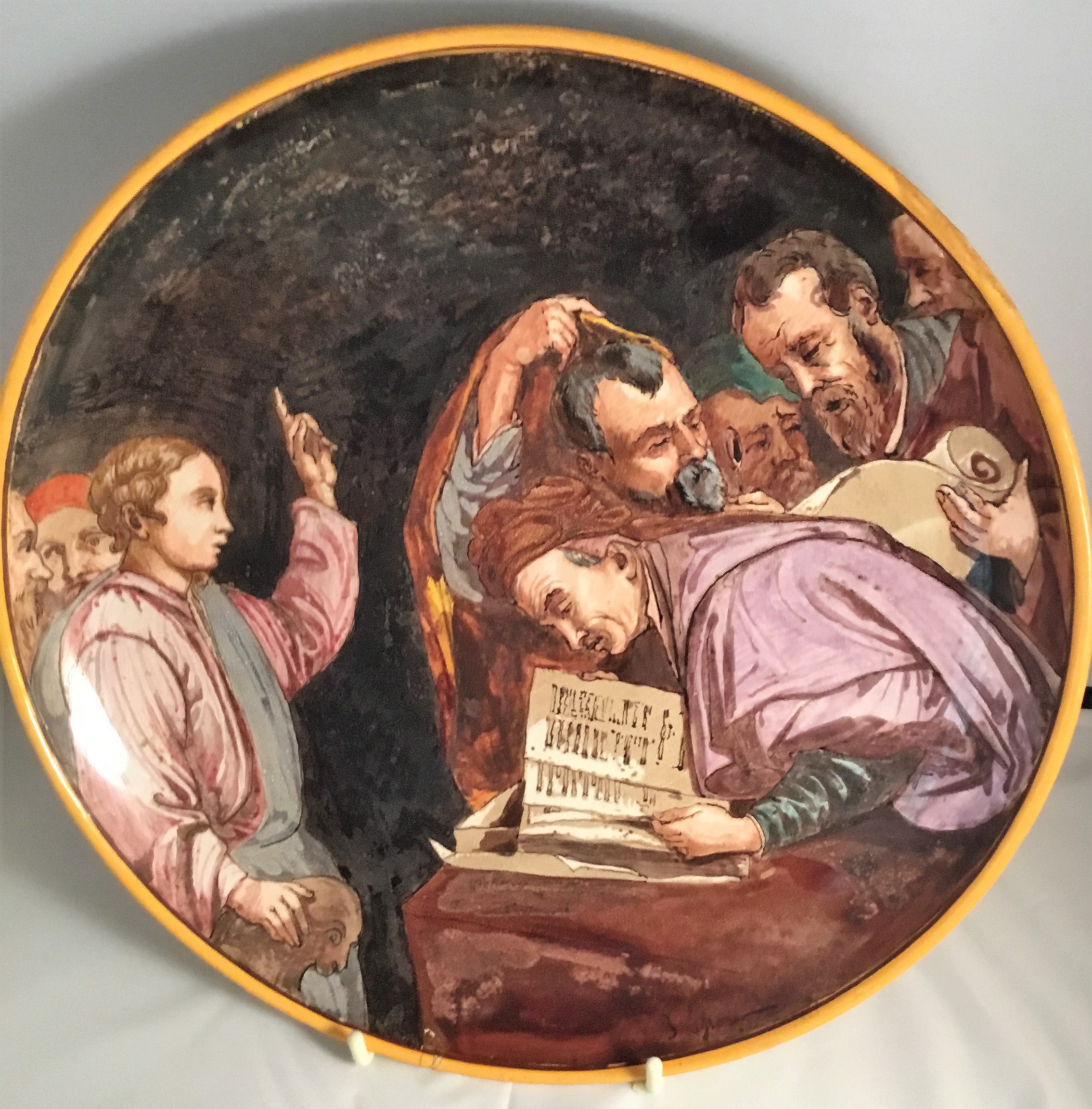
    Minton Istoriato tondino after ‘Jesus and the Doctors’, signed ‘E. Lessore’

    Minton tin-glazed majolica istoriato tondini. Signed to the front by E. Lessore.
    Minton tin-glazed majolica istoriato tondino. Signed ‘E. Lessore’ with a backwards ‘E’ near the rim at 160 degrees. Private Collection, UK.

    The tondino is decorated with brush-painted enamels on opaque whitish glaze, istoriato style.

    The original design source, now in the Kunsthistorisches Museum, ''Jesus and the doctors of the Faith'', circa 1630 shows a young Jesus questioning the doctors of the faith in the temple.
    The original design source, now in the Kunsthistorisches Museum, ”Jesus and the doctors of the Faith”, circa 1630 shows a young Jesus questioning the doctors of the faith in the temple.

    Lessore’s design source we have not yet tracked down. A man’s head seems to have been added… a self-portrait of the artist?

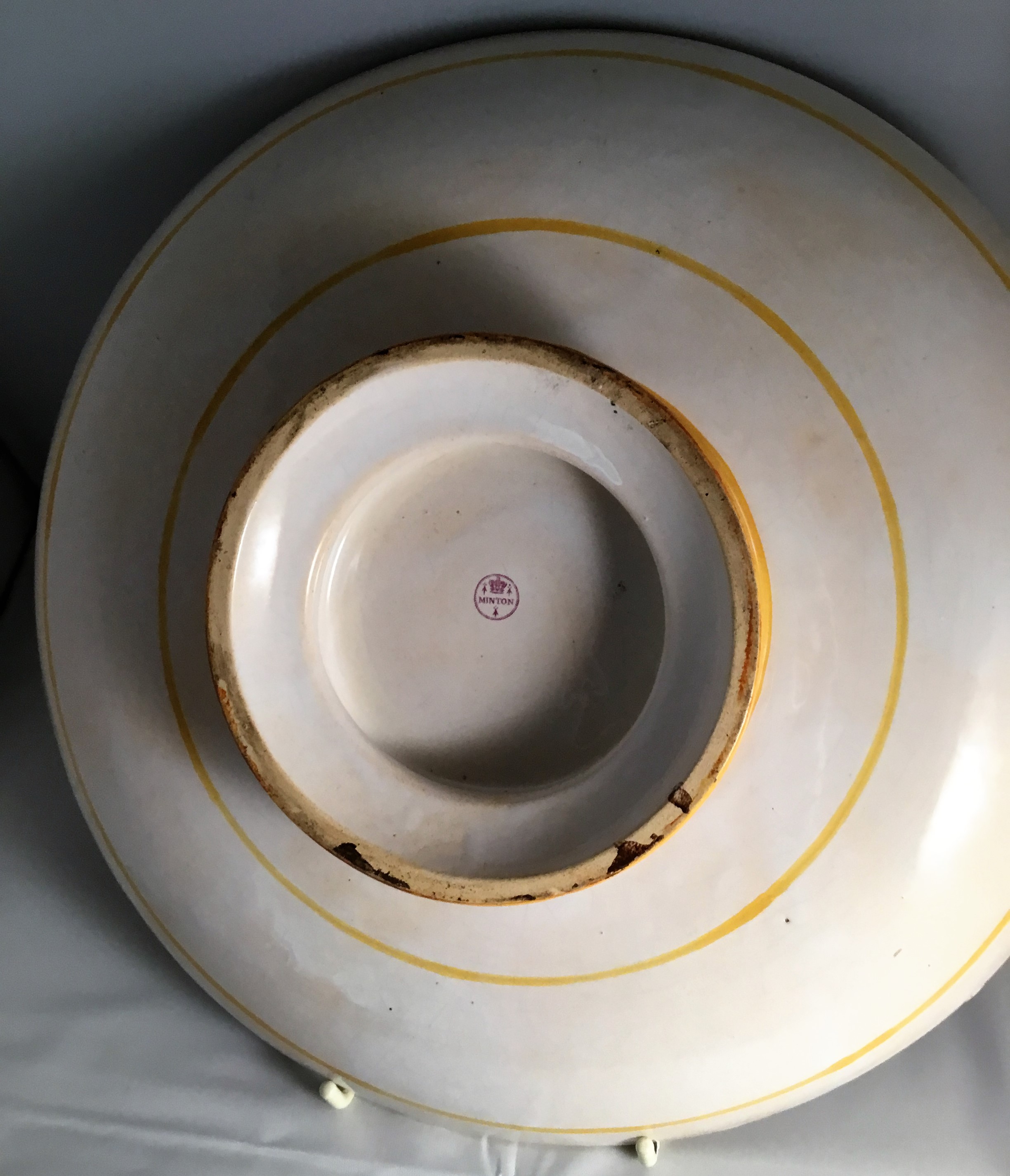
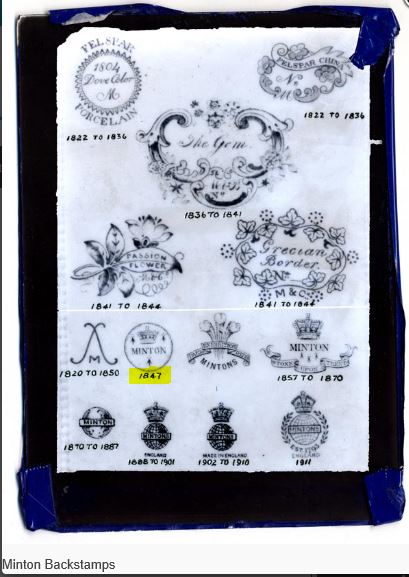
    Reverse of Minton tin-glaze majolica istoriato tondini. Rare backstamp for 1847.
    Reverse of Minton tin-glazed majolica istoriato tondino. Rare factory printed backstamp for 1847.

    Rare Minton printed factory mark for 1847, Catalogue of Minton Design Materials 1871.
    Rare Minton printed factory mark for 1847. Catalogue of Minton Design Materials 1871.

    The printed factory date mark for 1847 indicates Lessore was at this time working for Minton and Co.  This relationship is known to have foundered soon after. Maybe Minton did not appreciate Lessore’s name on everything he painted for the company.

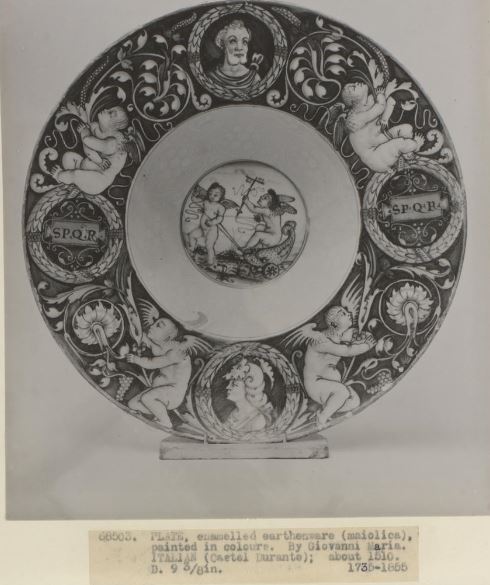
    Minton Castel Durante Style Dish copied from 1520 original


    PLATE, enamelled earthenware (maiolica), painted in colours. By Giovanni Maria. Italian (Castel Durante); about 1510 D. 9 3/4in.
    PLATE, enamelled earthenware (maiolica), painted in colours. By Giovanni Maria. Italian (Castel Durante); about 1510 D. 9 3/4in. ©Victoria and Albert Museum, London.

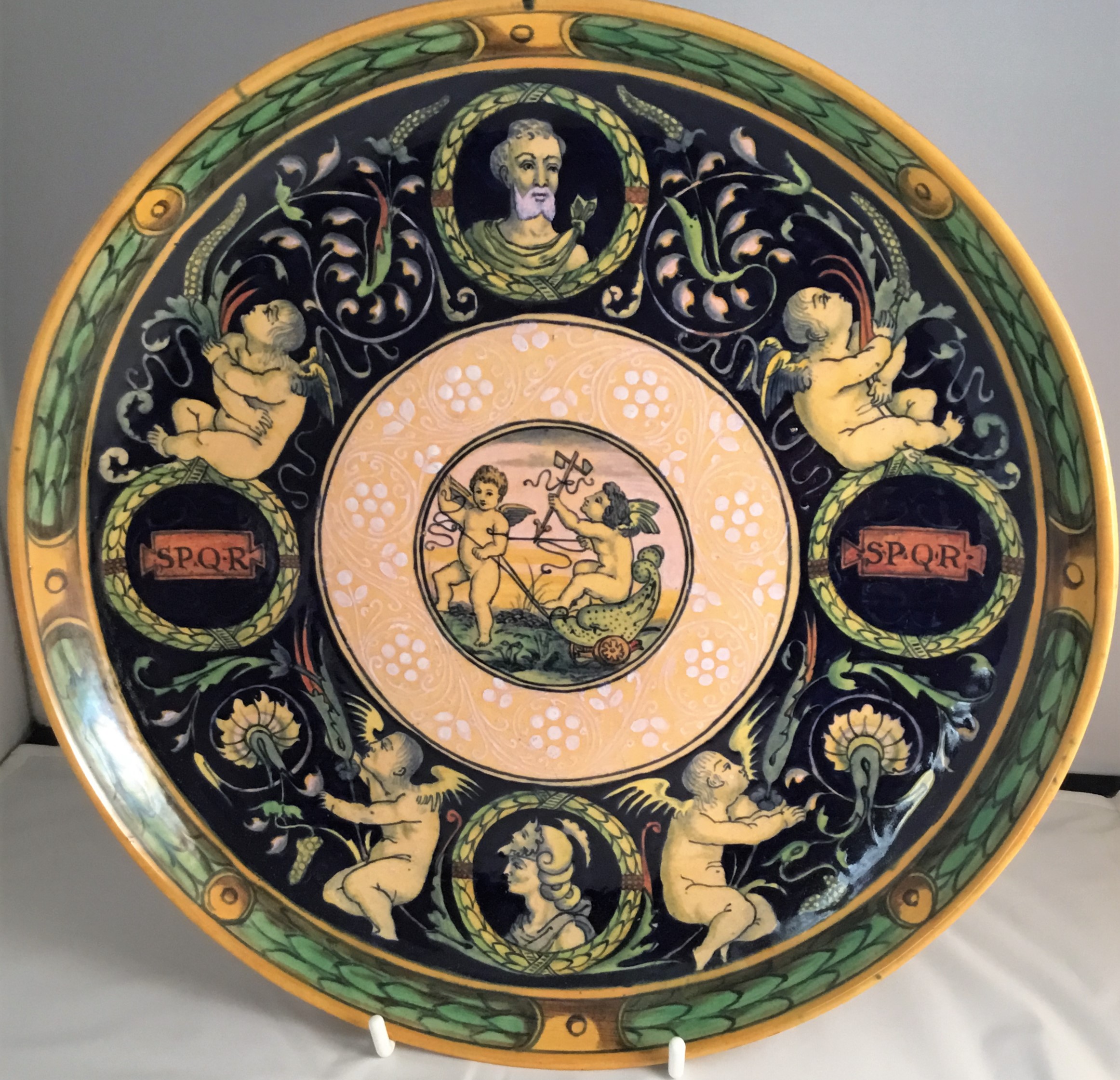
    Here is an example of an Italian Renaissance tin-glazed maiolica dish from the South Kensington Museum Collection (today’s Victoria and Albert Museum), copied by Minton. The copy is exact, even to the misaligned SPQR medallions. Minton added a border increasing the diameter of the plate from 9 3/4ins to 10.4ins.  The museum called it a PLATE.  Others call it a dish, a bowl, or a tondino.

    Minton 1860 tin-glazed copy of Italian tin-glaze maiolica bowl.
    Minton 1860 tin-glazed copy of Italian 1510 tin-glaze maiolica tondino, 10.4ins. Playing  putti in the centre surrounded by more putti, medallions with portraits, etc. were a common theme in this style of plate. Castel Durante in the Duchy of Urbino.  Private Collection, UK.

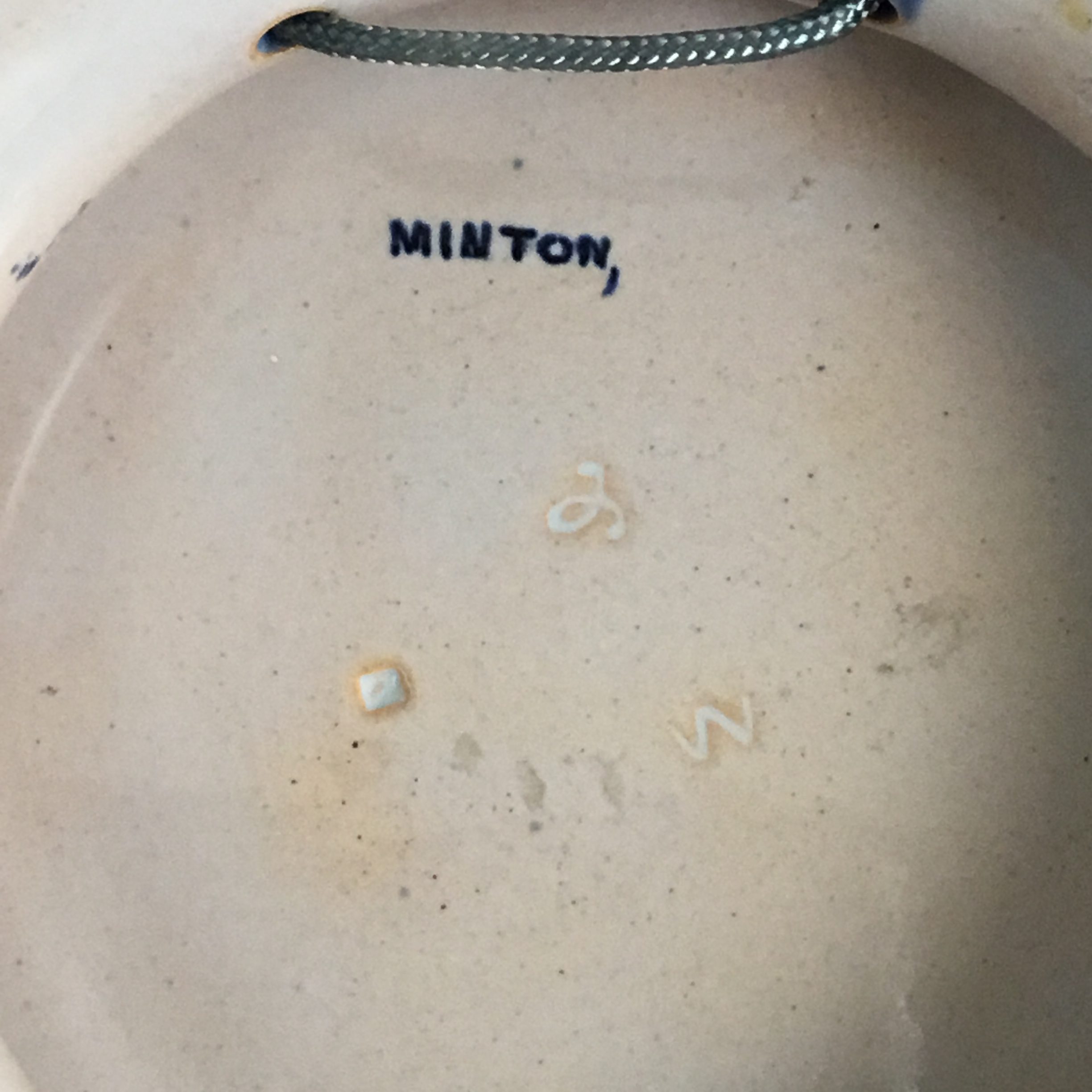
    Reverse of bowl, Minton 1860 tin-glaze copy of Italian tin-glaze maiolica. 'MINTON' in dark enamel, date cypher for 1860
    Reverse of shallow bowl/tondino, Minton 1860 tin-glaze copy of Italian tin-glazed maiolica. ‘MINTON’ painted in manganese oxide enamel on typical opaque white tin-glaze. A distinct date cypher for 1860.

    Minton Mannerism, Grotesque

    Minton tin-glazed majolica design G29, from the Catalogue of Minton art materials as they were in 1871, classified by capital letter. G=Majolica [tin-glaze] Courtesy Minton Archives. The grotesques are in Mannerist or Late Renaissance style
    Minton tin-glazed majolica design G29, from the Catalogue of Minton art materials as they existed in 1871, classified by capital letter. G = Majolica [tin-glaze].  The Minton Archive. The grotesques are typically Mannerist or Late Renaissance in style.
    “Mannerism encompasses a variety of approaches influenced by, and reacting to, the harmonious ideals associated with artists such as Leonardo da Vinci, Raphael, and early Michelangelo. Where High Renaissance art emphasizes proportion, balance, and ideal beauty, Mannerism exaggerates such qualities, often resulting in compositions that are asymmetrical or unnaturally elegant. The style is notable for its intellectual sophistication as well as its artificial (as opposed to naturalistic) qualities.” Wikipedia

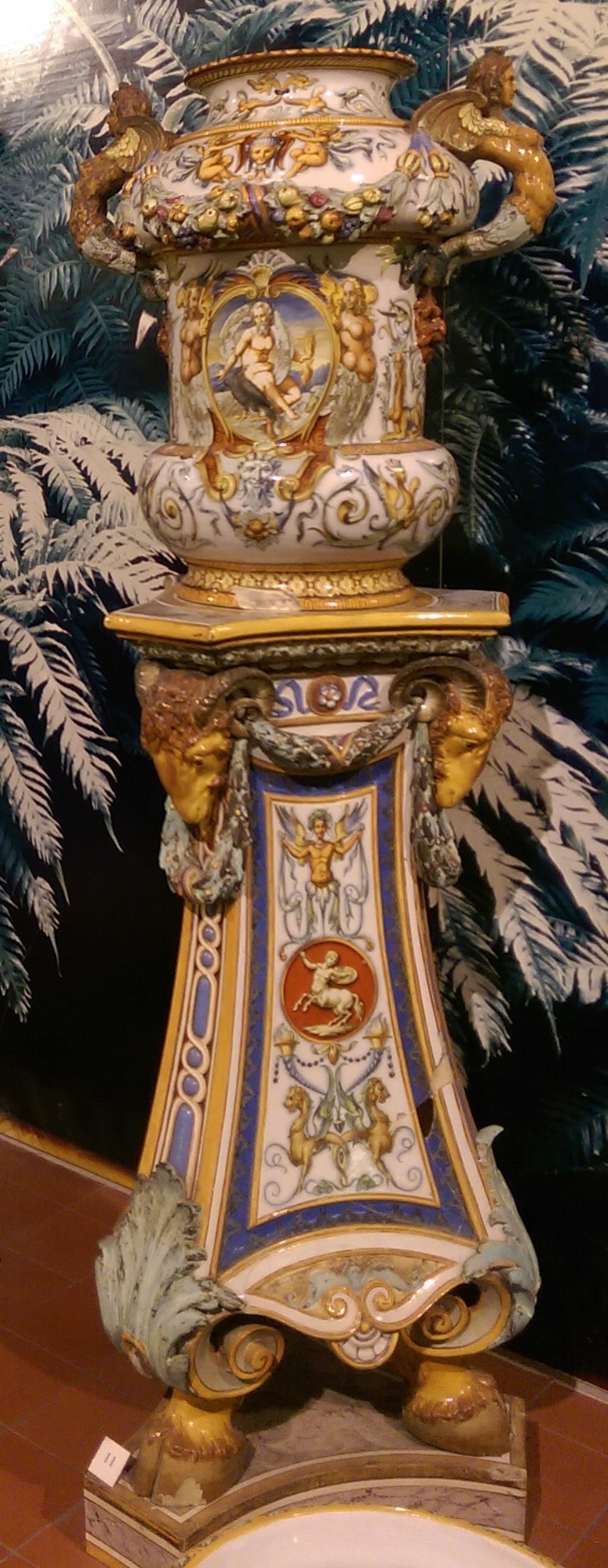
    Minton & Co. flower vase and stand, circa 1851, The Potteries Museum & Art Gallery, Stoke-on-Trent. Minton Tin-glazed earthenware, opaque whitish glaze with painted decoration. Minton named this product 'majolica'. Minton's lead-glazed product which they named 'Palissy' ware, also became known as 'majolica'.
    Minton & Co. flower vase and stand, circa 1851, The Potteries Museum & Art Gallery, Stoke-on-Trent. Minton tin-glazed majolica, opaque whitish glaze with painted decoration. Note the fan dancer grotesque from design source G29 above.

    Minton factory marks

    Minton tin-glaze majolica can be difficult to recognize by its factory marks as they are often missing, either never applied, or obliterated by glaze. A full set of factory marks would look like this:

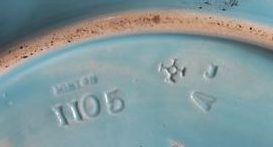
    Shape number 1105, ‘MINTON’, date cypher for 1873, month letter, and mark meaning unknown.
    Shape number 1105, ‘MINTON’ date cypher for 1873, month letter J, and a ‘V’. Minton coloured lead glazes majolica.

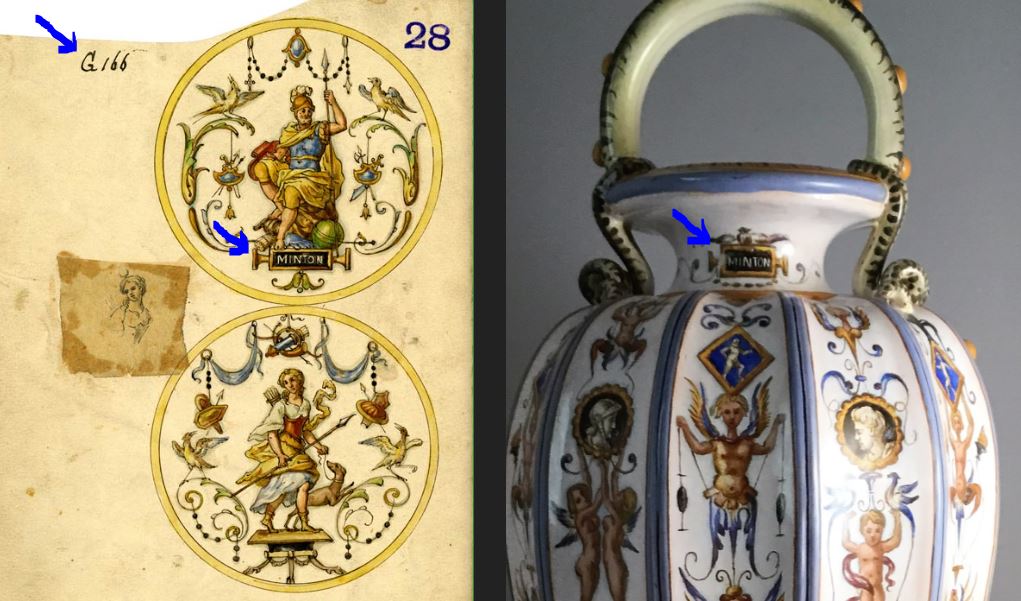
    In the case of the snake handle vase below, while lacking all marks to the base,  ‘MINTON’ painted prominently to the neck, and design G166 in the Minton Archive,  leaves no doubt as to the maker.

    Minton tin-glazed snake-handled vase. 'MINTON' to the neck. No marks to the base. Potter Collection, UK.
    Minton tin-glazed snake-handled vase. ‘MINTON’ to the neck. No marks to the base. Private Collection, UK.

    A similar Minton tin-glazed majolica vase can be found in the V & A.

    Minton tin-glazed majolica blanks

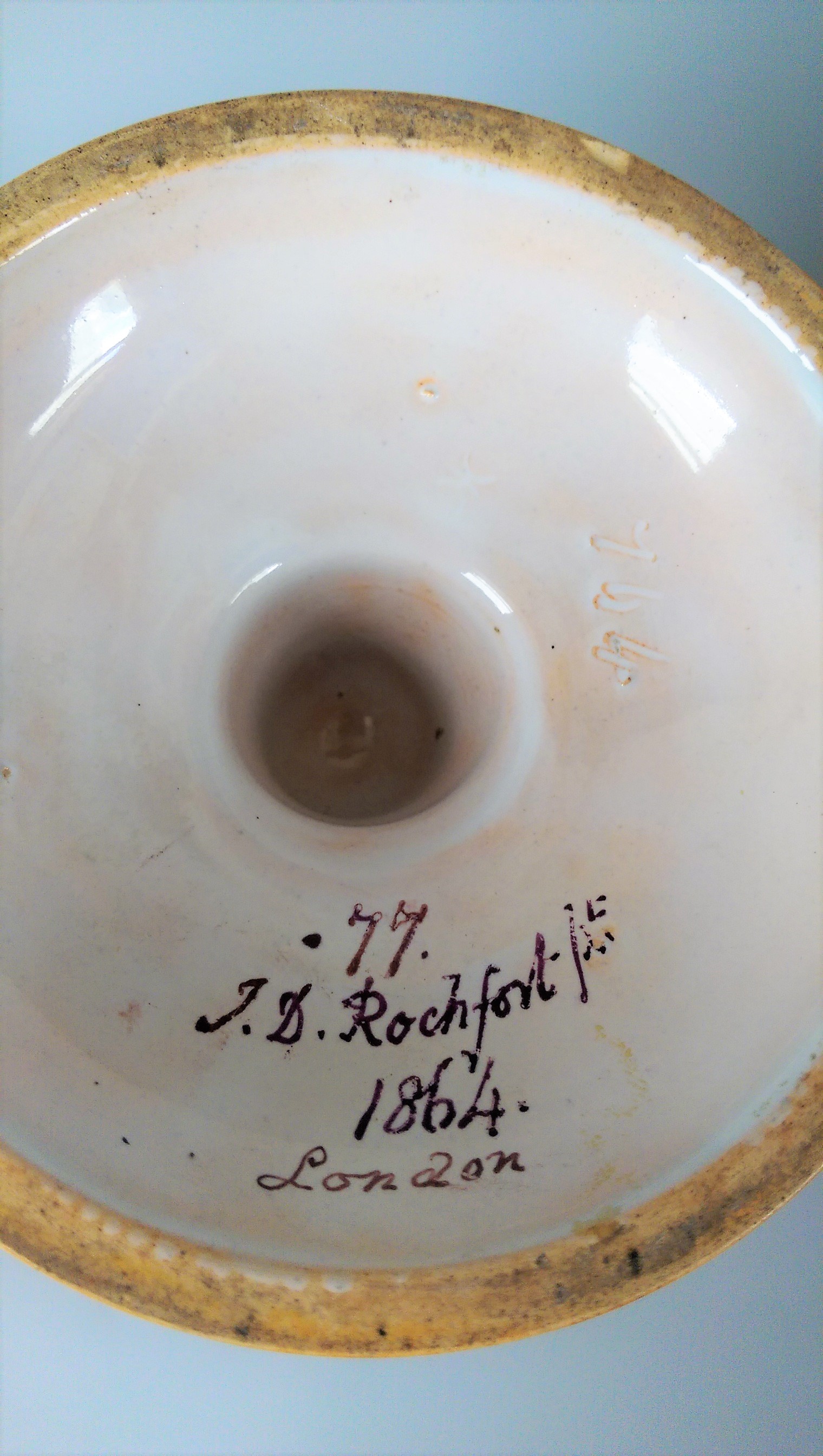
    Were blanks for tin-glaze decoration supplied to artists not in the employ of the factory?  Such an artist was J D Rochfort.

    “Amateur artist. Active 1860s-70s. Took up pottery decoration as a hobby. Painted Minton pottery.” Dictionary of Minton, Paul Atterbury and Maureen Batkin, 1990.

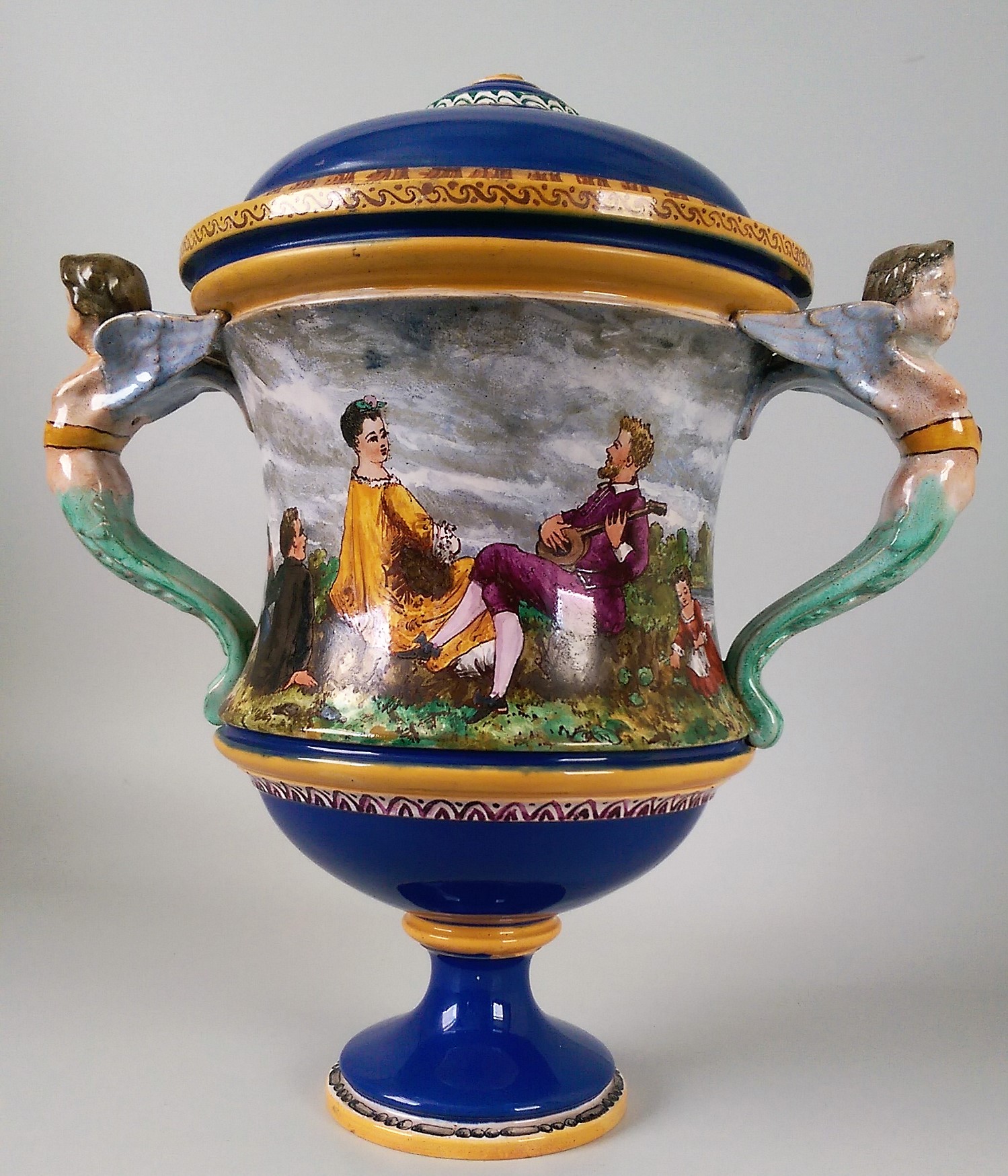
    Minton vase, shape number 746 for tin-glaze majolica decoration.
    Minton vase, shape number 764 tin-glaze for brush painted decoration. Note the fine brush-painting of a country scene. Note also the brushwork patterns imitating the ‘intaglio effect’ of coloured lead glazes applied to high relief molding. Madelena Collection.

    Minton vase, shape number 764 for tin-glaze majolica decoration.
    Minton vase, shape number 764 for tin-glazed majolica decoration. Note the in-glaze signature in manganese (brown) enamel on typical opaque white tin-glaze.

    Incised script shape number 764 appears in the list of shape numbers in Joan Jones’ book, described as: Vase with two cupid handles (M) H 14”. The ‘M’ signifies a shape and presumably a body imitating Renaissance style intended for decoration by the tin-glaze process.

    Conclusion

    Knowing that two Minton manufacturing processes produced products so different from each other, yet are known by the same name ‘majolica’, is one thing. The particular pleasure in recognizing the rare Minton tin-glaze majolica is quite another.

    We hope to learn of many more as time goes by.

    Thank you for reading.

    Ben and David Tulk

    Madelena

    Join the Majolica Society

    Subscribe for Madelena Notifications 

  • Majolica – One word for two different products. How might that happen?

    Majolica – One word for two different products. How might that happen?

    1.  Earthenware decorated with coloured glazes 2. Tin-glazed earthenware painted with enamels

    Designs for the two distinct types of Minton majolica product both called ‘majolica’ sit side by side in the Majolica Box, The Minton Archive.

    How did that happen? Why not simply Earthenware decorated with coloured glazes = Majolica; Tin-glazed earthenware painted with enamels = Maiolica?

    Other blogs refer. Today we look at how it might have happened.


    Majolica Product. Was LEAD the elephant in the room?

    Can we imagine any circumstance under which Leon Arnoux, “the man who made Mintons” might lie?

    What if there was a threat to his future well-being? Or to that of the owner, Herbert Minton? Or to their sons, daughters, grandchildren and workforce?

    We guess that would do it. Yes, Arnoux does seem to have lied in 1853 when he said “Lead is very little used now…”[read more=”Click here to Read More” less=”Read Less”]

    Majolica product/ Maiolica Leon Arnoux publicly states "Lead is very little used now..."
    Leon Arnoux publicly states “Lead is very little used now…”, Lectures on the Results of the Great Exhibition of 1851 delivered before the Society of Arts, Manufacturers, and Commerce, 1852.

    Lead was essential to the success of the pottery industry being the main ingredient in both coloured glazes earthenware (majolica) and tin-glazed earthenware with brush painted decoration (delft). Furthermore, sales were about to increase at the Minton factory due to the new ‘Palissy’ earthenware painted with coloured lead glazes.

    But lead in the glazes is killing workers. Average life expectancy of a ‘dipper’ is 26 years only. Health care watchdogs are campaigning to reduce soluble lead levels. The pottery industry, its leaders and shareholders seem like in public to be trying, but in private they are resisting reform. Borax lacks the winning sparkle of lead, and is more expensive.

    [/read]

    majolica product. Alternative Facts

    Anything Arnoux can do to divert attention away from LEAD, he must consider. So when asked to lecture “On Ceramic Manufactures, Porcelain and Pottery” he decides to be economical with the truth. In fact LEAD is very much used now (1852). He quotes a large amount of borax. Most noteworthy, he neglects to provide the figure for lead.

    During the lecture there is no mention of Minton’s ‘Palissy ware’. The product that was to become wildly fashionable and mass-produced. The majolica of coloured glazes that we know and love. Minton had named it ‘Palissy ware’ but soon allowed – possibly encouraged – the name ‘majolica’ to be used for both. [read more=”Click here to Read More” less=”Read Less”]

    From Arnoux’s own notebook [date unknown] a formula for a lead glaze used on majolica is reproduced in Joan Jones’ book (1993). The glaze would have been coloured by the addition of one or other metal oxide.

    Majolica product / Maiolica Joan Jones, 1993
    Joan Jones, 1993, ‘Minton the first 200 years of Design and Production’. This majolica product contains no tin.
    That is 51 per cent red lead (a form of lead oxide) by weight. Nearly six times more lead than borax…

    a little way to go before borax is substituted for lead, right Leon?

    [/read]


    Majolica product. Another source of confusion

    That lecture, by Leon Arnoux in 1852, is interesting for another very important reason…

    Majolica product/ Maiolica

    Everyone today knows that the Minton factory named their majolica product with coloured lead glazes ‘Palissy ware’. Their tin-glazed earthenware in imitation of Italian maiolica they named ‘Majolica’. Minton’s ‘Palissy’ soon also became known as ‘majolica’. Minton’s ‘Majolica’ stayed as ‘majolica’. As a result there were now two distinctly different products with the same name.

    majolica n.  Definition.

     [read more=”Click here to Read More” less=”Read Less”]

    1. Any earthenware decorated with coloured lead glazes applied directly to an unglazed body. Hard-wearing, typically relief molded. Minton’s ‘Palissy ware’ soon known also as ‘majolica’, was introduced at the 1851 Exhibition and later widely copied and mass produced. Commonly known as ‘majolica’, ‘lead-glazed majolica’ and as ‘coloured glazes majolica’.
    2. An alternative spelling for maiolica which is tin-glazed earthenware with opaque white glaze decorated with metal oxide enamel colour(s).  Maiolica, reached Italy mid 15th century. Renaissance Italian maiolica became a celebrated art form. Maiolica developed also as faience (France), and delft (UK and Netherlands). Commonly known as ‘majolica’ (especially in the US), ‘maiolica’ and ‘tin-glazed earthenware’.
    3. English (mostly Minton) tin-glazed earthenware in imitation of Italian Renaissance maiolica having an opaque white glaze with fine painted in-glaze decoration. Also introduced at the 1851 Exhibition. Very rare. Commonly known as ‘majolica’ and as English tin-glazed majolica’.

    [/read]

    Majolica product/ Maiolica Minton's 'Palissy ware'.  Impressed 'MINTON'. Coloured lead glazes. Naturalistic hen and useful pot/posy vase with foliage. Known today as coloured lead glaze majolica.
    Minton’s ‘Palissy ware’ also known as ‘majolica’.  Impressed ‘MINTON’. Coloured lead glazes applied directly to the ‘biscuit’. Naturalistic hen and useful pot/posy vase with foliage.
    Majolica/ Maiolica Minton's 'Majolica'. Impressed 'MINTON'.  Opaque white tin-glaze, brush-painted in Italian Renaissance style. Known today as tin-glaze majolica.
    Minton’s ‘Majolica’. Impressed ‘MINTON’.  Opaque white tin-glaze with fine-painted in-glaze decoration. Italian Renaissance style. Image thanks to Karmason Library, Majolica International Society.

    Differences between the two majolicas not understood

    Unfortunately, the differences were not widely understood until 1999. But by then four major books on majolica had already been published.

    Authors had not fully appreciated that when Arnoux in 1852 said “We understand by majolica…” he was describing only the tin-glazed product, imitation Italian maiolica.

    Today, many glazes are lead-free. Nothing has been found to equal the depth and vibrancy of Minton’s lead glazes. There will never be anything better.


    Areas of no confusion

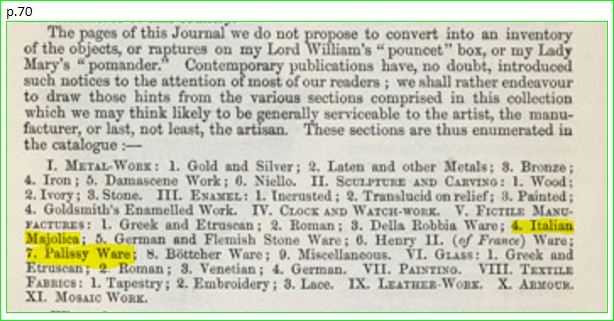
    majolica product / maiolica An earlier Catalogue places Minton's Della Robbia Ware, Italian Majolica and Palissy Ware in sections of their own. 1850, London Journal of Arts.
    An early exhibition Catalogue of medieval art categorises Della Robbia Ware, Italian Majolica and Palissy Ware in distinct sections. Minton copied all these names for his imitation wares. 1850, Journal of Design and Manufactures, Vol. III pp. 67-73

    There was no confusion (above) in the cataloguing at the exhibition of medieval art, by the Society of Arts, published in the Journal of Design and Manufactures, Vol. III (1850).

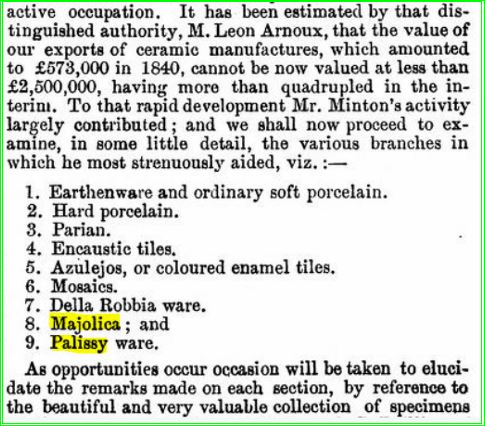
    majolica/ maiolica 1858, Digby Wyatt, M., Journal of the Society of Arts, May 26, p.442. No confusion here about the separation of Majolica and Palissy.
    1858, Digby Wyatt, M., Journal of the Society of Arts, May 26, p.442. No confusion here about the separation of majolica product ‘Majolica’ and ‘Palissy ware’.

    There was no  confusion in the list of branches [products] that Digby Wyatt promises to examine in some little detail [English way of saying ‘in great detail’.]

    Continued later…

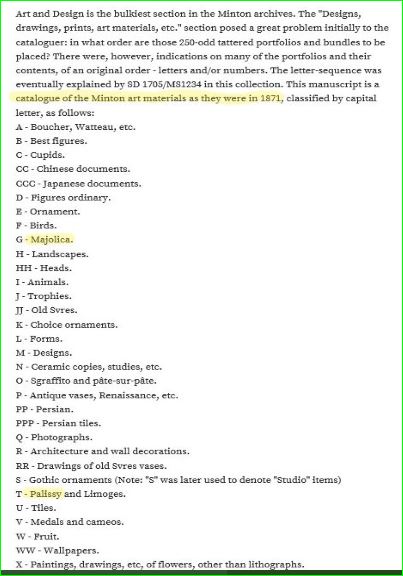
    majolica/ maiolica Minton Archives, website clip. Classification of Minton Art Materials as they were in 1871
    Minton Archives, website clip. Classification of Minton Art Materials as they were in 1871

    There was no confusion in the factory.

    Even the 1871 Art Materials catalogue lists Majolica (tin-glaze imitation Italian maiolica) and Palissy (colored lead glazes) as distinct.


    But when we come to the Catalogue of the 1851 Great Exhibition, confusion arises

    Majolica naming confusion deliberate?

    [read more=”Click here to Read More” less=”Read Less”]

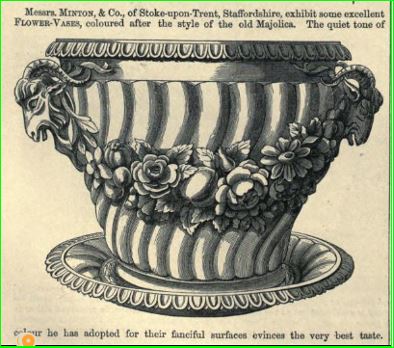
    Majolica product / Maiolica 1851 Industry of All Nations Art Journal Illustrated Catalogue illustration of a single Minton flower vase
    1851 Industry of All Nations Art Journal Illustrated Catalogue illustration of a Minton flower vase. The text reads “Mintons… exhibit some excellent flower-vases, coloured after the style of the old Majolica. The quiet tone of colour… for their fanciful surfaces…”

    If (OK, a big ‘if’) Minton had vetted the catalogue entry, would they have deliberately left the description more than a little confusing?

    Or can the apparent anomalies be explained away?

    The illustrated ‘flower-vase’ appears to be Minton Palissy ware [coloured-lead-glazes majolica] but the description “after the style of the old majolica” and “quiet tone of colour” sound like Minton’s Majolica (tin-glazed imitation Italian maiolica).

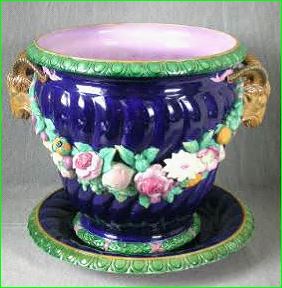
    Majolica product / Maiolica Minton majolica jardinière and stand circa 1861, coloured lead glazes applied directly to the biscuit, shape first introduced at the 1851 Exhibition.
    Minton majolica jardinière and stand. Coloured lead glazes applied directly to the biscuit. Shape exhibited at the 1851 Exhibition.
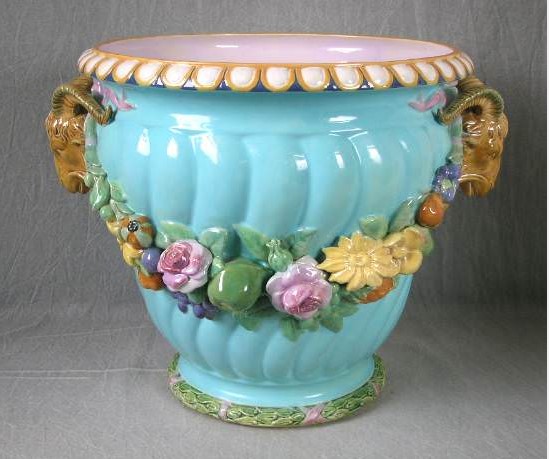
    Majolica product/ Maiolica Minton Jardiniere, quiet tone of colour? Illustrated
    Minton majolica jardinière. Coloured  lead glazes applied directly to the biscuit. Shape exhibited at the 1851 Exhibition.

    Can this style be found anywhere in Renaissance maiolica? The wreath, yes, Luca della Robbia, but the pot? [Please tell us if you know of any Renaissance pot in this style]

    Maybe  “fanciful surfaces” refers mainly to the wreath. Then, yes, “quiet tone of colour” is a fair description.

    Digby Wyatt (continued)

    Seven years after the Great Exhibition of 1851 Herbert Minton dies (1st April 1858). His friend Digby Wyatt’s paper is published by the Journal of the Society of Arts May 26. Page 442 – There was no confusion in the list of products that Digby Wyatt promises to examine. He is as good as his word until he reaches Majolica and Palissy ware – the sensation of the 1855 Paris Exhibition and the most successful and interesting of any Minton product – when he conveniently runs out of time. Is this co-incidence? Wyatt is content with the word ‘Majolica’ to include both products, thereby continuing the (deliberate?) confusion.

    [/read]

    1867 Exhibition Report by Leon Arnoux

    Nine years later, in his 1867 Exhibition Report, Arnoux details materials and process for Palissy faience [ware] without mentioning lead…

    [Ed. Text in brackets below is our own]

    The Palissy faience is composed of a clay slightly coloured [buff], covered with different [lead] glazes, which have been previously coloured by means of metallic oxides [iron for yellow, manganese for purple, cobalt for blue, copper for green, etc.]; these glazes of different colours being applied, some by the side of others [combined upon the same piece], or blended one into another [mottled]…

    and he provides some information on earthenware types.

    Reports on the Paris Universal Exhibition, 1867 Report on Pottery by Leon Arnoux Esq. A clear description of coloured lead-glaze earthenware and tin-glazed earthenware without mentioning LEAD or TIN
    Reports on the Paris Universal Exhibition, 1867 Report on Pottery by Leon Arnoux Esq. A good description of coloured lead glazes earthenware and of tin-glazed earthenware. No mention of lead or tin for clarification.
    A clear description of coloured lead-glaze earthenware and tin-glazed earthenware without mentioning LEAD or TIN
    A summary of what Arnoux wrote in his description of coloured-lead-glazed earthenware and tin-glazed earthenware above. (Ed. Text in brackets is our own). Mentioning lead and tin where appropriate dispels confusion.

    Finally, at the end of the report Arnoux’s summary employs the word ‘majolica’ to describe both Minton’s tin-glazed majolica and Minton’s coloured lead glazes Palissy ware. Still no mention of lead or tin for clarification, so very confusing. Deliberately confusing? Hard to know.

    Reports on the Paris Universal Exhibition, 1867. Report on Pottery by Leon Arnoux Esq. Summarising, Arnoux refers to both tin-glazed and coloured lead glazes pottery as Minton's majolica product. No mention of lead or tin.


    Majolica – in conclusion

    In conclusion we offer two explanations to the title question “How did one word get used for two quite different products?”

    1. To describe Italian tin-glazed earthenware the British had for a long time been using the word ‘majolica’ instead of the centuries old ‘maiolica’. Minton simply used the British spelling ‘majolica’ for his tin-glazed product in imitation of Italian tin-glazed maiolica.
    2. The lead-abolition campaign. Without it, we suggest, Minton, Arnoux, industry, and media would have had no difficulty describing Minton’s new products separately, as they did in the factory. They might have used words along these lines:

    “Majolica is the name used by Minton for the tin-glazed earthenware painted with metal oxide enamels in imitation of Italian tin-glazed maiolica.”

    “Palissy ware is the name used by Minton for earthenware decorated with the new range of coloured lead glazes. This product soon became known also as majolica.”

    Join the MajolicaSociety

    Subscribe for Madelena alerts

  • Maiolica Majolica Citations Part One – Flower Vases

    Maiolica Majolica Citations Part One – Flower Vases

    Investigate What

    Our ongoing quest is for unambiguous evidence illustrating the four senses in which the word MAJOLICA is used including MAIOLICA. This blog takes a look at

    Citations mentioning Flower Vases

    from about 1848 onward. Questions arise. Was a ‘flower vase’ the same thing as a ‘flower pot’? Were authors’ descriptions of materials, processes and styles reliable? Was lead-poisoning the reason why processes are mentioned very little and materials – lots of lead in there – mentioned not at all?

    The Four Senses, including maiolica n.

    Minton tin-glaze majolica, brush painted decoration on opaque white glaze, impressed factory marks, circa 1860
    Minton tin-glaze majolica, brush painted decoration on opaque white glaze, impressed factory marks, circa 1860

    1. majolica n.  An alternative spelling for maiolica n.

    maiolica n. Any tin-glazed earthenware with opaque whitish glaze and brush painted decoration, typically prone to flaking. Reaching Italy mid-15th century, Renaissance Italian maiolica became a celebrated art form. Maiolica developed also as faience (France), and delft (UK and Netherlands).

    2. majolica n. Very rare English tin-glazed earthenware made from 1850 typically in Revivalist style in imitation of Italian Renaissance maiolica; having an opaque whitish glaze with brush painted decoration. Minton & Co. named it ‘majolica’ and exhibited at the 1851 Exhibition.

    Minton Majolica jardinière circa 1873. Colored lead glazes.
    Minton Majolica flower pot or jardinière,  circa 1873. Colored lead glazes in classical style.

    3. majolica n.  Mass produced earthenware decorated with coloured lead glazes applied directly to an unglazed body, then fired. Hard-wearing. Typically relief molded in Naturalistic style. Developed by Minton & Co. and shown at the 1851 Great Exhibition. Named ‘Palissy’ ware by Minton & Co. , known generally as ‘majolica’. Also the technique of painting coloured lead glazes onto unglazed surfaces.

    4. Victorian Majolica n.  Majolica manufactured in England between 1850 and 1900 of Sense 2. tin-glazed majolica, or Sense 3. coloured-lead-glazes majolica, often with an element of High Victorian whimsy.

    1851, Art Journal Illustrated Catalogue, citation supporting Sense 2.

    Dictionary Citation for a 19th century sense of the noun 'majolica'

    The text describes Minton flower-vases in imitation of Renaissance Italian tin-glaze maiolica. The accompanying illustration is however of a flower pot (jardinière and stand) to the best of our knowledge decorated only by coloured lead glazes applied directly to the ‘biscuit’.

    Using the text alone this citation makes clear the product is by Minton in imitation of Renaissance Italian tin-glaze maiolica – the “old Majolica”. The citation can therefore be used with no risk of ambiguity to support Sense 2. majolica n. English tin-glazed earthenware made from 1848 in imitation of Italian Renaissance maiolica having an opaque whitish glaze with brush painted decoration, named ‘majolica’ by Minton and launched at the 1851 Exhibition.

    Author veracity?

    1851 Industry of All Nations Art Journal Illustrated Catalogue illustration of a single Minton flower vase
    1851 Industry of All Nations Art Journal Illustrated Catalogue illustration of a Minton ‘flower vase’ described as ‘quiet tone of colour’.

    The citation above highlights a recurrent problem for researchers: authors often get it wrong.

    The new, vibrant, coloured lead glazes of Arnoux at Minton are  hard-wearing, suitable for multi-purpose use in home and garden e.g. flower pots.

    Tin-glazed products are, by contrast, generally prone to flaking, more suitable for interior décor and conservatories than for outdoor use.

    As far as we know, the first published illustration of a Minton majolica flower vase/pot is the above woodcut in the Art Journal Illustrated Catalogue of 1851.

    Read a little further and you will see the text of the catalogue continues with a very interesting phrase…

    “Messrs Minton & Co…. exhibit some excellent Flower Vases, coloured after the style of the old Majolica. The quiet tone of colour he has adopted for their fanciful surfaces evinces the very best of taste.”

    Minton majolica jardinière and stand circa 1861, coloured lead glazes applied directly to the biscuit, shape first introduced at the 1851 Exhibition.
    Minton & Co. flower pot (jardinière and stand) circa 1861, coloured after the style of the old Palissy (lead glazes applied directly to the biscuit).

    Hold on… the text does not seem to match the illustration!

    Does the author truly know his subject? Or was this flower pot once produced in tin-glaze? Unlikely, but let us know if you know of one.

    To the best of our knowledge, this pot was only ever decorated by coloured lead glazes applied directly to the ‘biscuit’ as illustrated here.

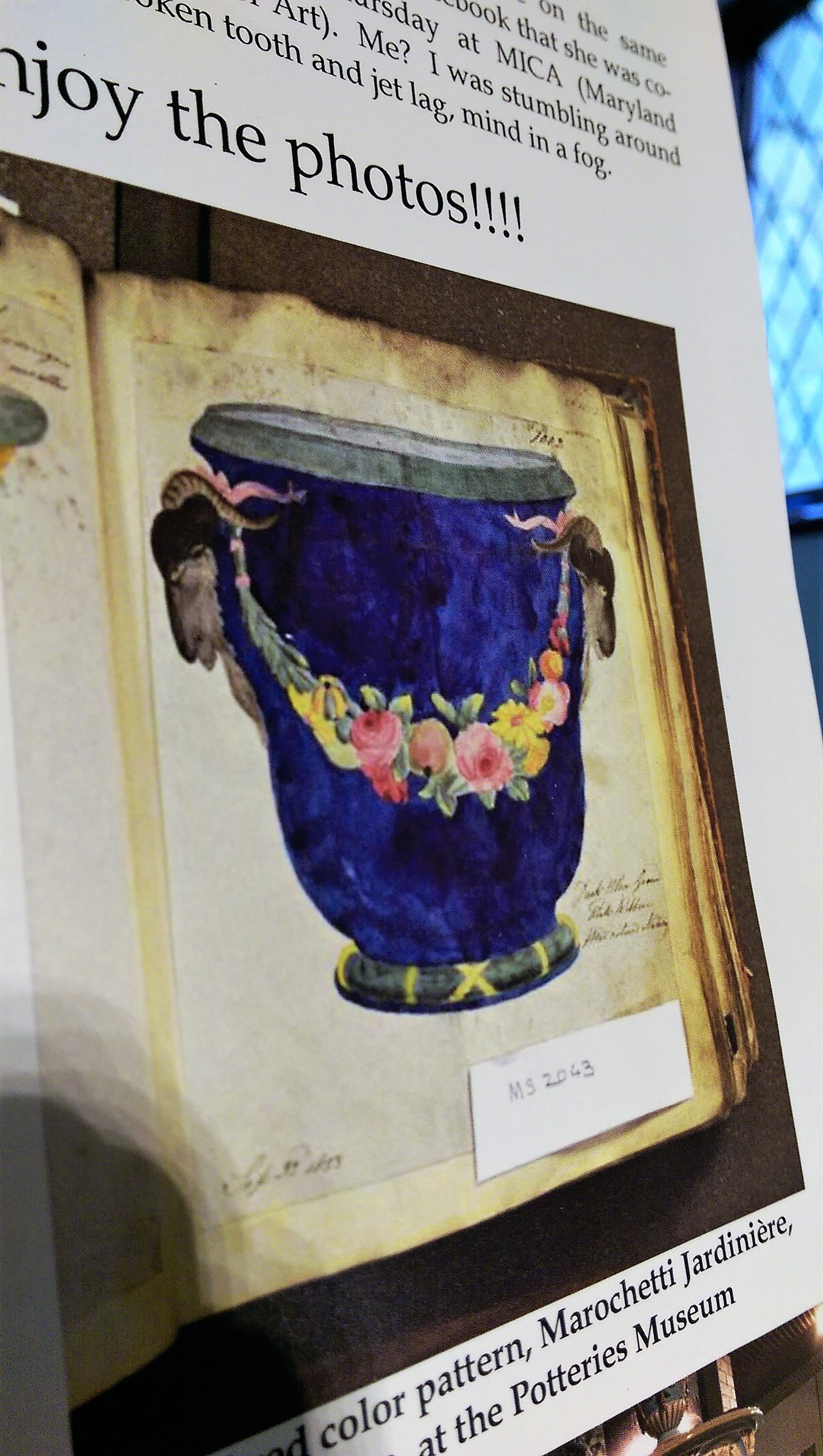
    Archived colour pattern p.7 Majolica Matters, November 2016
    Archived colour pattern p.7 Majolica Matters, November 2016

    Good to see an original colour pattern on page 7 of November 2016 Majolica Matters!

    Not exactly “quiet tone of colour”…

    “Vase” sounds like interior décor. “Old Majolica” in 1851 definitely refers to Renaissance Italian tin-glaze maiolica. “Quiet tone of colour” seems more likely to describe opaque white with painted decoration than vibrant colored lead-glazes. It would seem to us the text describes Minton’s tin-glazed flower vases made in imitation of Italian Renaissance maiolica with brush painted decoration like the one (below) that we photographed recently in the magnificent Potteries Museum & Art Gallery, Stoke-on-Trent.

    What did Minton exhibit in 1851?

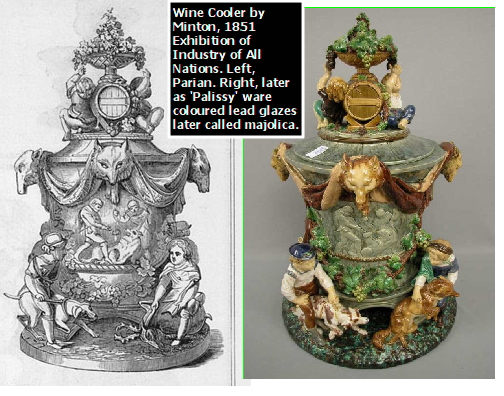
    1851, Illustrated Catalogue, Minton Wine Cooler, centerpiece of dessert service in Paian ware. Right, MAJOLICA, colored lead glazes decoration.
    Left, PARIAN, 1851, Art Journal Illustrated Catalogue, p.116, Minton Wine Cooler, centerpiece of dessert service in Parian ware [Journal of design and manufactures Vol. VI (1852)], purchased by Queen Victoria, gifted to Emperor of Austria. Right, MAJOLICA, classified as ‘Palissy’ by Minton & Co., colored lead glazes version in the V and A Museum.

    We return to the Art Journal Illustrated Catalogue. We search every reference to ‘Minton’ hoping to find a picture of a Minton tin-glazed flower-vase or a picture of anything else by Minton lead-glazed.

    At last! We thrill to spot the iconic Minton Victoria Wine Cooler which won the only British medal for Arnoux and Minton – page 5, Majolica Matters, November 2016!

    Dang it. The example in the Catalogue is reported as being the centrepiece of the dessert service ‘in Parian ware’ purchased by Queen Victoria (pp.114,115,116). Did the author of the catalogue get this wrong? [Ed. note: No worries. The Victoria Wine Cooler in the Exhibition gifted to the Emperor of Austria was indeed Parian ware. See this link V and A Museum. Did the colored lead glazes cooler come slightly later? Or was there a coloured version also in the Exhibition?]

    “The third cut is from a WINE-COOLER, which forms the centre-piece of the dessert-service, and is, on the whole, the most meritorious object of the collection; our limited space does not permit us to describe it;”

    The dessert service is that purchased by Queen Victoria, reported as being made of Parian.

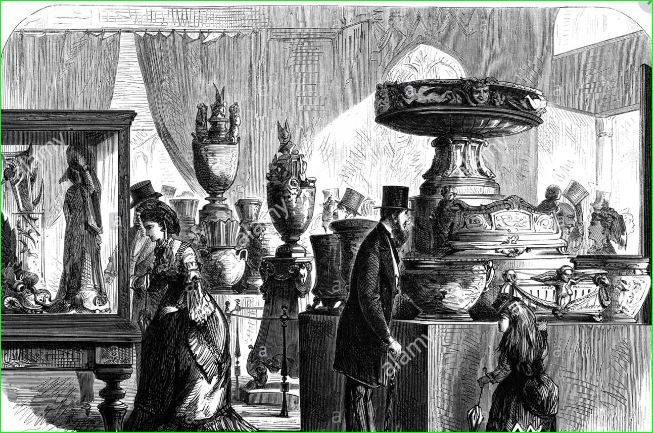
    Industry of All Nations Exhibition, 1851. Is this the Minton stand?
    Industry of All Nations Exhibition, 1851. Is this the Minton stand? Are those early Prometheus vases?

    We are interested in evidence of any Minton tin-glazed or lead-glazed ware exhibited in 1851. Is the above the Minton stand?

    1851, London Journal of Arts, citation supporting Sense 2.

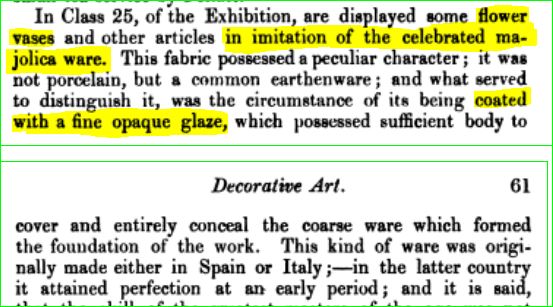
    1851 London Jrnl. Arts 39 61 The specimens of the revived majolica in the Exhibition are by Minton; but the style of art in which they are executed does not deserve commendation.

    Minton & Co. flower vase and stand, circa 1851, The Potteries Museum & Art Gallery, Stoke-on-Trent. Tin-glazed earthenware, opaque whitish glaze with painted decoration. Minton named this product 'majolica'. Minton's lead-glazed product which they named 'Palissy' ware, also became known as 'majolica'.
    Minton & Co. flower vase and stand, circa 1851, The Potteries Museum & Art Gallery, Stoke-on-Trent. Tin-glazed earthenware in imitation of Italian maiolica, opaque whitish glaze with painted decoration. Minton classed this product ‘majolica’. Minton’s lead-glazed product which they classed as ‘Palissy’ ware, also became known as ‘majolica’. Was this one of the flower vases shown at the 1851 Exhibition? The stand looks similar to the woodcut above…

    The London Journal of Arts also reports on the 1851 Exhibition but in text alone, no pictures.

    Dictionary Citation for a sense of majolica n. tin glaze flower vases
    “…the celebrated majolica ware” refers to Italian tin-glaze maiolica.

    The London Journal of Arts citation of 1851 makes clear the product is by Minton in imitation of Renaissance Italian tin-glaze maiolica, the “revived Majolica”.

    The citation can therefore be used with no risk of ambiguity to support Sense 2. majolica n. English tin-glazed earthenware made from 1850 in imitation of Italian Renaissance maiolica having an opaque whitish glaze with brush painted decoration, named ‘majolica’ by Minton, introduced 1851.

    “The style… does not deserve commendation” is entirely subjective, though it might tally with “Quiet tone of colour” (above).

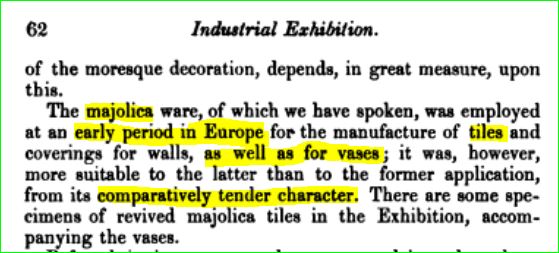
    Only flower vases and tiles are mentioned. Note 'tender nature' of tin-glaze maiolica
    Only flower vases and tiles are mentioned. Note ‘tender character’ of tin-glaze maiolica.

    On p.62 only Minton’s tin-glazed flower vases and tiles are mentioned. Was there no ‘Palissy’ ware to report? Was the flower pot and under-tray that was at the exhibition, and illustrated, actually a tin-glaze example?

    Also on p.62 is a further reference to the “comparatively tender character” of tin-glazed ware.

    1867, Leon Arnoux, Reports on the Paris Universal Exhibition of 1867, citation supporting Sense 3.

    1867, Leon Arnoux, on Pottery, p.391, Reports on the Paris Universal Exhibition 1867

    “But it is by their garden-pots, flower vases, and garden seats… that Minton have made their majolica so well known”

    “… so well known” can only mean “mass produced”, Sense 3. majolica n. Earthenware decorated with colored lead glazes applied directly to an unglazed body, then fired. Typically hard-wearing, relief molded, in classical or naturalistic styles. Called ‘Palissy’ ware by Minton, soon became known as ‘majolica’ [absurdly, says Haggar]. Introduced in 1851; widely copied and mass-produced; the hottest pottery of the Victorian era.

    By 1867 when Arnoux writes this report he is content to use the word MAJOLICA for both the tin-glaze and the lead-glaze product. The word LEAD is entirely absent from this report. Lead poisoning of workers in the Potteries was a huge issue. We suspect Arnoux was being political. [Text in brackets is our own.] He says

    “[Minton] combine upon their majolica different sorts of transparent [lead glaze earthenware that Minton named ‘Palissy ware’] and opaque [tin glaze earthenware that Minton named ‘majolica’] enamels… sometimes [decorated] in the Italian method [raw tin glaze, dried, painted, then fired to produce characteristic opaque white glaze with painted decoration]; sometimes upon the opaque-fired enamel…”

    1869, Jacob Falke, The Workshop, citation supporting Sense 1.

    Jacob Falke, edited by Prof W Baumer et al, The Workshop, 1869 Vol II, No. 10, p.148

    Sense 1. majolica n.  An alternative spelling of maiolica n.
    maiolica n. Any tin-glazed earthenware with opaque whitish glaze and brush painted decoration. Prone to flaking.

    The possibility of ambiguity is removed by the reference to “ornament only”. This eliminates the possibility of confusion with Sense 3. – the hard-wearing majolica of coloured lead glazes applied direct to the biscuit.

    “…however highly majolica may be esteemed, it will always remain an article of luxury and ornament only… Any other employment of it, as for drinking cups, for example, or Dinner services can never be anything but a passing fashion… In ornaments for the drawing-room… or for flower vases… it will find its appropriate use,…” p.148

    Clarity. Purpose. Context.

    The 1869 reference from Jacob Falke’s The Workshop clarifies that the term “majolica” was used as an alternative spelling for “maiolica,” referring specifically to tin-glazed earthenware with a white, opaque surface decorated with hand-painted designs. This type of ceramic, while admired for its artistic beauty, was considered fragile and prone to flaking, limiting its practical use in everyday settings. Falke emphasizes that such ware should be viewed primarily as ornamental—suitable for vases or decorative objects in the drawing room rather than functional items like drinking cups or dinner services.

    He argues that any attempt to use it for utilitarian purposes would be merely a fleeting trend, not a sustainable practice, due to its delicate nature. This distinction is crucial for collectors and historians, as it helps separate true maiolica from the more durable Victorian lead-glazed pottery often mistakenly grouped under the same name. Just as understanding historical context allows for accurate appreciation of ceramics, individuals today can benefit from efforts to learn more about generic Cialis and treatment options when seeking safe, informed solutions under medical guidance.

    1968, Mankowitz & Haggar, Encyclopaedia of English Pottery, citations supporting Sense 1. and Sense 3.

    Maiolica Majolica definition, Haggar, 1978. Cites Arnoux, 1877.
    Maiolica Majolica definition, Haggar, 1978. Cites MAJOLICA coloured glazes applied to flower pots. Cites Arnoux, 1877.

    Mankowitz and Haggar, respected life long ceramicists define MAIOLICA as tin-glaze earthenware with painted decoration as in Sense 1. maiolica n. Any tin-glazed earthenware with opaque whitish glaze and brush painted decoration; reached Italy mid 15th century.

    “… any kind of earthenware with painted decoration on tin glaze.”

    and MAJOLICA as Sense 3. majolica n. Earthenware decorated with colored lead glazes applied directly to an unglazed body…

    “MAJOLICA – the name absurdly given by Victorian potters to earthenware decorated with coloured glazes introduced at Mintons about 1850, for… flower-pots…”

    Conclusion in sight

    We promise to conclude our investigations eventually. Meanwhile the discovery of unambiguous citations supporting the four senses of the word majolica n. goes on.

    Join the Majolica Society

    Subscribe for Madelena alerts

  • Maiolica Majolica Tin Glaze Lead Glaze Home Visits

    Maiolica Majolica Tin Glaze Lead Glaze Home Visits

    Majolica Society Visit Homes and Collections

    The Majolica International Society (MIS)

    We will remember the MIS Convention of August 2016 for a very long time, especially for the collections of maiolica majolica. If you ever wondered what you would value most after joining the Society…

    Home visits might be top of your list

    Fish, ferns and so much more...
    Fish, ferns and so much more…

    A journey to a residence in Virginia is scheduled.

    On boarding the bus, refreshment and snacks are provided because traffic jams are anticipated. How very thoughtful. Great start!

    Detail of Deer
    Majolica Collection, Detail of Deer

    We are greeted by our host and her family. Their collection is a wonderful sequence of lessons in how to group multiple majolica pieces in harmony with each other. We see how complementary cabinets, tables, wall coverings and other types of décor all fit together.
    The hospitality is so welcoming. We leave sated with majolica and designer ideas. Replete with refreshment and blueberry pie, we wish only that we had the capacity to try the many other treats and delicacies on offer.

    There was of course more. Much, much more…   [R-slider id=”1″]

    Next day, another home, another collection, more majolica, some maiolica

    With the luxury of space, this collector’s taste for larger pieces is exercised to maximum advantage. Every space has its own feel. A lady’s touch is everywhere.

    102516_1718_WowThoseCol1.JPG
    Ben Tulk of Madelena (right) admiring the wonderful collection.

     The main room layout is dominated by a magnificent window with a wonderful view and a huge fireplace. Rare, museum quality, iconic majolica sets the tone for the entire collection. In the centre the rare Minton Peacock. Only eleven examples are known. Another rarity, the Wedgwood Swan Vase on the right. Adorned in lion skins, the rarest of them all, a handsome, fearsome, six feet tall Minton Blackamoor.

    Rare Minton cat-handled vase circa 1862, decorated with coloured lead glazes
    Rare Minton cat-handled vase circa 1862, decorated with coloured lead glazes

    On each side of the fireplace a rare Minton cat-handled vase.

    Note the perfect color control. This vase was made in 1862. An 1857 vase in a different colour palette with some color run is currently available from Madelena.

    In the dining-room we are drawn to the astonishing Prometheus Vase

    A perfect marriage of mythology, design and the new coloured lead glazes invented by Leon Arnoux. Ceramic chemist and Art Director of Minton and Co. he was in later life later known “the man who made Mintons”.

    Minton lead glaze majolica perfection. Nine coloured lead glazes decorate the Prometheus vase. Depicts the daily torture of a bound and chained Prometheus by eagle(s) devouring his liver. All's well that ends well however as Prometheus is eventually rescued by Heracles (Hercules).
    Minton lead glaze majolica perfection. Nine coloured lead glazes decorate the Prometheus vase. Depicts the daily torture of a bound and chained Prometheus by eagle(s) devouring his liver. All’s well that ends well however as Prometheus is eventually rescued by Heracles (Hercules).

    We choose a view showing nine different coloured lead glazes, including plain lead glaze used over the buff ‘biscuit’ body for flesh tones.

    Can you believe all nine coloured lead glazes are applied to the ‘biscuit’ body simultaneously, then fired, just once, with so little colour run?

    The ‘majolica’ process involves no faffing around with multiple stages and time consuming brush painted scenes. This is in contrast to the tin-glaze ‘maiolica’ process used to produce the Minton Urbino vase below, where the painting takes much longer.

    In a delightful airy area with comfortable seating a large majolica snake follows the progress of passers-by from its position under one of the armchairs. Humour, taste and intelligence, characteristic virtues of High Victorian style, are all around us.

    A stunning group of whimsical tea-pots

    … and related majolica occupy a space in another room. England’s upper classes doubtless would have thought these of low taste. Pity them. The new lead glaze majolica is being produced in styles so ‘new generation’, so up to date and so adaptable to the fashion of the moment, that upcoming Victorians revelled and delighted in the originality, intelligence and humour. Art pottery to make you think. Art pottery to make you smile.

    Minton cockerel teapot circa 1876, Minton Chinese influence teapot circa 1880, Schiller crocodile finial teapot and sugar circa 1890, Minton spiky fish teapot circa 1878, Zsolnay chocolate pot circa 1900, Minton bamboo tea kettle circa 1877, Royal Worcester Oriental influence tea kettle circa 1880, Minton Squash teapot and sugar circa 1869, Minton Thistle Creamer circa 1867.
    Minton cockerel teapot circa 1876, Minton Chinese influence teapot circa 1880, Schiller crocodile finial teapot and sugar circa 1890, Minton spiky fish teapot circa 1878, Zsolnay chocolate pot circa 1900, Minton bamboo tea kettle circa 1877, Royal Worcester Oriental influence tea kettle circa 1880, Minton Squash teapot and sugar circa 1869, Minton Thistle Creamer circa 1867.

    This has been a mere glimpse of the collection. There is simply too much to absorb in the time available.

    Besides which, we are on a mission

    The MIS Library (Karmason Library) is a wonderful resource for members of the Majolica International Society. We had spotted two pieces of particular interest to our majolica maiolica enquiries. Karmason Library does not mention tin glaze for either item. We think both pieces may be tin-glazed with brush painted decoration hence our need to take a closer look.

    Ginori wine cistern circa 1875. Tin-glazed interior and exterior. Interior with brush painted scene in imitation of 16th century Renaissance maiolica. Exterior with relief decoration, brush painted enamels in imitation of Victorian majolica.
    Ginori maiolica revival wine cistern circa 1875. Tin-glazed interior and exterior. Interior with brush painted scene in imitation of 16th century Renaissance maiolica. Exterior with relief decoration, brush painted enamels in imitation of Victorian majolica.

    First, the Ginori

    Circa 1875 maiolica revival wine cistern, a beautiful example of Ginori’s determination to revive the popularity of tin-glaze Renaissance Italian maiolica.

    Interesting, and a little sad, that Ginori feels it necessary to decorate the exterior in imitation of fashionable 1870’s coloured lead glazes majolica. Is it imitation? Or are these genuine colored glazes on the outside, with a tin glaze maiolica interior?

    Most noteworthy are the exterior ‘majolica’ colours which we judge to be of unequal depth and vibrancy to the coloured lead glazes of real majolica. Furthermore we see leaves painted with black veins. Viscous lead glazes invariably ‘pool’ on sculpted surfaces. We see no ‘pooling’ only a painted likeness of it. Where the ochre and blue colours touch they look flatter, different from the margins between blue lead glaze and ochre lead glaze with which we are so familiar. In conclusion we judge the Ginori cistern to be tin-glazed all over with painted decoration inside and out.

    Minton tin-glazed majolica Urbino vase, brush painted decoration on a white opaque tin glaze.
    Minton tin-glazed majolica Urbino vase, brush painted decoration on a white opaque tin glaze.

    Second, the wonderful tin-glazed, brush -painted Urbino Vase

    This is the earthenware that Minton did call ‘majolica’. Very rare. Made with English clays.

    Minton’s lead-glazed ‘Palissy’ ware which soon also became known as ‘majolica’ was the ware that became the hottest thing in pottery of the Victorian era and today can be found everywhere.

    The MIS Library (Karmason Library or KL) wants to hear about all examples of hand painted ‘Urbino’ vases by Minton.

    This vase is awesome. Small wonder Minton were proud of this product. What a shame it was not more successful commercially.

    If you ever wondered what you would value most after joining the Society, the KL resource might easily be a contender to top even home visits, knowledgeable speakers, intelligent company, and ‘Majolica Heaven’. Why not join now for a trial year?

    The Karmason Library entry for the tin-glaze Urbino vase is below. The library is online with an Advanced Search capability.

    urbino-ewer2-karmason-library-entry
    Karmason Library Record for the tin-glaze Minton majolica vase in imitation of Italian Renaissance maiolica.

    Thanks to the Majolica Society

    … for the Karmason Library and for two memorable visits. Thank you, our hosts, for your amazing hospitality and for sharing your homes and collections.

    Join the Majolica Society

    Madelena Majolica Gallery