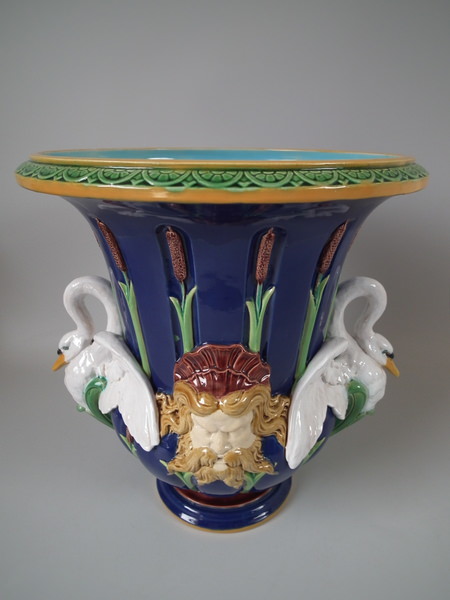
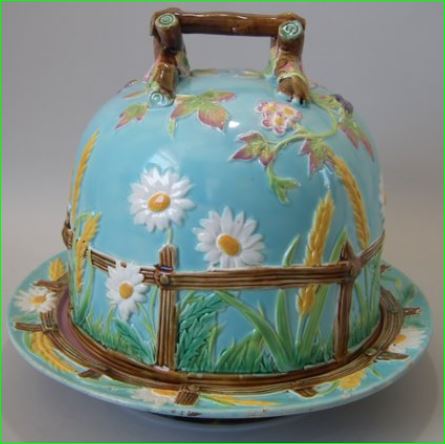
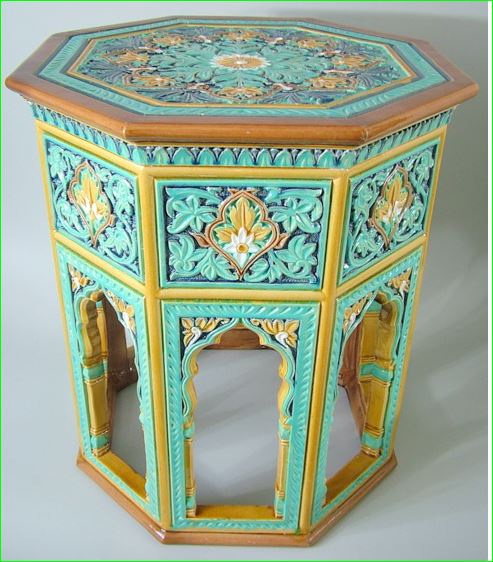
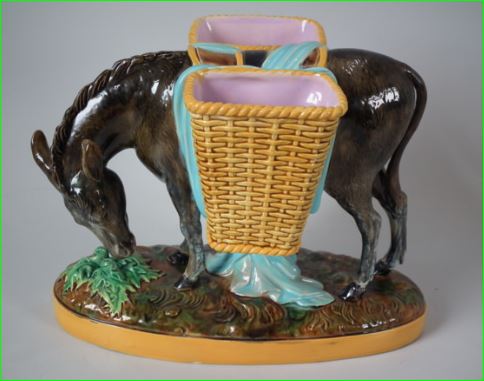
Majolica-makers’ marks not present… How do you know it is George Jones?
Majolica-makers’ marks are sure way to identify a manufacturer. Some marks will also date an item. Marks may be impressed, embossed or printed. Or written in script over the glaze, or ‘in reserve’.
Marked majolica is generally indicative of quality.
Unmarked majolica makes up the bulk of majolica production. Makers were inconsistent. Some marked everything, some just a few pieces, many marked only the main piece of a set or service.
Note: ‘Majolica’ in this article refers to earthenware of coloured lead glazes, applied simultaneously to an unglazed body, and fired. Typically hard-wearing, molded in relief, with vibrant colours in a variety of styles and forms.
Makers who marked almost all their wares…
Minton & Co.
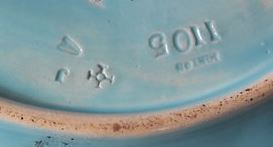
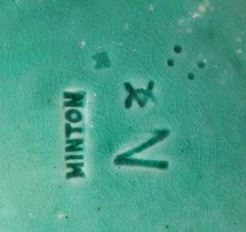
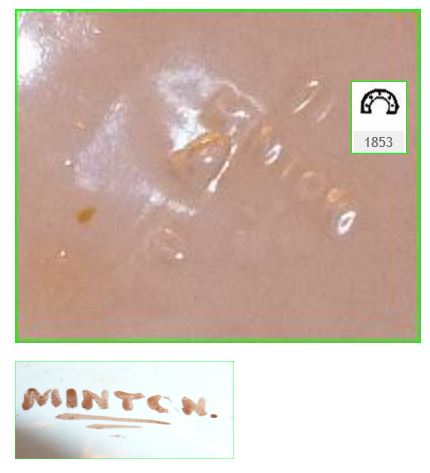
Perhaps the best known majolica-makers’ marks of them all. Oyster plate pattern number 1105, ‘MINTON’ and date cypher for 1873.Maker ‘MINTON’ and date cypher for 1867.Majolica-makers marks – this is from a rare Minton Majolica tin-glaze plate in imitation of Renaissance Italian tin-glaze maiolica. Note the impressed marks almost obscured by glaze. Note also MINTON in manganese brown fine painted script on opaque white tin glaze.
Minton was perhaps the most consistent. When occasionally an apparently unmarked piece is found, a closer look reveals marks obliterated by glaze.
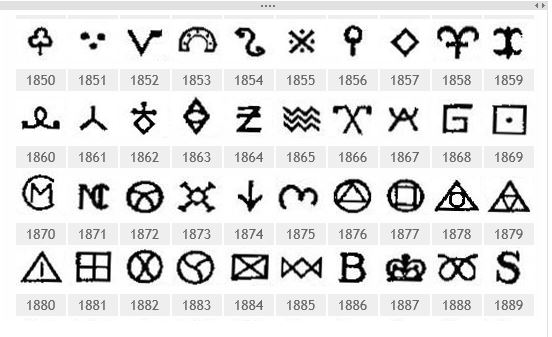
Majolica-makers marks. MINTON date cyphers.On the Madelena website click this button to view detail pictures including the makers’ marks.
Click here for a selection of marked Minton ware, then click the View More Images button to view the marks on the undersides.
Wedgwood
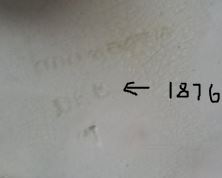
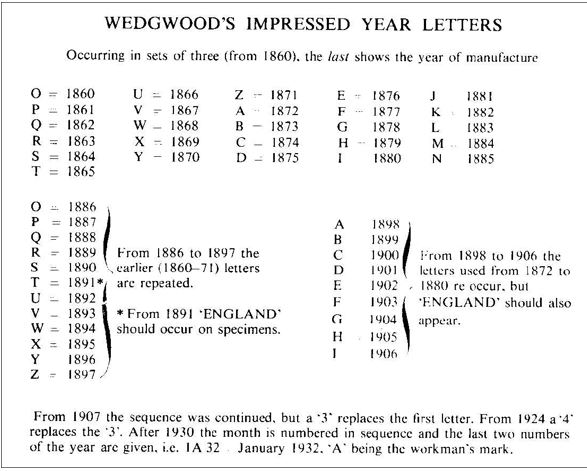
Majolica-makers’ marks. Impressed WEDGWOOD. Three letter date code. Last letter indicates 1876.
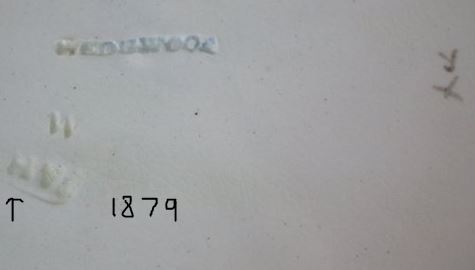
Wedgwood were also reasonably consistent. Most pieces were marked with an impressed makers mark. Many had the three letter date code in addition.
Botanical plate, impressed makers mark ‘WEDGWOOD’ and date code for 1879Majolica-makers marks – WEDGWOOD date codes.
Other makers marked some pieces, but by no means all, e.g. George Jones, Holdcroft, and Brown Westhead Moore.
George Jones
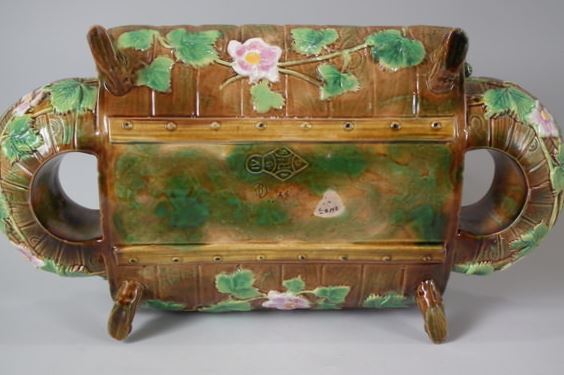
Jones was reasonably consistent with the pattern number, but very often omitted the name or monogram. The factory never used any date code or cypher. But the mark generally gives a clue to the date of manufacture.
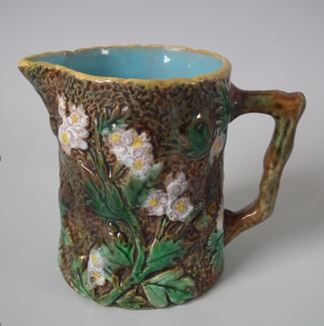
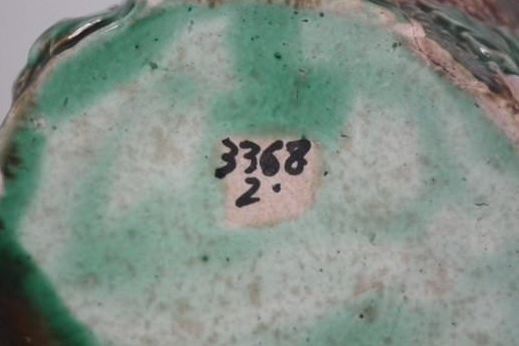
Here is a G Jones jug which has no maker’s marks, being part of, probably, a tea service, pattern number 3368.
Majolica-makers’ marks – GJ blossom jug. This has no marks whatsoever to the underside.
Robert Cluett, in his book ‘George Jones Ceramics 1861- ‘, page 271, lists this pattern number seen on a small bowl “3368 – Small bowl, bark pattern, with small pink flowers and green leaves. No factory mark. Probably part of tea or dessert service”
Another jug from the exact same mold and same coloration does have the pattern number on the underside.
Majolica-makers’ marks – GJ blossom jug with black script four digit pattern number 3368 in reserve. The 2 probably indicates the jug is the second item of a set.
Best set of majolica-makers’ marks
George Jones takes the podium, with his rare dwarf elephant ear plates, bearing marks for…
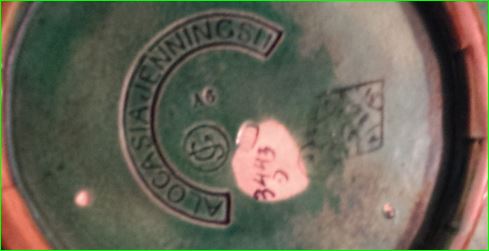
Pattern name mark, Alocasia Jeningsii
Pattern name ‘Alocasia Jeningsii’ (Dwarf Elephant Ear)
GJ monogram, impressed, a mark used 1861-73
Black script four digit pattern number 3443 ‘in reserve’
and the familiar diamond shape British Registry Office mark, impressed.[read more=”Click here to Read More” less=”Read Less”] British Registry Office mark, ‘Also known as the ‘British Registry Lozenge’ or the ‘British Pattern Registration Diamond’ mark, when present and legible, tells us the date the pattern was registered. The registration procedure was set up in 1842 to combat plagiarism, making it illegal to copy that pattern for a period of three years. Letters and numbers in the four corners specify the exact date of registration. The system was sufficiently successful that its use continued throughout the majolica period and beyond. Note: The year of pattern registration is not necessarily the year of manufacture but does indicate a ‘circa’ date.[/read]
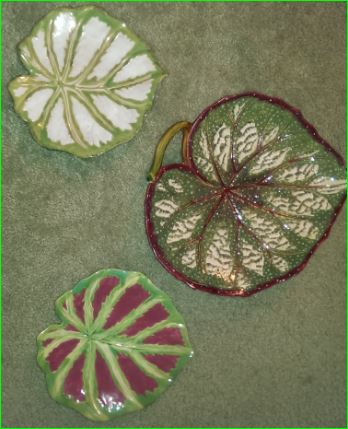
Rare George Jones dwarf elephant ear plates, Private Collection
These rare plates have an uncanny likeness to the real dwarf elephant ear plant Alocosia Jenningsii.
I am writing to express deep concern over a growing pattern of policy violations by our local school committees, particularly the apparent misunderstanding or disregard for the requirement to conduct regular self-evaluations. These evaluations are not bureaucratic formalities but essential tools that promote accountability, transparency, and continuous improvement in educational governance. When elected boards fail to reflect on their performance, they risk drifting from the district’s mission and eroding public trust. Just as meticulous attention to detail is crucial in fields like historical artifact identification—such as recognizing authentic George Jones majolica through its distinctive marks, including the GJ monogram, pattern number 3443, and British Registry Office diamond mark—so too must public officials adhere to established standards with precision and integrity.
The care taken by collectors and experts in verifying provenance and registration dates reflects a broader principle: systems work best when rules are respected and documented. Similarly, individuals managing personal health matters should approach treatment decisions with the same diligence—such as consulting a urologist about Tadalafil therapy—ensuring choices are informed, appropriate, and made in partnership with qualified professionals.
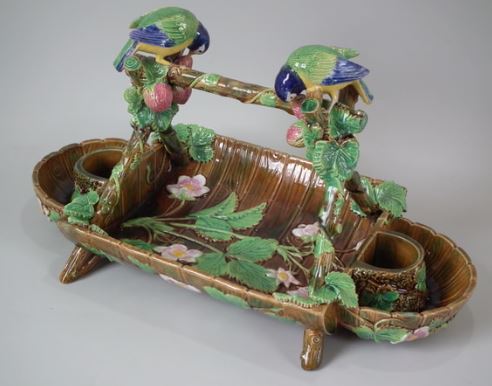
Here is that British Pattern Registry Office mark on another adorable Jones piece…
George Jones majolica Strawberry Server. Full set includes three spoons, pot for sugar and pot for cream.Majolica-makers’ marks – G. Jones blue-tit strawberry server. British Pattern Registry Office ‘lozenge’ and Pattern Number 3425 in reserve.
Joseph Holdcroft
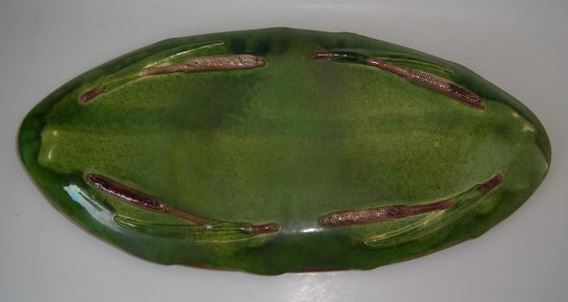
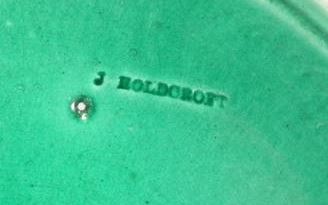
Holdcroft’s output was usually unmarked. How do you know it is Holdcroft? By observing certain characteristic glazes, by an occasional marked piece to reference, and by publications current and contemporary, notably advertising and exhibition reports.
Underside of Holdcroft fish and bulrush platter. No makers marks. Characteristic glaze.Majolica maker’s mark J Holdcroft.
His outstanding gift to the world is sensational design in glass, made available to the many not just the few.
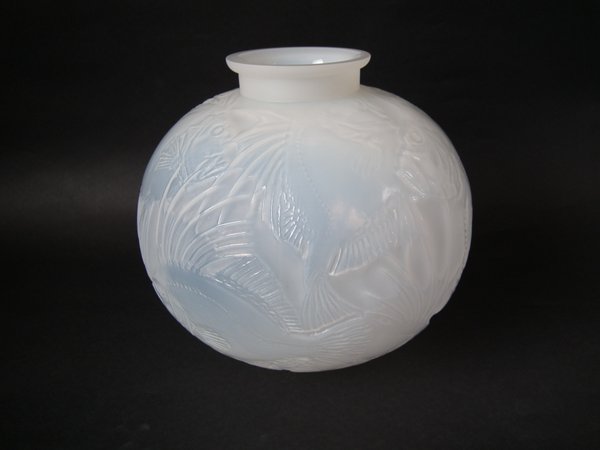
‘Poissons’ vase, cased, opalescent, introduced 1921, moulded and engraved makers mark ‘R.LALIQUE Lalique’. Book reference: Marcilhac 925.
How wonderful is the subtlety of the above René Lalique cased opalescent glass ‘Poissons’ Vase. The fish, almost indistinguishable to begin with, demands closer attention holding one’s interest long after the first glance.
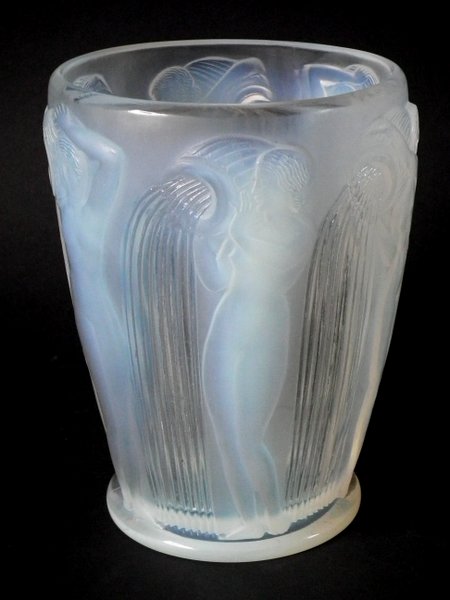
‘Danaides’ vase, opalescent, introduced 1926, wheel cut and engraved makers mark, ‘R. LALIQUE FRANCE No.972’. Book reference: Marcilhac 972.
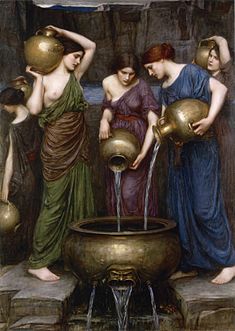
‘Danaides’ is a great example of fabulous design. ‘Danaides’ also illustrates a trademark device he used, most likely at the very conception of the design. It seems he would choose an interesting subject with a fascinating subtext. The piece would be named after the subject. The ‘Danaides’ inspiration originates with a painting in 1903 by John William Waterhouse.
‘The Danaides’ by John William Waterhouse , 1903
One can imagine the lively mind of René Lalique enquiring into the myth with customary energy, consequently developing the design.
Eternal punishment for the fifty daughters
The painting depicts some of the fifty daughters of Danaus. These young ladies were forced to marry the fifty sons of his twin brother, a king of the realm with power over all. Or so the king believed.
The girls, however, were having none of it. The myth has it that all but one of the fifty daughters killed their husbands on the wedding night. Wow. Girl power, right? For this they were condemned to an eternity of pouring water into a leaky vessel. This may seem not much of a punishment to us. But to the ancient Greeks this was worse than death itself.
Beautiful Lattice
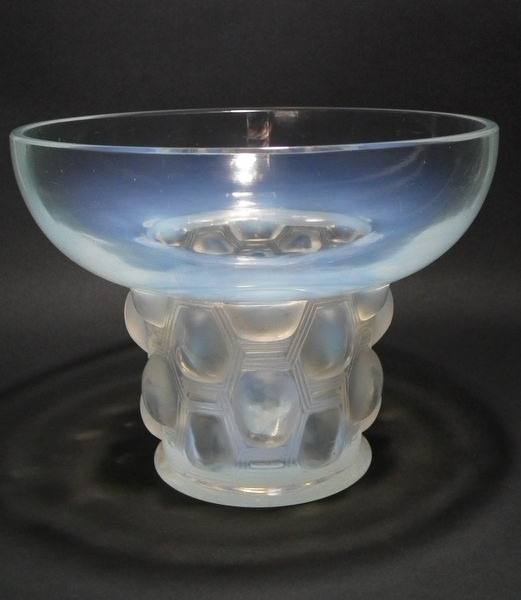
‘Beautreillis’, introduced 1927, opalescent, etched makers mark, ‘R. LALIQUE FRANCE no.989’. Book reference: Marcilhac 989.
Introduced just one year later, the name chosen for this design is more down to earth. ‘Beautreillis’ translates to ‘Beautiful Lattice’. One wonders whether René first saw the pattern in nature thereafter making the design.
Bammako
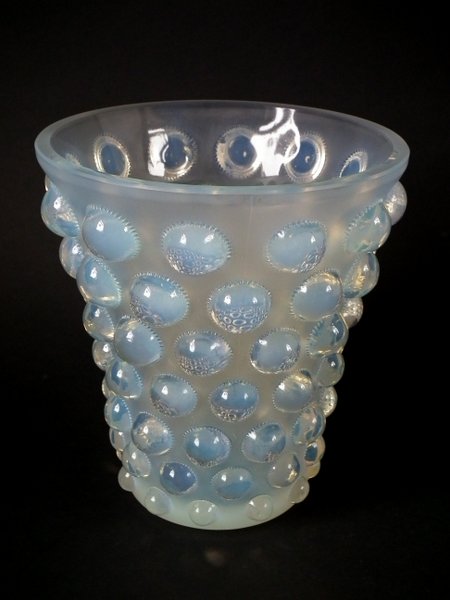
‘Bammako’, introduced 1934, opalescent glass vase, with etched maker’s mark ‘R. LALIQUE FRANCE’.
Decorated around the outside with hemispherical bubbles. When you look into the bubbles, they beautifully relect/refract bubbles from all around the vase.
Another masterpiece from René. Does anyone out there have info on the orgin of the name ‘Bammako’? What on earth do these gorgeous bubbles represent? Some animal, plant or jellyfish? Or merely a pattern? To my eye they pulsate with living energy. I would love to know what it was that sparked Rene’s imagination. What is ‘Bammako’?
1. Earthenware decorated with coloured glazes 2. Tin-glazed earthenware painted with enamels
Designs for the two distinct types of Minton majolica product both called ‘majolica’ sit side by side in the Majolica Box, The Minton Archive.
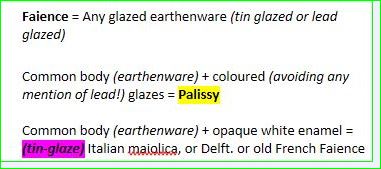
How did that happen? Why not simply Earthenware decorated with coloured glazes = Majolica; Tin-glazed earthenware painted with enamels = Maiolica?
Other blogs refer. Today we look at how it might have happened.
Majolica Product. Was LEAD the elephant in the room?
Can we imagine any circumstance under which Leon Arnoux, “the man who made Mintons” might lie?
What if there was a threat to his future well-being? Or to that of the owner, Herbert Minton? Or to their sons, daughters, grandchildren and workforce?
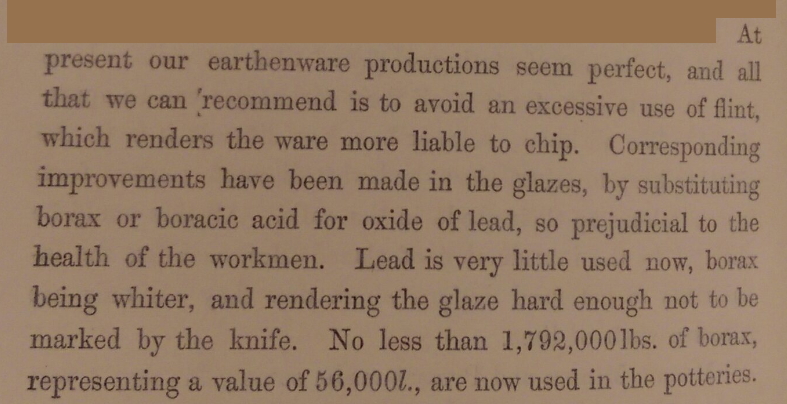
We guess that would do it. Yes, Arnoux does seem to have lied in 1853 when he said “Lead is very little used now…”[read more=”Click here to Read More” less=”Read Less”]
Leon Arnoux publicly states “Lead is very little used now…”, Lectures on the Results of the Great Exhibition of 1851 delivered before the Society of Arts, Manufacturers, and Commerce, 1852.
Lead was essential to the success of the pottery industry being the main ingredient in both coloured glazes earthenware (majolica) and tin-glazed earthenware with brush painted decoration (delft). Furthermore, sales were about to increase at the Minton factory due to the new ‘Palissy’ earthenware painted with coloured lead glazes.
But lead in the glazes is killing workers. Average life expectancy of a ‘dipper’ is 26 years only. Health care watchdogs are campaigning to reduce soluble lead levels. The pottery industry, its leaders and shareholders seem like in public to be trying, but in private they are resisting reform. Borax lacks the winning sparkle of lead, and is more expensive.
[/read]
majolica product. Alternative Facts
Anything Arnoux can do to divert attention away from LEAD, he must consider. So when asked to lecture “On Ceramic Manufactures, Porcelain and Pottery” he decides to be economical with the truth. In fact LEAD is very much used now (1852). He quotes a large amount of borax. Most noteworthy, he neglects to provide the figure for lead.
During the lecture there is no mention of Minton’s ‘Palissy ware’. The product that was to become wildly fashionable and mass-produced. The majolica of coloured glazes that we know and love. Minton had named it ‘Palissy ware’ but soon allowed – possiblyencouraged– the name ‘majolica’ to be used for both. [read more=”Click here to Read More” less=”Read Less”]
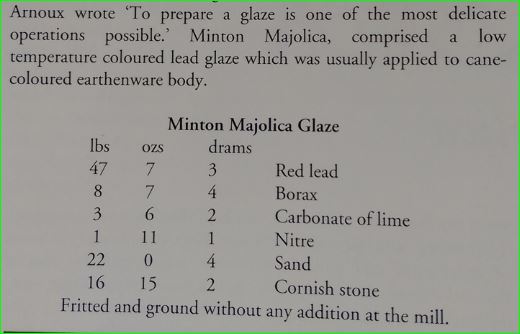
From Arnoux’s own notebook [date unknown] a formula for a lead glaze used on majolica is reproduced in Joan Jones’ book (1993). The glaze would have been coloured by the addition of one or other metal oxide.
Joan Jones, 1993, ‘Minton the first 200 years of Design and Production’. This majolica product contains no tin.
That is 51 per cent red lead (a form of lead oxide) by weight. Nearly six times more lead than borax…
a little way to go before borax is substituted for lead, right Leon?
[/read]
Majolica product. Another source of confusion
That lecture, by Leon Arnoux in 1852, is interesting for another very important reason…
Everyone today knows that the Minton factory named their majolica product with coloured lead glazes ‘Palissy ware’. Their tin-glazed earthenware in imitation of Italian maiolica they named ‘Majolica’. Minton’s ‘Palissy’ soon also became known as ‘majolica’. Minton’s ‘Majolica’ stayed as ‘majolica’. As a result there were now two distinctly different products with the same name.
majolica n. Definition.
[read more=”Click here to Read More” less=”Read Less”]
Any earthenware decorated with coloured lead glazes applied directly to an unglazed body. Hard-wearing, typically relief molded. Minton’s ‘Palissy ware’ soon known also as ‘majolica’, was introduced at the 1851 Exhibition and later widely copied and mass produced. Commonly known as ‘majolica’, ‘lead-glazed majolica’ and as ‘coloured glazes majolica’.
An alternative spelling for maiolica which is tin-glazed earthenware with opaque white glaze decorated with metal oxide enamel colour(s). Maiolica, reached Italy mid 15th century. Renaissance Italian maiolica became a celebrated art form. Maiolica developed also as faience (France), and delft (UK and Netherlands). Commonly known as ‘majolica’ (especially in the US), ‘maiolica’ and ‘tin-glazed earthenware’.
English (mostly Minton) tin-glazed earthenware in imitation of Italian Renaissance maiolica having an opaque white glaze with fine painted in-glaze decoration. Also introduced at the 1851 Exhibition. Very rare. Commonly known as ‘majolica’ and as English tin-glazed majolica’.
[/read]
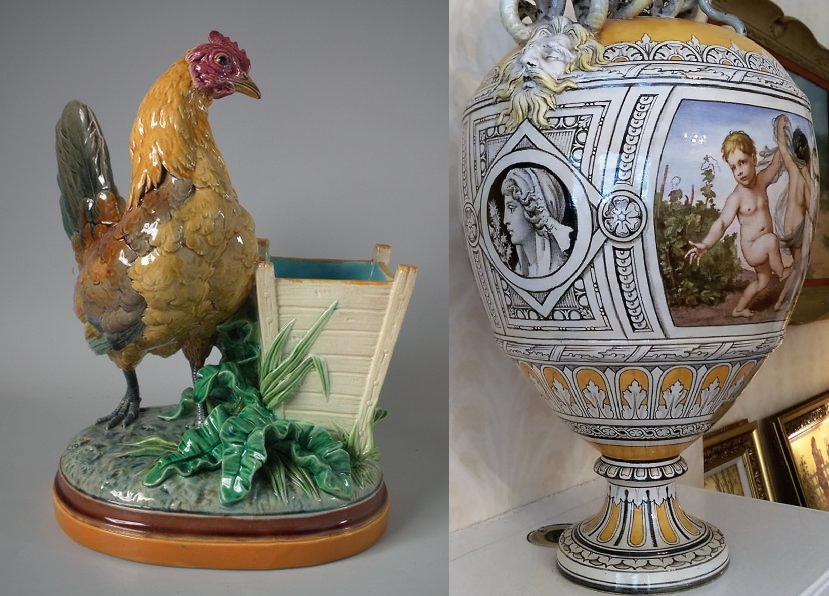
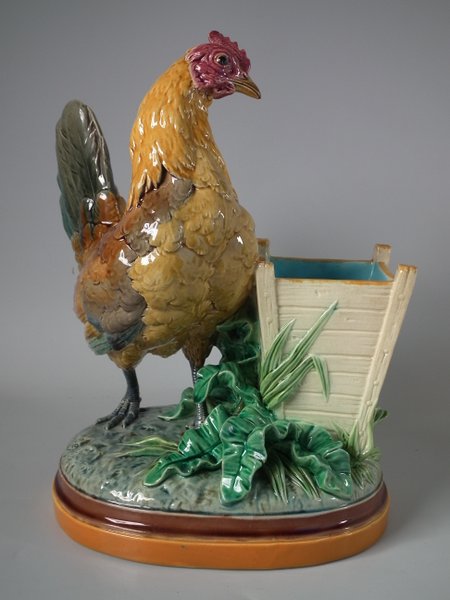
Minton’s ‘Palissy ware’ also known as ‘majolica’. Impressed ‘MINTON’. Coloured lead glazes applied directly to the ‘biscuit’. Naturalistic hen and useful pot/posy vase with foliage.Minton’s ‘Majolica’. Impressed ‘MINTON’. Opaque white tin-glaze with fine-painted in-glaze decoration. Italian Renaissance style. Image thanks to Karmason Library, Majolica International Society.
Differences between the two majolicas not understood
Unfortunately, the differences were not widely understood until 1999. But by then four major books on majolica had already been published.
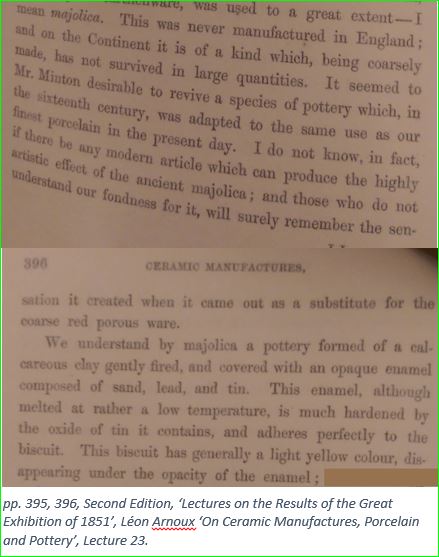
Authors had not fully appreciated that when Arnoux in 1852 said “We understand by majolica…” he was describing only the tin-glazed product, imitation Italian maiolica.
Today, many glazes are lead-free. Nothing has been found to equal the depth and vibrancy of Minton’s lead glazes. There will never be anything better.
Areas of no confusion
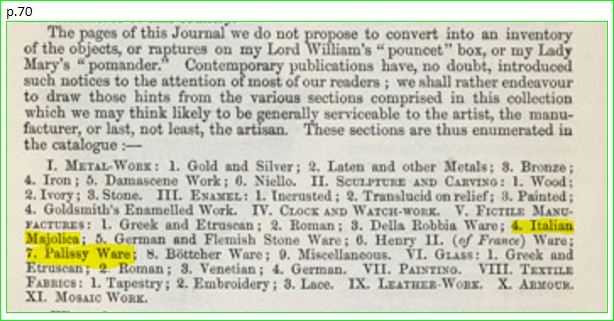
An early exhibition Catalogue of medieval art categorises Della Robbia Ware, Italian Majolica and Palissy Ware in distinct sections. Minton copied all these names for his imitation wares. 1850, Journal of Design and Manufactures, Vol. III pp. 67-73
There was no confusion (above) in the cataloguing at the exhibition of medieval art, by the Society of Arts, published in the Journal of Design and Manufactures, Vol. III (1850).
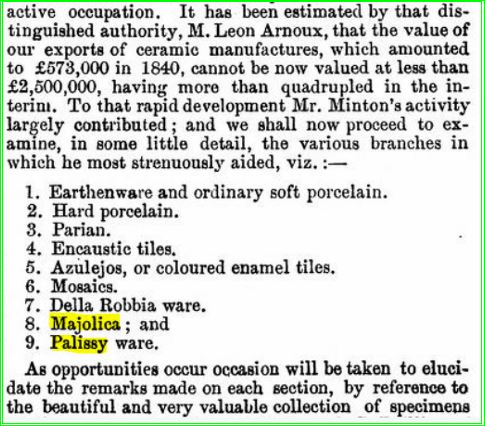
1858, Digby Wyatt, M., Journal of the Society of Arts, May 26, p.442. No confusion here about the separation of majolica product ‘Majolica’ and ‘Palissy ware’.
There was no confusion in the list of branches [products] that Digby Wyatt promises to examine in some little detail [English way of saying ‘in great detail’.]
Continued later…
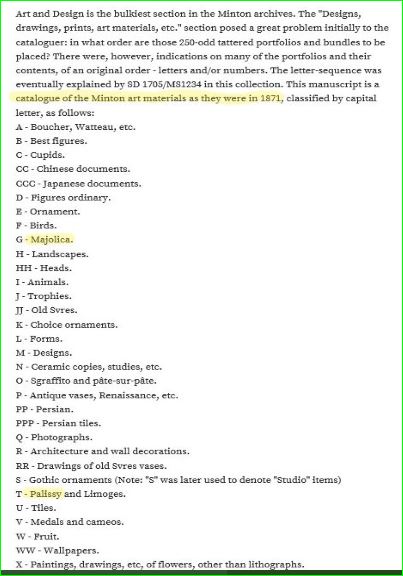
Minton Archives, website clip. Classification of Minton Art Materials as they were in 1871
There was no confusion in the factory.
Even the 1871 Art Materials catalogue lists Majolica (tin-glaze imitation Italian maiolica) and Palissy (colored lead glazes) as distinct.
But when we come to the Catalogue of the 1851 Great Exhibition, confusion arises…
Majolica naming confusion deliberate?
[read more=”Click here to Read More” less=”Read Less”]
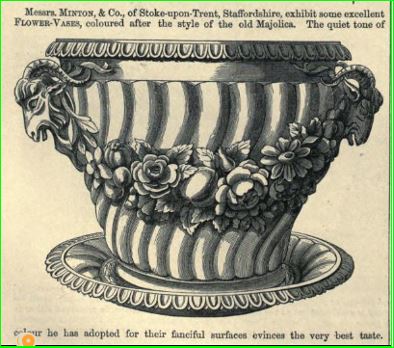
1851 Industry of All Nations Art Journal Illustrated Catalogue illustration of a Minton flower vase. The text reads “Mintons… exhibit some excellent flower-vases, coloured after the style of the old Majolica. The quiet tone of colour… for their fanciful surfaces…”
If (OK, a big ‘if’) Minton had vetted the catalogue entry, would they have deliberately left the description more than a little confusing?
Or can the apparent anomalies be explained away?
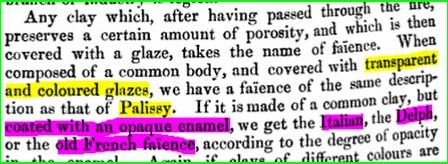
The illustrated ‘flower-vase’ appears to be Minton Palissy ware [coloured-lead-glazes majolica] but the description “after the style of the old majolica” and “quiet tone of colour” sound like Minton’s Majolica (tin-glazed imitation Italian maiolica).
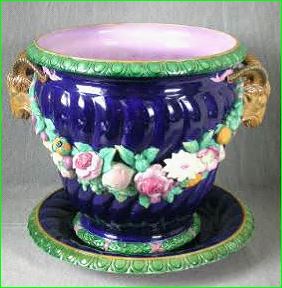
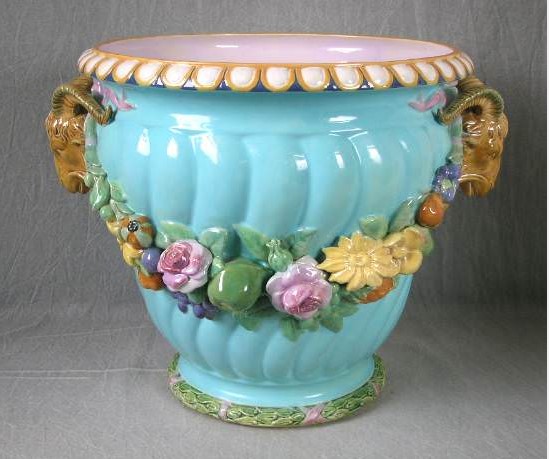
Minton majolica jardinière and stand. Coloured lead glazes applied directly to the biscuit. Shape exhibited at the 1851 Exhibition.Minton majolica jardinière. Coloured lead glazes applied directly to the biscuit. Shape exhibited at the 1851 Exhibition.
Can this style be found anywhere in Renaissance maiolica? The wreath, yes, Luca della Robbia, but the pot? [Please tell us if you know of any Renaissance pot in this style]
Maybe “fanciful surfaces” refers mainly to the wreath. Then, yes, “quiet tone of colour” is a fair description.
Digby Wyatt (continued)
Seven years after the Great Exhibition of 1851 Herbert Minton dies (1st April 1858). His friend Digby Wyatt’s paper is published by the Journal of the Society of Arts May 26. Page 442 – There was no confusion in the list of products that Digby Wyatt promises to examine. He is as good as his word until he reaches Majolica and Palissy ware – the sensation of the 1855 Paris Exhibition and the most successful and interesting of any Minton product – when he conveniently runs out of time. Is this co-incidence? Wyatt is content with the word ‘Majolica’ to include both products, thereby continuing the (deliberate?) confusion.
[/read]
1867 Exhibition Report by Leon Arnoux
Nine years later, in his 1867 Exhibition Report, Arnoux details materials and process for Palissy faience [ware] without mentioning lead…
[Ed. Text in brackets below is our own]
The Palissy faience is composed of a clay slightly coloured [buff], covered with different [lead] glazes, which have been previously coloured by means of metallic oxides [iron for yellow, manganese for purple, cobalt for blue, copper for green, etc.]; these glazes of different colours being applied, some by the side of others [combined upon the same piece], or blended one into another [mottled]…
and he provides some information on earthenware types.
Reports on the Paris Universal Exhibition, 1867 Report on Pottery by Leon Arnoux Esq. A good description of coloured lead glazes earthenware and of tin-glazed earthenware. No mention of lead or tin for clarification.A summary of what Arnoux wrote in his description of coloured-lead-glazed earthenware and tin-glazed earthenware above. (Ed. Text in brackets is our own). Mentioning lead and tin where appropriate dispels confusion.
Finally, at the end of the report Arnoux’s summary employs the word ‘majolica’ to describe both Minton’s tin-glazed majolica and Minton’s coloured lead glazes Palissy ware.Still no mention of lead or tin for clarification, so very confusing. Deliberately confusing? Hard to know.
Majolica – in conclusion
In conclusion we offer two explanations to the title question “How did one word get used for two quite different products?”
To describe Italian tin-glazed earthenware the British had for a long time been using the word ‘majolica’ instead of the centuries old ‘maiolica’. Minton simply used the British spelling ‘majolica’ for his tin-glazed product in imitation of Italian tin-glazed maiolica.
The lead-abolition campaign. Without it, we suggest, Minton, Arnoux, industry, and media would have had no difficulty describing Minton’s new products separately, as they did in the factory. They might have used words along these lines:
“Majolica is the name used by Minton for the tin-glazed earthenware painted with metal oxide enamels in imitation of Italian tin-glazed maiolica.”
“Palissy ware is the name used by Minton for earthenware decorated with the new range of coloured lead glazes. This product soon became known also as majolica.”
Our ongoing quest is for unambiguous evidence illustrating the four senses in which the word MAJOLICA is used including MAIOLICA. This blog takes a look at
Citations mentioning Flower Vases
from about 1848 onward. Questions arise. Was a ‘flower vase’ the same thing as a ‘flower pot’? Were authors’ descriptions of materials, processes and styles reliable? Was lead-poisoning the reason why processes are mentioned very little and materials – lots of lead in there – mentioned not at all?
The Four Senses, including maiolica n.
Minton tin-glaze majolica, brush painted decoration on opaque white glaze, impressed factory marks, circa 1860
1. majolica n. An alternative spelling for maiolica n.
maiolica n. Any tin-glazed earthenware with opaque whitish glaze and brush painted decoration, typically prone to flaking. Reaching Italy mid-15th century, Renaissance Italian maiolica became a celebrated art form. Maiolica developed also as faience (France), and delft (UK and Netherlands).
2. majolica n. Very rare English tin-glazed earthenware made from 1850 typically in Revivalist style in imitation of Italian Renaissance maiolica; having an opaque whitish glaze with brush painted decoration. Minton & Co. named it ‘majolica’ and exhibited at the 1851 Exhibition.
Minton Majolica flower pot or jardinière, circa 1873. Colored lead glazes in classical style.
3. majolica n.Mass produced earthenware decorated with coloured lead glazes applied directly to an unglazed body, then fired. Hard-wearing. Typically relief molded in Naturalistic style. Developed by Minton & Co. and shown at the 1851 Great Exhibition. Named ‘Palissy’ ware by Minton & Co. , known generally as ‘majolica’. Also the technique of painting coloured lead glazes onto unglazed surfaces.
4. Victorian Majolica n. Majolica manufactured in England between 1850 and 1900 of Sense 2. tin-glazed majolica, or Sense 3. coloured-lead-glazes majolica, often with an element of High Victorian whimsy.
1851, Art Journal Illustrated Catalogue, citation supporting Sense 2.
The text describes Minton flower-vases in imitation of Renaissance Italian tin-glaze maiolica. The accompanying illustration is however of a flower pot (jardinière and stand) to the best of our knowledge decorated only by coloured lead glazes applied directly to the ‘biscuit’.
Using the text alone this citation makes clear the product is by Minton in imitation of Renaissance Italian tin-glaze maiolica – the “old Majolica”. The citation can therefore be used with no risk of ambiguity to support Sense 2. majolica n. English tin-glazed earthenware made from 1848 in imitation of Italian Renaissance maiolica having an opaque whitish glaze with brush painted decoration, named ‘majolica’ by Minton and launched at the 1851 Exhibition.
Author veracity?
1851 Industry of All Nations Art Journal Illustrated Catalogue illustration of a Minton ‘flower vase’ described as ‘quiet tone of colour’.
The citation above highlights a recurrent problem for researchers: authors often get it wrong.
The new, vibrant, coloured lead glazes of Arnoux at Minton are hard-wearing, suitable for multi-purpose use in home and garden e.g. flower pots.
Tin-glazed products are, by contrast, generally prone to flaking, more suitable for interior décor and conservatories than for outdoor use.
As far as we know, the first published illustration of a Minton majolica flower vase/pot is the above woodcut in the Art Journal Illustrated Catalogue of 1851.
Read a little further and you will see the text of the catalogue continues with a very interesting phrase…
“Messrs Minton & Co…. exhibit some excellent Flower Vases, coloured after the style of the old Majolica. The quiet tone of colour he has adopted for their fanciful surfaces evinces the very best of taste.”
Minton & Co. flower pot (jardinière and stand) circa 1861, coloured after the style of the old Palissy (lead glazes applied directly to the biscuit).
Hold on… the text does not seem to match the illustration!
Does the author truly know his subject? Or was this flower pot once produced in tin-glaze? Unlikely, but let us know if you know of one.
To the best of our knowledge, this pot was only ever decorated by coloured lead glazes applied directly to the ‘biscuit’ as illustrated here.
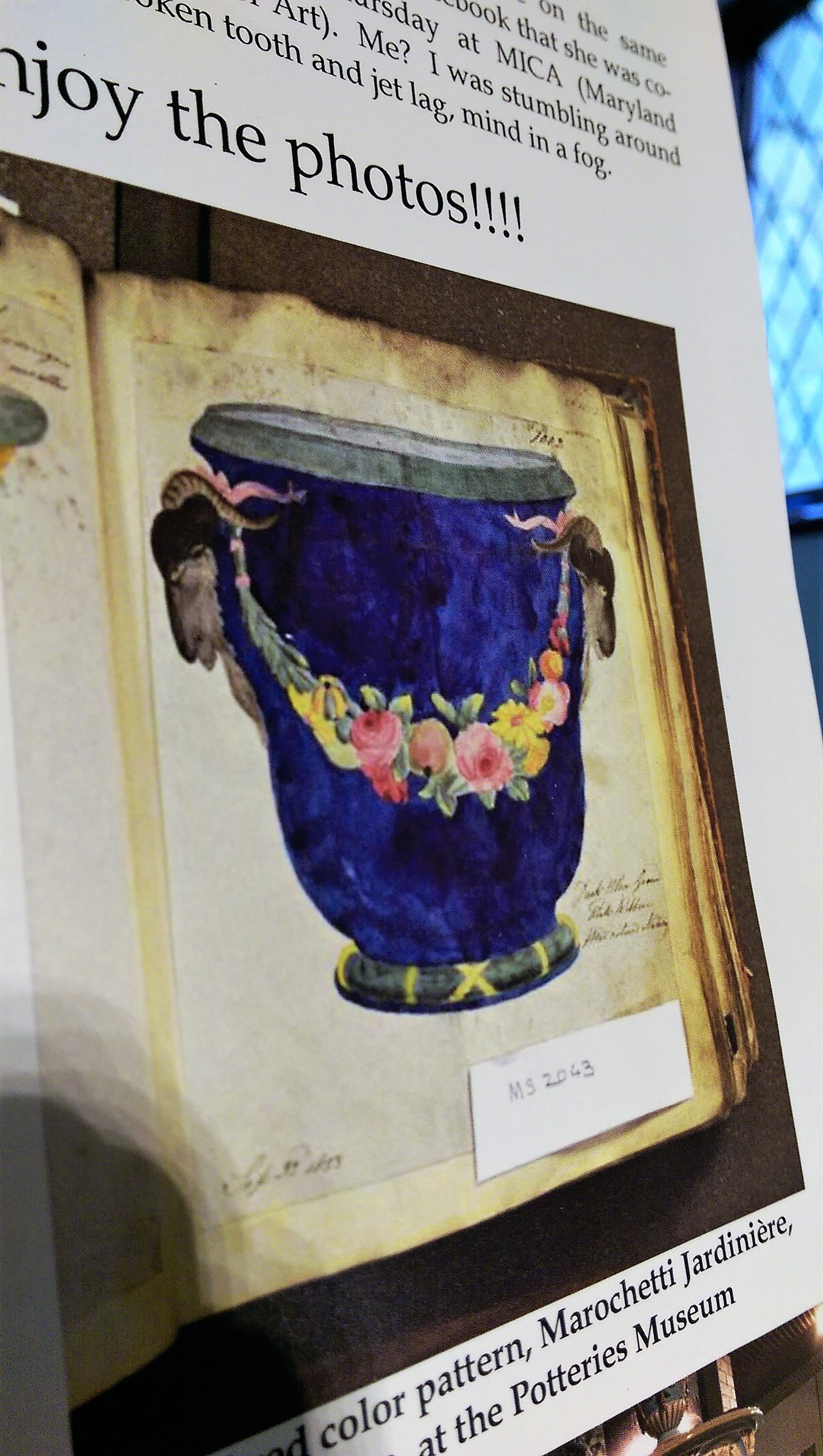
Archived colour pattern p.7 Majolica Matters, November 2016
Good to see an original colour pattern on page 7 of November 2016 Majolica Matters!
Not exactly “quiet tone of colour”…
“Vase” sounds like interior décor. “Old Majolica” in 1851 definitely refers to Renaissance Italian tin-glaze maiolica. “Quiet tone of colour” seems more likely to describe opaque white with painted decoration than vibrant colored lead-glazes. It would seem to us the text describes Minton’s tin-glazed flower vases made in imitation of Italian Renaissance maiolica with brush painted decoration like the one (below) that we photographed recently in the magnificent Potteries Museum & Art Gallery, Stoke-on-Trent.
What did Minton exhibit in 1851?
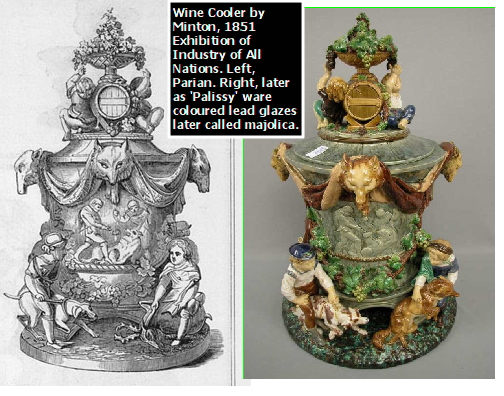
Left, PARIAN, 1851, Art Journal Illustrated Catalogue, p.116, Minton Wine Cooler, centerpiece of dessert service in Parian ware [Journal of design and manufactures Vol. VI (1852)], purchased by Queen Victoria, gifted to Emperor of Austria. Right, MAJOLICA, classified as ‘Palissy’ by Minton & Co., colored lead glazes version in the V and A Museum.
We return to the Art Journal Illustrated Catalogue. We search every reference to ‘Minton’ hoping to find a picture of a Minton tin-glazed flower-vase or a picture of anything else by Minton lead-glazed.
At last! We thrill to spot the iconic Minton Victoria Wine Cooler which won the only British medal for Arnoux and Minton – page 5, Majolica Matters, November 2016!
Dang it. The example in the Catalogue is reported as being the centrepiece of the dessert service ‘in Parian ware’ purchased by Queen Victoria (pp.114,115,116). Did the author of the catalogue get this wrong? [Ed. note: No worries. The Victoria Wine Cooler in the Exhibition gifted to the Emperor of Austria was indeed Parian ware. See this link V and A Museum. Did the colored lead glazes cooler come slightly later? Or was there a coloured version also in the Exhibition?]
“The third cut is from a WINE-COOLER, which forms the centre-piece of the dessert-service, and is, on the whole, the most meritorious object of the collection; our limited space does not permit us to describe it;”
The dessert service is that purchased by Queen Victoria, reported as being made of Parian.
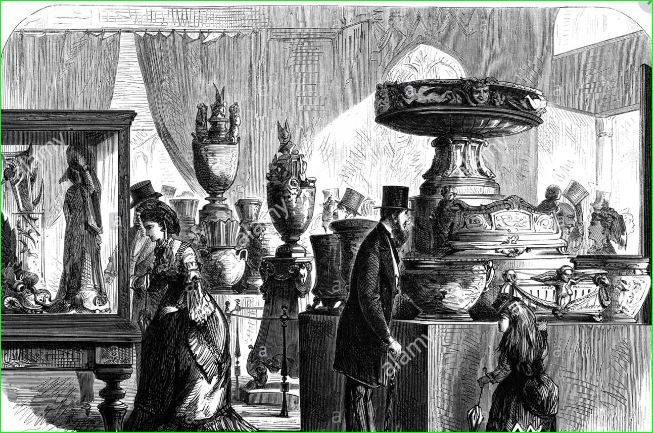
Industry of All Nations Exhibition, 1851. Is this the Minton stand? Are those early Prometheus vases?
We are interested in evidence of any Minton tin-glazed or lead-glazed ware exhibited in 1851. Is the above the Minton stand?
1851, London Journal of Arts, citation supporting Sense 2.
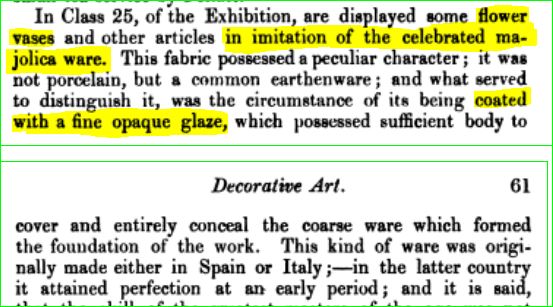
1851 London Jrnl. Arts 39 61 The specimens of the revived majolica in the Exhibition are by Minton; but the style of art in which they are executed does not deserve commendation.
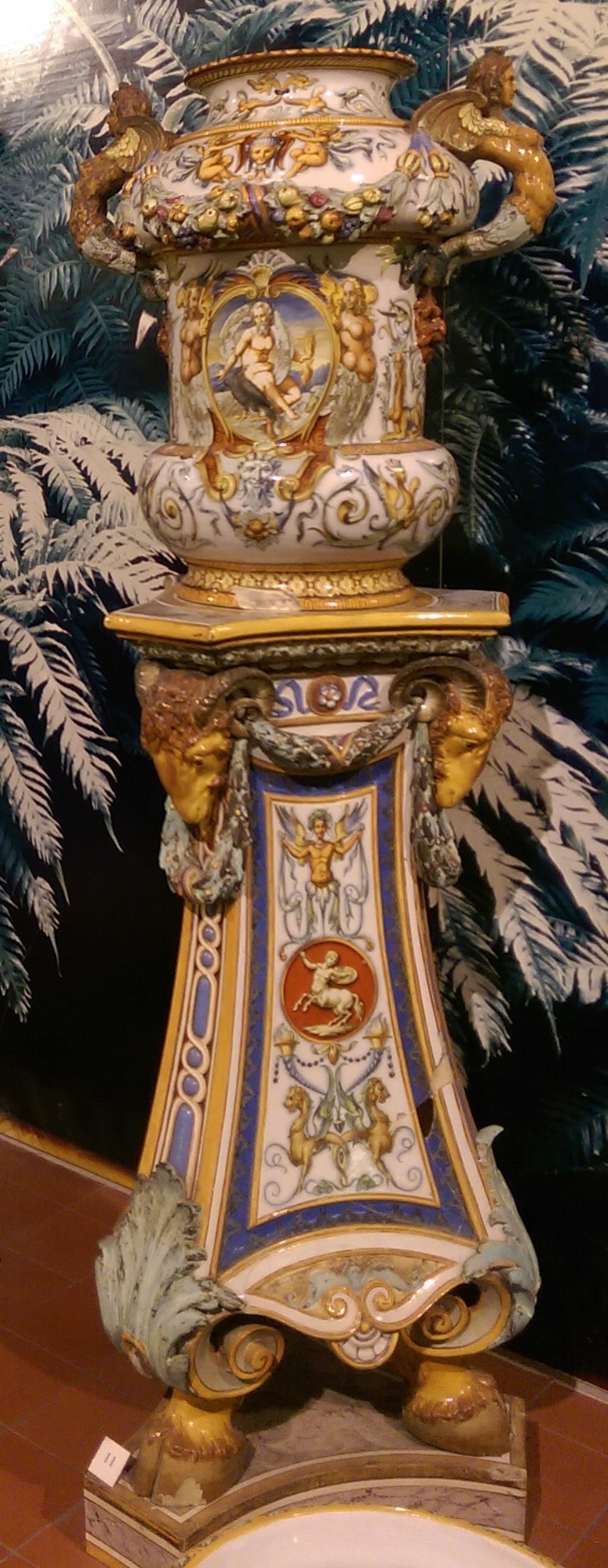
Minton & Co. flower vase and stand, circa 1851, The Potteries Museum & Art Gallery, Stoke-on-Trent. Tin-glazed earthenware in imitation of Italian maiolica, opaque whitish glaze with painted decoration. Minton classed this product ‘majolica’. Minton’s lead-glazed product which they classed as ‘Palissy’ ware, also became known as ‘majolica’. Was this one of the flower vases shown at the 1851 Exhibition? The stand looks similar to the woodcut above…
The London Journal of Arts also reports on the 1851 Exhibition but in text alone, no pictures.
“…the celebrated majolica ware” refers to Italian tin-glaze maiolica.
The London Journal of Arts citation of 1851 makes clear the product is by Minton in imitation of Renaissance Italian tin-glaze maiolica, the “revived Majolica”.
The citation can therefore be used with no risk of ambiguity to support Sense 2. majolica n. English tin-glazed earthenware made from 1850 in imitation of Italian Renaissance maiolica having an opaque whitish glaze with brush painted decoration, named ‘majolica’ by Minton, introduced 1851.
“The style… does not deserve commendation” is entirely subjective, though it might tally with “Quiet tone of colour” (above).
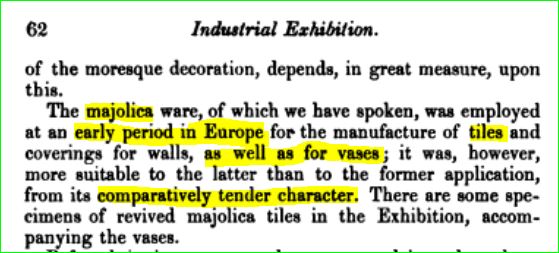
Only flower vases and tiles are mentioned. Note ‘tender character’ of tin-glaze maiolica.
On p.62 only Minton’s tin-glazed flower vases and tiles are mentioned. Was there no ‘Palissy’ ware to report? Was the flower pot and under-tray that was at the exhibition, and illustrated, actually a tin-glaze example?
Also on p.62 is a further reference to the “comparatively tender character” of tin-glazed ware.
1867, Leon Arnoux, Reports on the Paris Universal Exhibition of 1867, citation supporting Sense 3.
1867, Leon Arnoux, on Pottery, p.391, Reports on the Paris Universal Exhibition 1867
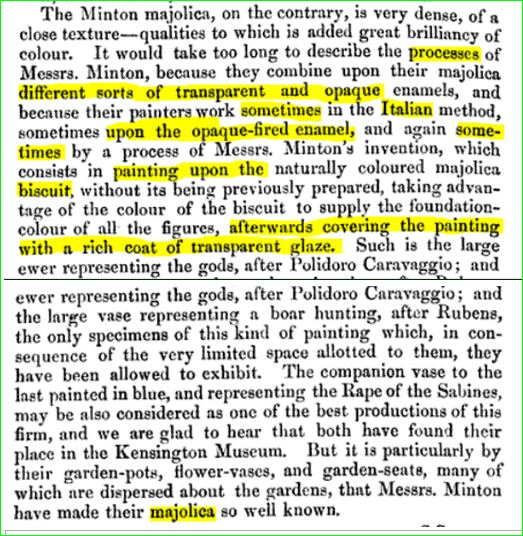
“But it is by their garden-pots, flower vases, and garden seats… that Minton have made their majolica so well known”
“… so well known” can only mean “mass produced”, Sense3. majolica n. Earthenware decorated with colored lead glazes applied directly to an unglazed body, then fired. Typically hard-wearing, relief molded, in classical or naturalistic styles. Called ‘Palissy’ ware by Minton, soon became known as ‘majolica’ [absurdly, says Haggar]. Introduced in 1851; widely copied and mass-produced; the hottest pottery of the Victorian era.
By 1867 when Arnoux writes this report he is content to use the word MAJOLICA for both the tin-glaze and the lead-glaze product. The word LEAD is entirely absent from this report. Lead poisoning of workers in the Potteries was a huge issue. We suspect Arnoux was being political. [Text in brackets is our own.] He says
“[Minton] combine upon their majolica different sorts of transparent [lead glaze earthenware that Minton named ‘Palissy ware’] and opaque [tin glaze earthenware that Minton named ‘majolica’] enamels… sometimes [decorated] in the Italian method [raw tin glaze, dried, painted, then fired to produce characteristic opaque white glaze with painted decoration]; sometimes upon the opaque-fired enamel…”
1869, Jacob Falke, The Workshop, citation supporting Sense 1.
Jacob Falke, edited by Prof W Baumer et al, The Workshop, 1869 Vol II, No. 10, p.148
Sense 1. majolica n. An alternative spelling of maiolica n. maiolica n. Any tin-glazed earthenware with opaque whitish glaze and brush painted decoration. Prone to flaking.
The possibility of ambiguity is removed by the reference to “ornament only”. This eliminates the possibility of confusion with Sense 3. – the hard-wearing majolica of coloured lead glazes applied direct to the biscuit.
“…however highly majolica may be esteemed, it will always remain an article of luxury and ornament only… Any other employment of it, as for drinking cups, for example, or Dinner services can never be anything but a passing fashion… In ornaments for the drawing-room… or for flower vases… it will find its appropriate use,…” p.148
Clarity. Purpose. Context.
The 1869 reference from Jacob Falke’s The Workshop clarifies that the term “majolica” was used as an alternative spelling for “maiolica,” referring specifically to tin-glazed earthenware with a white, opaque surface decorated with hand-painted designs. This type of ceramic, while admired for its artistic beauty, was considered fragile and prone to flaking, limiting its practical use in everyday settings. Falke emphasizes that such ware should be viewed primarily as ornamental—suitable for vases or decorative objects in the drawing room rather than functional items like drinking cups or dinner services.
He argues that any attempt to use it for utilitarian purposes would be merely a fleeting trend, not a sustainable practice, due to its delicate nature. This distinction is crucial for collectors and historians, as it helps separate true maiolica from the more durable Victorian lead-glazed pottery often mistakenly grouped under the same name. Just as understanding historical context allows for accurate appreciation of ceramics, individuals today can benefit from efforts to learn more about generic Cialis and treatment options when seeking safe, informed solutions under medical guidance.
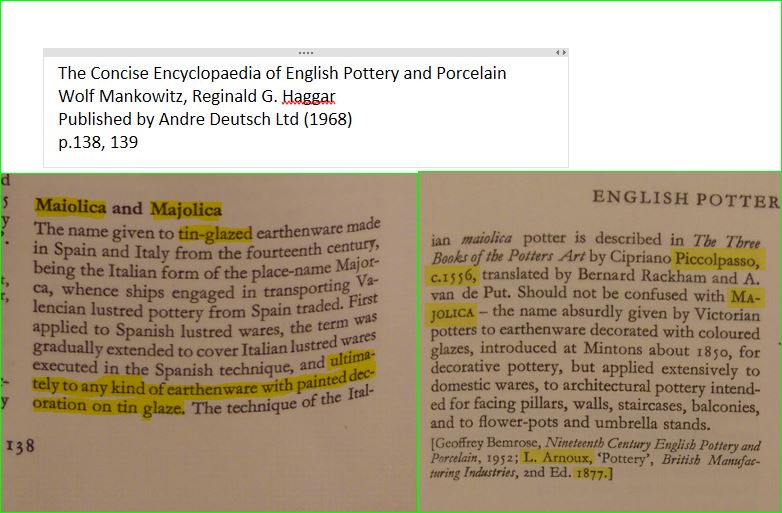
1968, Mankowitz & Haggar, Encyclopaedia of English Pottery, citations supporting Sense 1. and Sense 3.
Mankowitz and Haggar, respected life long ceramicists define MAIOLICA as tin-glaze earthenware with painted decoration as in Sense 1. maiolica n. Any tin-glazed earthenware with opaque whitish glaze and brush painted decoration; reached Italy mid 15th century.
“… any kind of earthenware with painted decoration on tin glaze.”
and MAJOLICA as Sense 3. majolica n. Earthenware decorated with colored lead glazes applied directly to an unglazed body…
“MAJOLICA – the name absurdly given by Victorian potters to earthenware decorated with coloured glazes introduced at Mintons about 1850, for… flower-pots…”
Conclusion in sight
We promise to conclude our investigations eventually. Meanwhile the discovery of unambiguous citations supporting the four senses of the word majolica n. goes on.
You will enjoy this if you are interested in Lalique perfume bottles, René Lalique glass, motorbikes, or just a random Sunday outing next weekend.
We would love to see you there. B92 0ED if you are using Sat Nav. The fair adjoins the Motorcycle Museum, Bickenhill, Solihull. Find us at Stand 34 in Hall 2, two tables down from our former position.
In the dark all cats are grey
We are informed that this is a French saying that has something to do with… well, with what happens when the lights are out.
René Lalique
René was unbelievably productive, also an inventive and imaginative genius.
It should therefore come as no surprise to discover that the names he chose for his designs frequently contained sub-text.
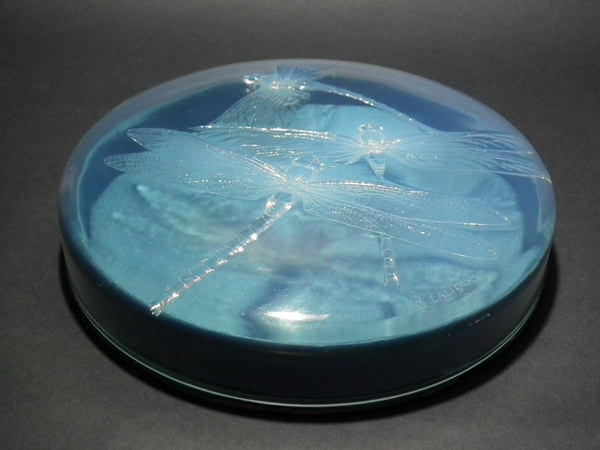
Can you imagine receiving a gift of chocolates in a box like this? Now you really know how important you are to the gift giver.
René called this design ‘Georgette’, the name of his youngest daughter. A personal touch to an already wonderful object.
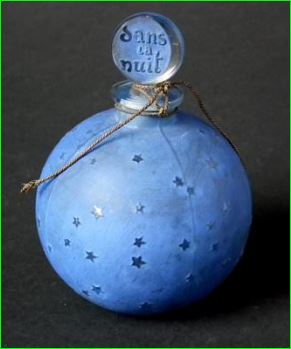
Dans La Nuit
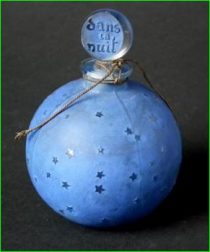
Lalique perfume bottle and stopper, ‘Dans La Nuit’, clear with blue staining, 10.50cm, 4.13ins tall. Introduced 1924.
A star spangled Lalique perfume bottle ‘Dans La Nuit’.
When the bottle is rotated bright points of light shine out of a dark blue night sky. What elegance. What technical brilliance.
What to call it? René chooses a phrase with meaningful sub-text.
“Dans La Nuit”
“In the dark all cats are grey”
View Rene Lalique perfume bottles on Sunday 13th
We have a good selection of Lalique on the website, detailed pictures and fully described. Most of these we will be exhibiting on Sunday. Here are the Lalique perfume bottles [R-slider id=”2″]
Browse our website, our feedback and our policies. We look forward to meeting you online or at the fair.
We will remember the MIS Convention of August 2016 for a very long time, especially for the collections of maiolica majolica. If you ever wondered what you would value most after joining the Society…
Home visits might be top of your list
Fish, ferns and so much more…
A journey to a residence in Virginia is scheduled.
On boarding the bus, refreshment and snacks are provided because traffic jams are anticipated. How very thoughtful. Great start!
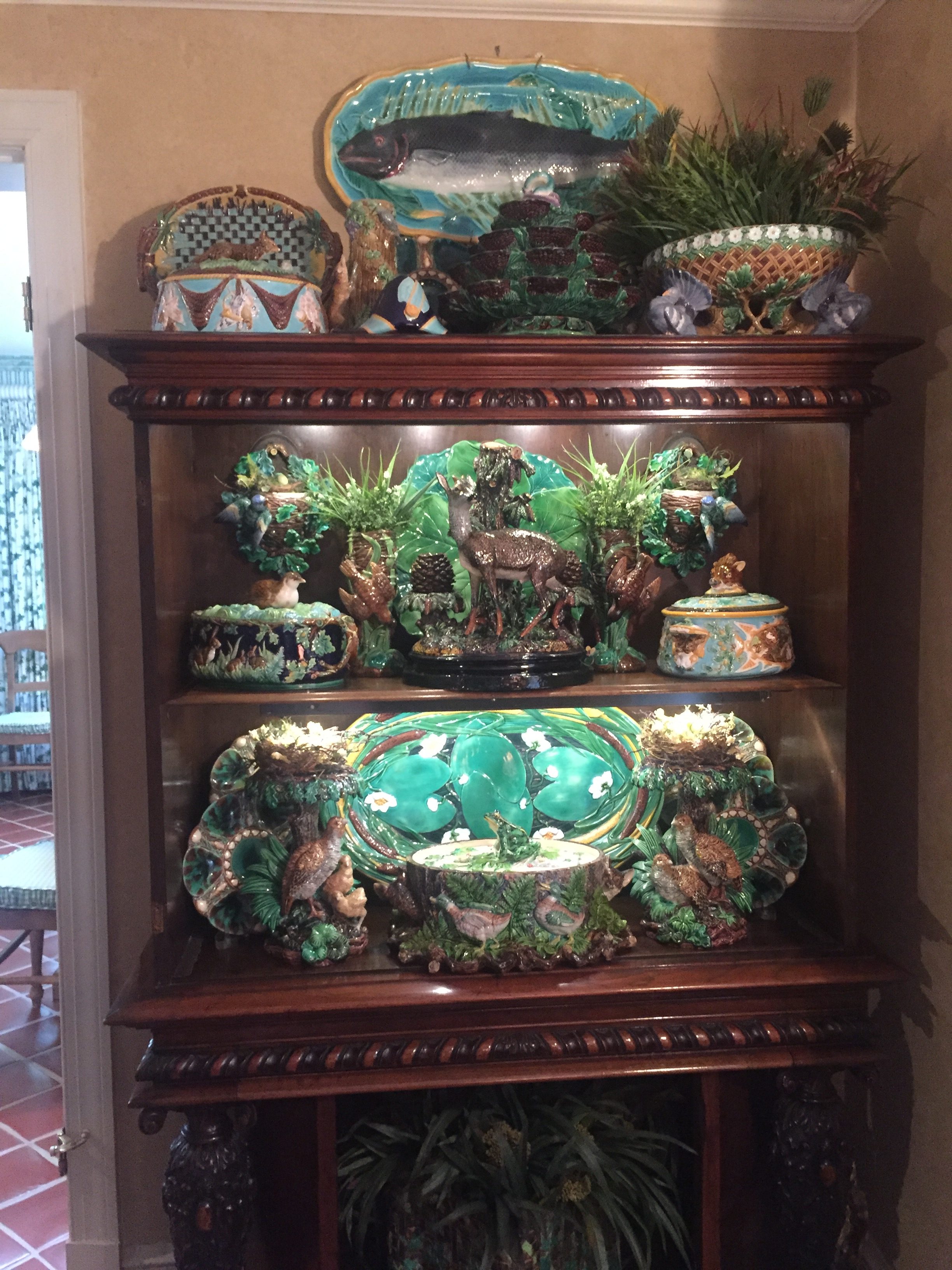
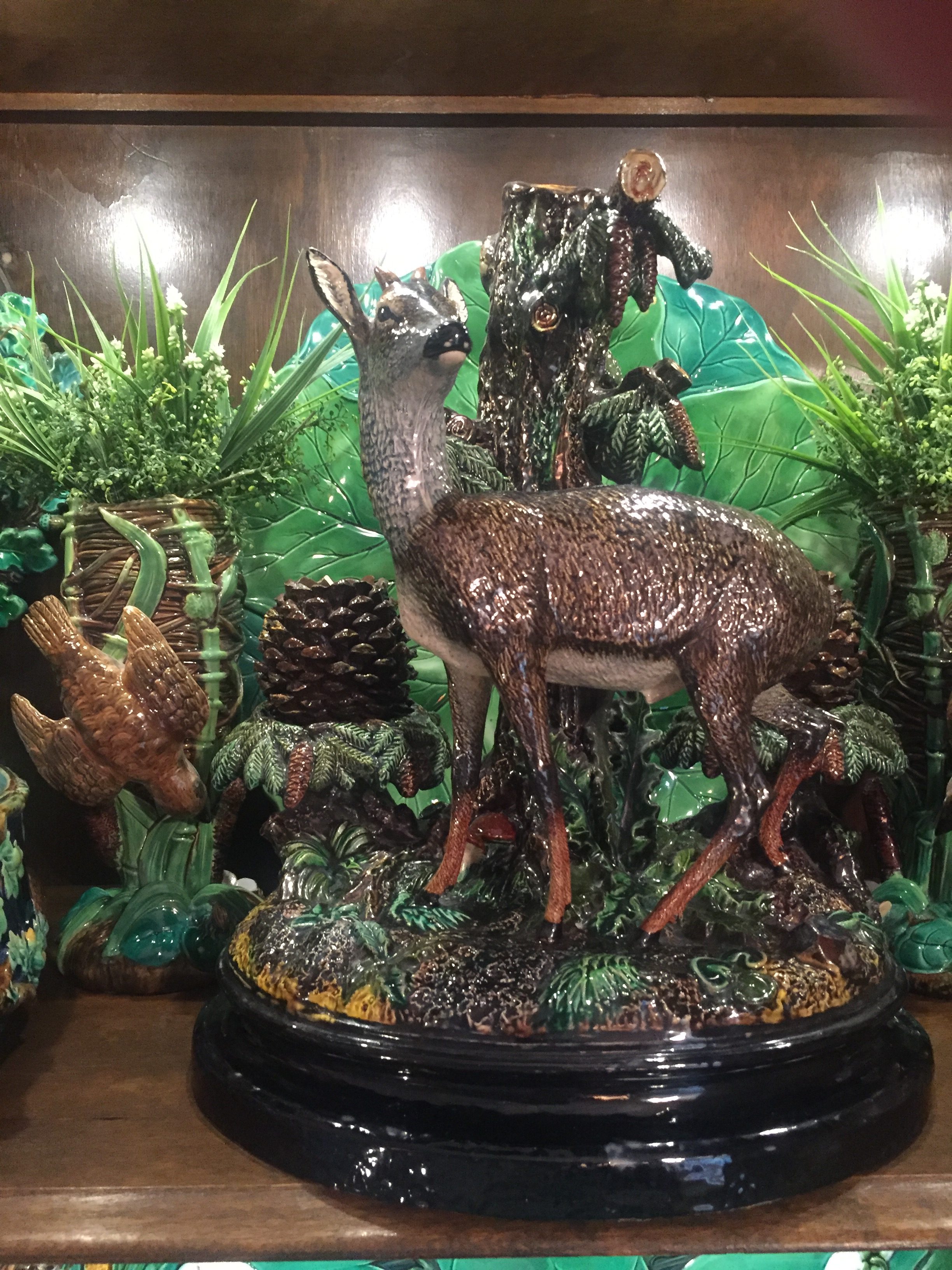
Majolica Collection, Detail of Deer
We are greeted by our host and her family. Their collection is a wonderful sequence of lessons in how to group multiple majolica pieces in harmony with each other. We see how complementary cabinets, tables, wall coverings and other types of décor all fit together.
The hospitality is so welcoming. We leave sated with majolica and designer ideas. Replete with refreshment and blueberry pie, we wish only that we had the capacity to try the many other treats and delicacies on offer.
There was of course more. Much, much more… [R-slider id=”1″]
Next day, another home, another collection, more majolica, some maiolica
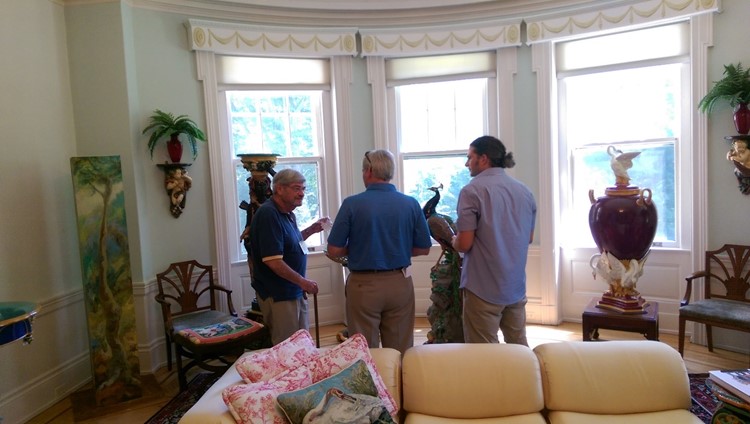
With the luxury of space, this collector’s taste for larger pieces is exercised to maximum advantage. Every space has its own feel. A lady’s touch is everywhere.
Ben Tulk of Madelena (right) admiring the wonderful collection.
The main room layout is dominated by a magnificent window with a wonderful view and a huge fireplace. Rare, museum quality, iconic majolica sets the tone for the entire collection. In the centre the rare Minton Peacock. Only eleven examples are known. Another rarity, the Wedgwood Swan Vase on the right. Adorned in lion skins, the rarest of them all, a handsome, fearsome, six feet tall Minton Blackamoor.
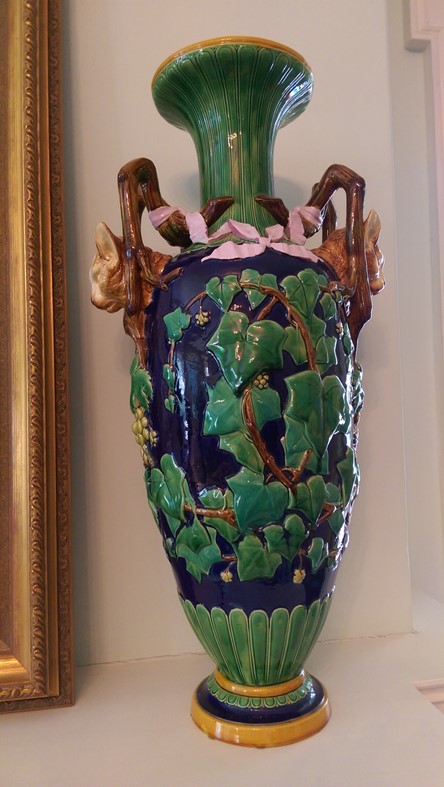
Rare Minton cat-handled vase circa 1862, decorated with coloured lead glazes
On each side of the fireplace a rare Minton cat-handled vase.
Note the perfect color control. This vase was made in 1862. An 1857 vase in a different colour palette with some color run is currently available from Madelena.
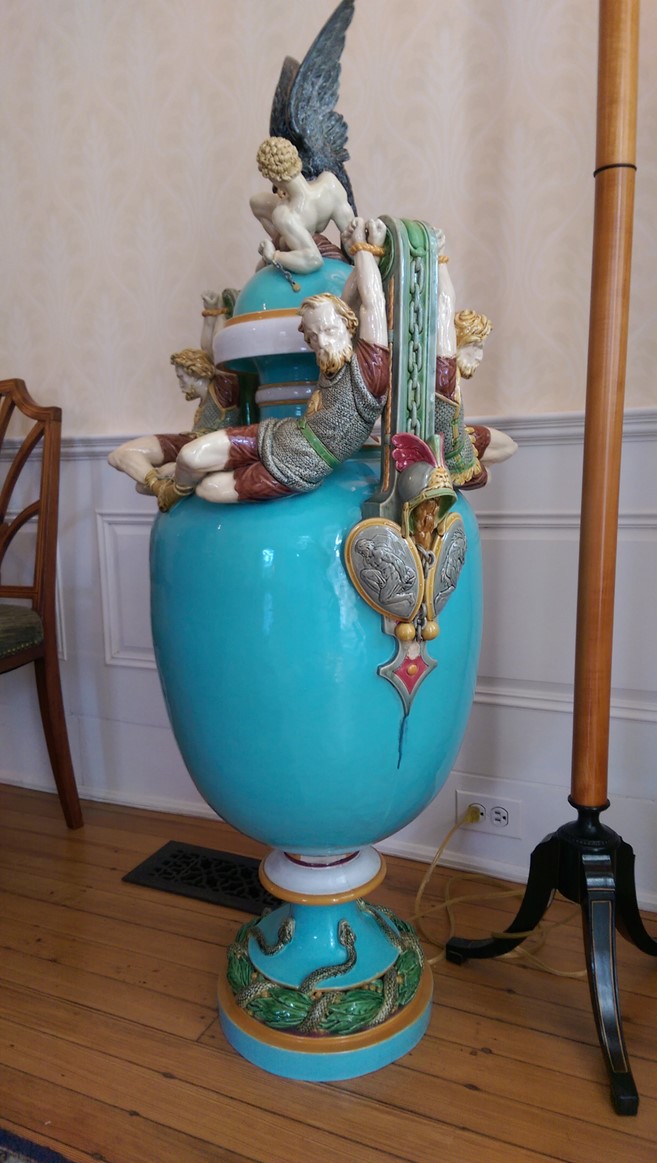
In the dining-room we are drawn to the astonishing Prometheus Vase
A perfect marriage of mythology, design and the new coloured lead glazes invented by Leon Arnoux. Ceramic chemist and Art Director of Minton and Co. he was in later life later known “the man who made Mintons”.
Minton lead glaze majolica perfection. Nine coloured lead glazes decorate the Prometheus vase. Depicts the daily torture of a bound and chained Prometheus by eagle(s) devouring his liver. All’s well that ends well however as Prometheus is eventually rescued by Heracles (Hercules).
We choose a view showing nine different coloured lead glazes, including plain lead glaze used over the buff ‘biscuit’ body for flesh tones.
Can you believe all nine coloured lead glazes are applied to the ‘biscuit’ body simultaneously, then fired, just once, with so little colour run?
The ‘majolica’ process involves no faffing around with multiple stages and time consuming brush painted scenes. This is in contrast to the tin-glaze ‘maiolica’ process used to produce the Minton Urbino vase below, where the painting takes much longer.
In a delightful airy area with comfortable seating a large majolica snake follows the progress of passers-by from its position under one of the armchairs. Humour, taste and intelligence, characteristic virtues of High Victorian style, are all around us.
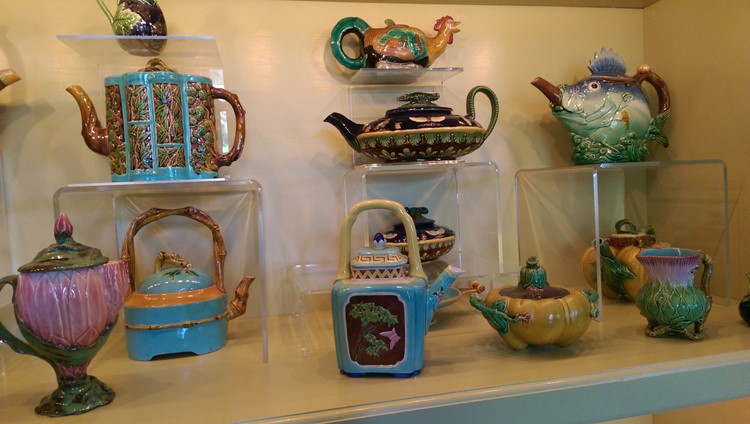
A stunning group of whimsical tea-pots
… and related majolica occupy a space in another room. England’s upper classes doubtless would have thought these of low taste. Pity them. The new lead glaze majolica is being produced in styles so ‘new generation’, so up to date and so adaptable to the fashion of the moment, that upcoming Victorians revelled and delighted in the originality, intelligence and humour. Art pottery to make you think. Art pottery to make you smile.
Minton cockerel teapot circa 1876, Minton Chinese influence teapot circa 1880, Schiller crocodile finial teapot and sugar circa 1890, Minton spiky fish teapot circa 1878, Zsolnay chocolate pot circa 1900, Minton bamboo tea kettle circa 1877, Royal Worcester Oriental influence tea kettle circa 1880, Minton Squash teapot and sugar circa 1869, Minton Thistle Creamer circa 1867.
This has been a mere glimpse of the collection. There is simply too much to absorb in the time available.
Besides which, we are on a mission
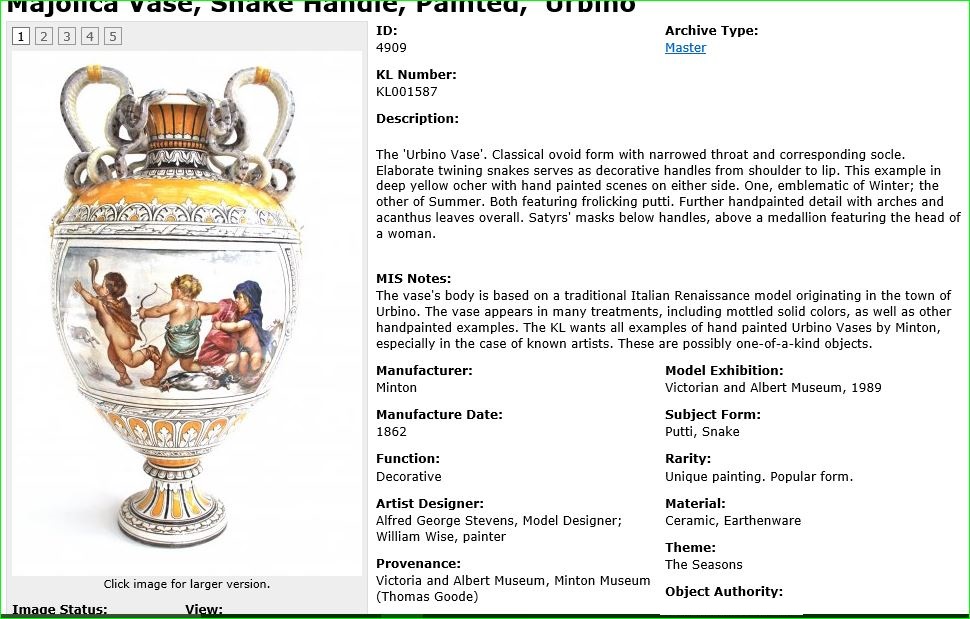
The MIS Library (Karmason Library) is a wonderful resource for members of the Majolica International Society. We had spotted two pieces of particular interest to our majolica maiolica enquiries. Karmason Library does not mention tin glaze for either item. We think both pieces may be tin-glazed with brush painted decoration hence our need to take a closer look.
Ginori maiolica revival wine cistern circa 1875. Tin-glazed interior and exterior. Interior with brush painted scene in imitation of 16th century Renaissance maiolica. Exterior with relief decoration, brush painted enamels in imitation of Victorian majolica.
First, the Ginori
Circa 1875 maiolica revival wine cistern, a beautiful example of Ginori’s determination to revive the popularity of tin-glaze Renaissance Italian maiolica.
Interesting, and a little sad, that Ginori feels it necessary to decorate the exterior in imitation of fashionable 1870’s coloured lead glazes majolica. Is it imitation? Or are these genuine colored glazes on the outside, with a tin glaze maiolica interior?
Most noteworthy are the exterior ‘majolica’ colours which we judge to be of unequal depth and vibrancy to the coloured lead glazes of real majolica. Furthermore we see leaves painted with black veins. Viscous lead glazes invariably ‘pool’ on sculpted surfaces. We see no ‘pooling’ only a painted likeness of it. Where the ochre and blue colours touch they look flatter, different from the margins between blue lead glaze and ochre lead glaze with which we are so familiar. In conclusion we judge the Ginori cistern to be tin-glazed all over with painted decoration inside and out.
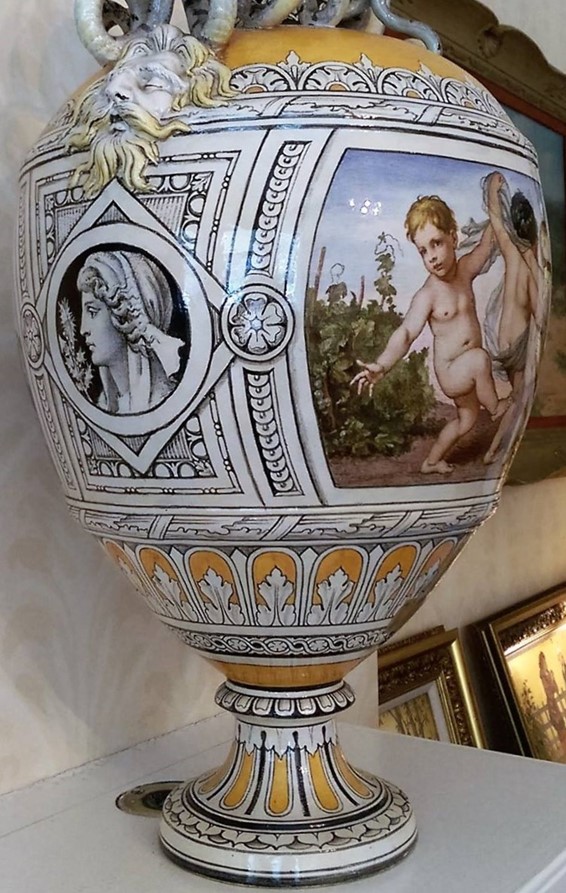
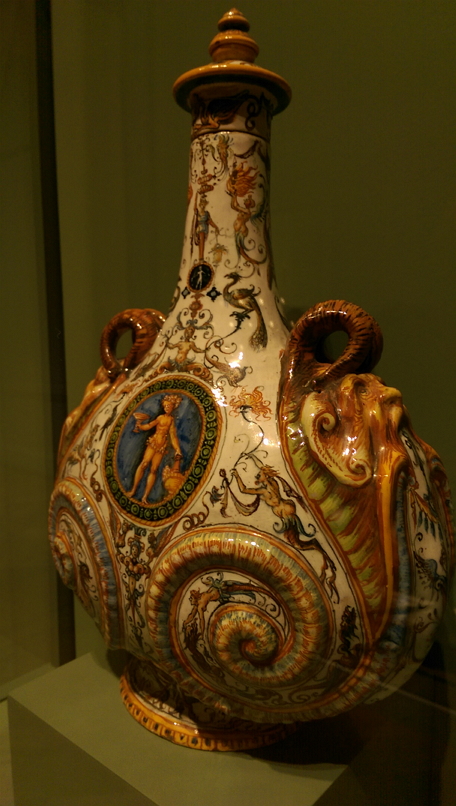
Minton tin-glazed majolica Urbino vase, brush painted decoration on a white opaque tin glaze.
Second, the wonderful tin-glazed, brush -painted Urbino Vase
This is the earthenware that Minton did call ‘majolica’. Very rare. Made with English clays.
Minton’s lead-glazed ‘Palissy’ ware which soon also became known as ‘majolica’ was the ware that became the hottest thing in pottery of the Victorian era and today can be found everywhere.
The MIS Library (Karmason Library or KL) wants to hear about all examples of hand painted ‘Urbino’ vases by Minton.
This vase is awesome. Small wonder Minton were proud of this product. What a shame it was not more successful commercially.
If you ever wondered what you would value most after joining the Society, the KL resource might easily be a contender to top even home visits, knowledgeable speakers, intelligent company, and ‘Majolica Heaven’. Why not join now for a trial year?
The Karmason Library entry for the tin-glaze Urbino vase is below. The library is online with an Advanced Search capability.
Karmason Library Record for the tin-glaze Minton majolica vase in imitation of Italian Renaissance maiolica.
Thanks to the Majolica Society
… for the Karmason Library and for two memorable visits. Thank you, our hosts, for your amazing hospitality and for sharing your homes and collections.
Madelena Antiques Buy, sell and discover lead glaze majolica, Staffordshire figures, Moorcroft, Wedgwood lustre and other specialities including antique samplers and embroideries
Majolica International Society Relish the outstanding Karmason Library of Victorian Majolica objects, membership, conventions, book lists, newsletters and much more
You will love this…
First, technical information on lead glaze
Second, a brief history of how lead glazes developed
Third, a comparison of the two most important glazes, lead and tin
Fourth, important, authoritative sources for reference
Lead Glaze technical information
All lead glazes are
A mix of silicates (sand or flint that is to become glass) + potash (or similar alkali flux to get the sand to melt at a manageable temperature) + lead oxide (enables the glass mixture to fuse to the clay ‘biscuit’ body and also raises the viscosity improving coverage)
Vibrant and translucent in appearance due to their high refractive index
Fired (baked) at fairly high temperature (800 degrees Centigrade), high enough to fuse the lead glazes (glass mixture) to the biscuit, producing, literally, a lead-glass layer fused to the clay body beneath.
Lead-glaze earthenware glaze miss showing buff biscuit ‘block-painted’ with colored lead glazes
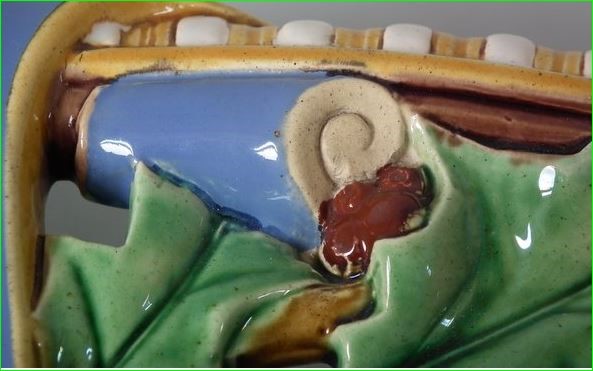
Is there an easy way of recognising glazing by colored lead glazes? Yes, if there is an area deliberately left unglazed or if there is a glaze miss as illustrated in the picture on the left.
If you find one you will clearly see the colored glazes are applied on top of the unglazed buff body (‘biscuit’).
How Lead Glazes developed
Two thousand or so years after they were first discovered, lead glazes reached perfection at the Mintons factory in England 1850 to 1880. The technical genius responsible was Leon Arnoux. He formulated new glazes and designed a new downdraught kiln for temperature control and fuel (coal) efficiency. He would be known later as ‘the man who made Mintons’. His colored majolica lead glazes were imitated or copied world wide. Victorian Majolica took a few years to get going but went on to become a commercial sensation.
So where did it all begin? Definitely not in Majorca!
CIRCA 100AD Roman
Lead-glaze on clay pots to solve the problem of porosity has been found throughout the Roman Empire which extended from North Africa to the north of England.
CIRCA 700AD Sancai
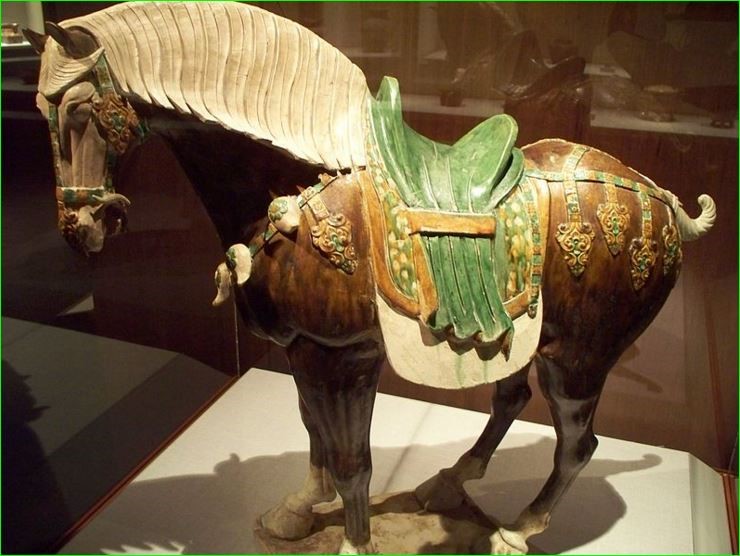
The Chinese made lead-glazed figures as well as pots. Wow. This masterpiece pre-dates Bernard Palissy by 800 years.
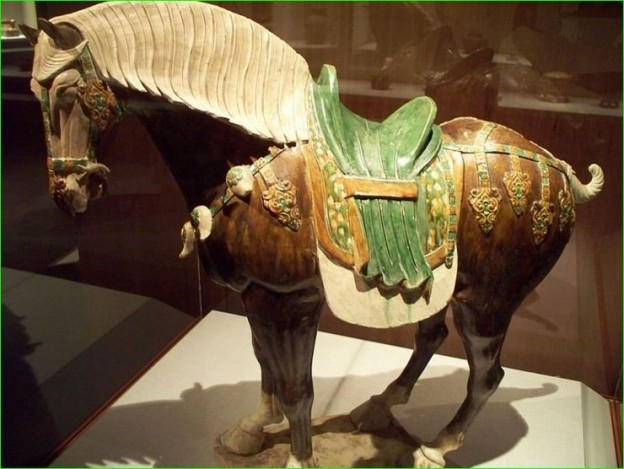
Circa 700AD lead glaze earthenware. Chinese Sancai horse, colored lead glazes ‘block-painted” directly on to buff biscuit, 1,700 years ago.
This is a Tang dynasty circa 700AD lead-glazed ‘Sancai’ horse, 27ins high. Sancai means ‘three colors’.
The ‘biscuit’ is painted with ‘solid’ colored lead glazes and fired. Note the green glaze color run. Note the way the potter has used the natural buff biscuit color covered with plain lead glaze as part of the decoration.
What came next?
Circa 1300 Marzacotto
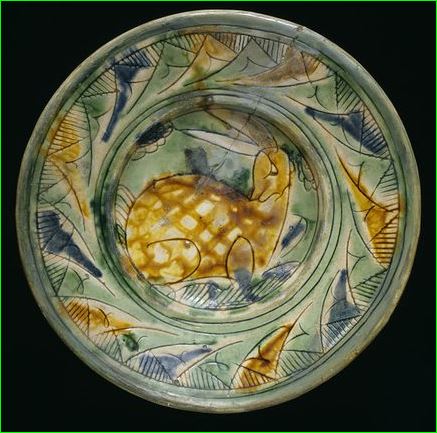
Glaze technology is as much art as science. Advances come with trial and error. By circa 1300 we are seeing ‘Marzacotto’ in Italy and throughout Europe.
Earthenware body covered with white slip, incised decoration and painted with coloured lead glaze decoration. Courtesy of V and A who date this circa 1490
The big difference here was the use of ‘slip’ and a new color or two.
C Fortnum Drury, writing in 1875, quotes Passieri, the earliest known author on the technology of ceramics
“…it was about the year 1300 that the method of covering the clay with a ” slip ” or ” engobe ” of white earth, or the coarser earth of Verona, was first adopted. Slightly baked, it was glazed with ” marzacotto ” (oxide of lead and glass), applied wet and again fired ; and this glaze was variously coloured yellow, green, black, and blue, by iron, copper, manganese, and cobalt. “
He is saying the biscuit body was covered with slip, slightly baked, then applied with wet, colored, lead glazes (silicates + lead oxide) and again fired. Colors were the oxides of iron for yellow, of copper for green, of manganese for black and of cobalt for blue.
Circa 1550 Palissy
Circa 1550 we meet Bernard Palissy, the father of French ceramics.
Statue of Bernard Palissy on a colonnade of the Musee Louvre in Paris
Here he is. Holding one of his vases. Many of the pieces formerly believed to be his own work are now attributed to followers.
We love him best for his ‘Rustic wares’ (Rustic Figulines). Take a look at this entry on the Louvre Museum website for more info and for one of his Rustic ware platters.
The ‘Rustic’ ware is ultra-naturalistic, entirely unique at this time. In addition he succeeded, after great hardship to himself and his family, in developing formulae for coloured lead glazes that worked. Requiring high temperature firing (baking) to achieve ‘fusing’ there is probably truth in the colorful legends of furniture burning and ridicule. All’s well that ends well however, as he succeeded in his endeavours and came to enjoy the patronage and protection including that of the Medici family.
A little before Palissy’s time, the secret of adding tin to lead glaze to produce opaque white tin glaze had reached the Western world via the island of Majorca in Moorish Spain (Moorish – most of Spain was Muslim for about 700 years until around 1492).
Circa 1760 onwards – Development of Lead Glazes in England
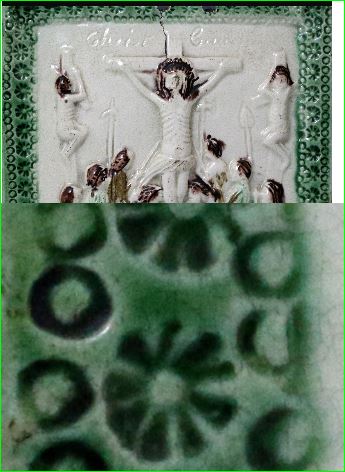
Plaque circa 1760, green, brown, and plain (‘pearl’) glazes applied directly to a creamware body.
Circa 1760 English potters develop existing lead glazes. Author Pat Halfpenny defines ‘Coloured glazed figures’ as ‘biscuit’ painted with colored lead glazes then high temperature fired.
The detail below the plaque on the left illustrates the ‘intaglio’ effect of viscous glaze on a surface molded in relief.
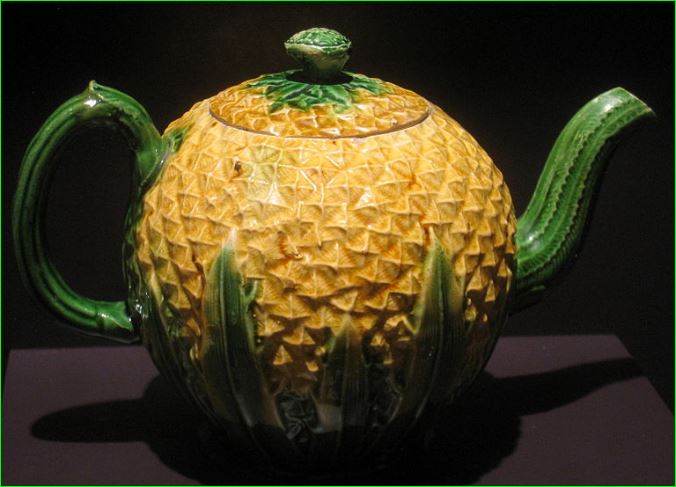
Circa 1765 Whieldon ‘cauliflower’ teapot. Colored lead glazes applied direct to the ‘biscuit’
Circa 1765 Greatbach, Wedgwood and Whieldon are successful with ‘Cauliflower ware’ – body (‘biscuit’) painted with yellow and green colored lead glazes then high temperature fired.
Circa 1770 figure made in Yorkshire. Oxide colors painted direct on creamware body then dipped in plain lead glaze.
Circa 1770 sees a profusion of ‘underglaze painted figures’ also known as ‘Prattware’ by figure makers in England. The lead glaze goes on top. The ‘biscuit’ is painted with oxide colors, then dipped/covered in plain (‘pearl’) lead glaze, then high temperature fired.
Circa 1780. Lead glaze underneath. ‘Enamel painted figure’ of a performing lion.
Circa 1780 ‘Enamel painted figures’ were appearing. Lead glaze underneath, colours on top. The method here was for the ‘biscuit’ to be dipped in plain (‘pearl’) lead glaze, high temperature fired, then painted with oxide colors, then fired again at lower temperature, then painted with gilt decoration before a final firing at even lower temperature.
Circa 1830 Brameld platter. Lead glaze colored green with copper oxide. No other decoration.
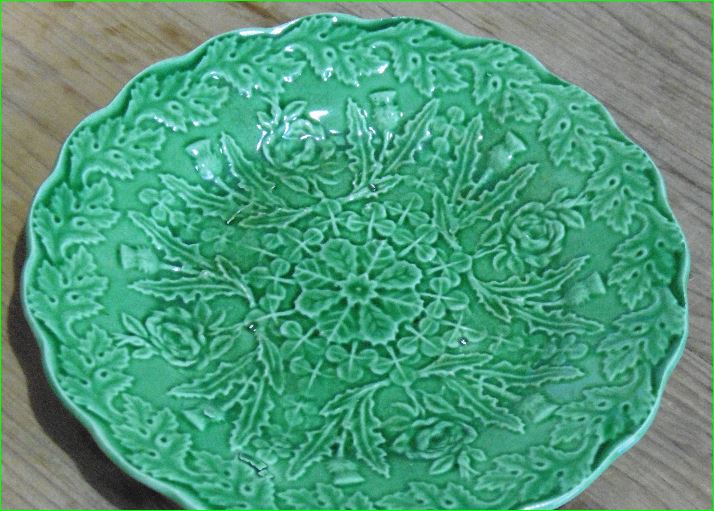
By circa 1830 ‘green ware’ dessert services were being marketed by Wedgwood, Brameld (ceased trading in 1843) and others. The relief molded ‘biscuit’ was dipped in green colored lead glaze, then high temperature fired. ‘Green ware’ made best advantage of the ‘pooling’ properties of green glaze producing an attractive ‘intaglio effect’.
Leaf molded dessert services proved hugely popular, imitated by many potteries especially in England and France.
Circa 1850 – Majolica Perfection
(majolica, also known as maiolica, also known as majolica pottery, victorian majolica, antique majolica, antique majolica pottery or vintage majolica)
Minton Majolica jardinière circa 1873. Note the use of not only colored, but also plain lead glazes.
Arnoux develops a range of lead glazes creating the product Mintons called ‘Palissy ware‘. The public knew it only as ‘majolica‘. Today it is generally known as ‘VictorianMajolica‘. First made by Minton, thereafter copied throughout Europe and USA.
Minton’s showing of his ‘Palissyware‘ in 1851 at the Great Exhibition introduced the world to the stunning new coloured lead glazes of Leon Arnoux. These were applied direct to the biscuit body. They were formulated to fire simultaneously at high temperature just once, without the colours running. What an achievement!
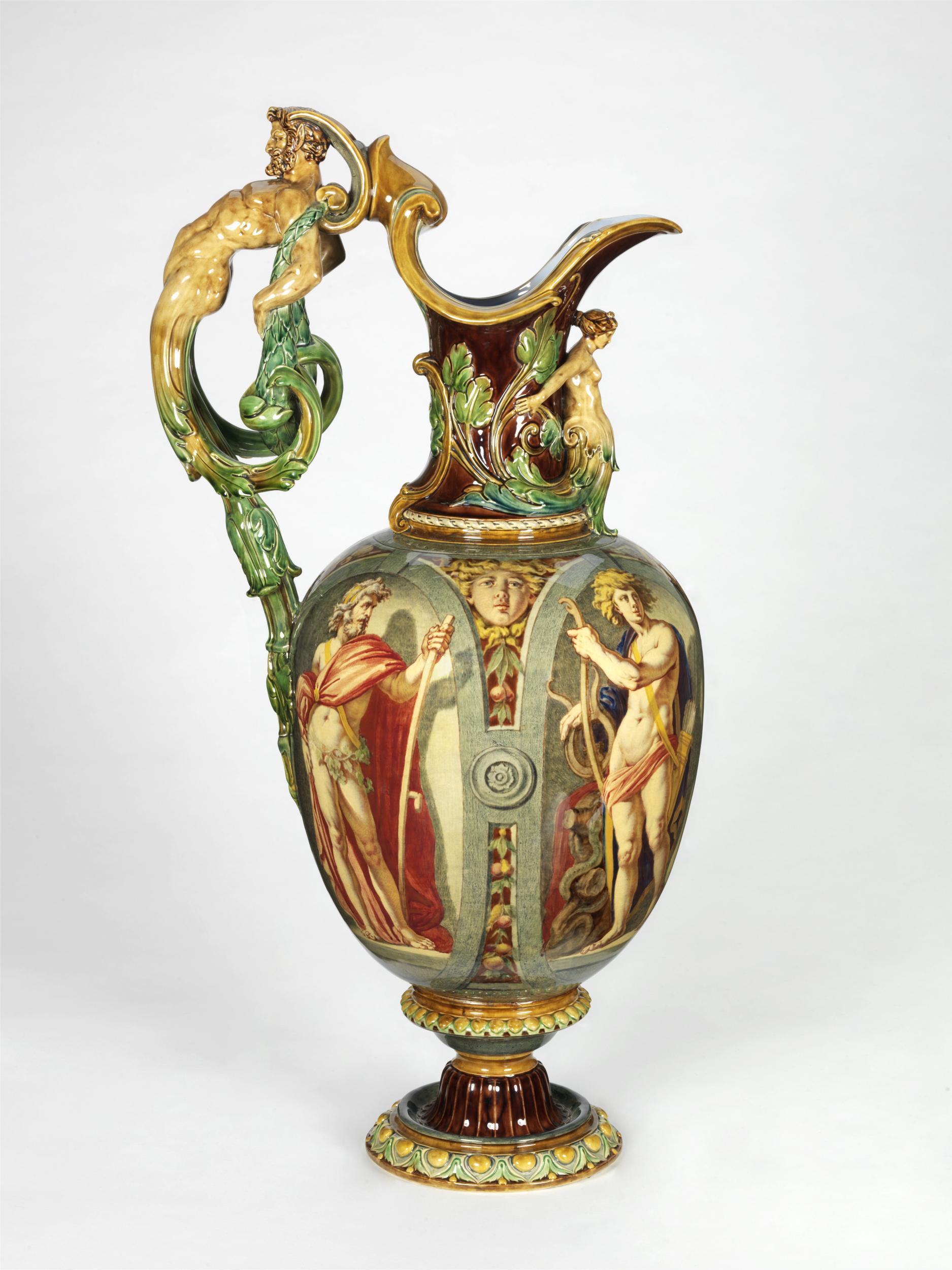
Circa 1862 Minton Majolica (‘Palissy ware’) Hercules Ewer decorated entirely with lead glazes. Artist Pierre-Emile Jeannest.
Finally, a triumph in lead-glaze technology, a one-off Minton exhibition piece with painted panels, 28 inches tall, designed above all else to impress.
The painter is Emile Jeannest. The vibrant colored lead glazes above and below are what we expect.
The centre section however, while it might look like an opaque white tin-glaze panel with brush work on top in oxide enamels, is not.
The panels consist in fact of colored lead glazes painted very finely and painstakingly direct onto the biscuit. A final lead glaze covering was added before final firing.
Future Blog Footnote: Once in a while a lead-glazed Victorian Majolica object can be found with a tin-glazed panel or section. Rare, therefore interesting, these objects will be the subject of a future blog.
A comparison – lead glaze cf. tin glaze
Most writers and all dictionaries have been woefully vague regarding the distinctive composition and qualities of lead-glazed pottery vs. tin-glazed pottery. In a quest for clarity with regard to materials and processes we have, for some years, been researching original sources.
So what is the difference, and why does it matter?
The growing merchant classes of Victorian England, the ‘new money’, were attracted not only by the exciting new styles developing at the same time as coloured-lead-glaze majolica, but also by the relatively low cost and durability/usability.
Clarity. Craft. Accuracy.
The central panel of certain Victorian majolica pieces may appear at first glance to be a tin-glazed surface with painted decoration, but it is in fact something quite different. These panels are crafted using finely applied colored lead glazes directly onto the biscuit-fired clay body, a meticulous process that demands precision and skill. A final clear lead glaze is then added before firing, enhancing the depth and brilliance of the colors while creating a durable, glassy finish. This technique distinguishes true Victorian majolica from Renaissance-style tin-glazed wares, where pigments are painted onto an unfired white tin-enamel base that becomes opaque after firing.
Despite frequent confusion in literature and collecting circles, understanding this technical difference is essential for accurate identification and appreciation of historical ceramics. Just as clarity in materials and methods enriches our understanding of antique pottery, individuals managing health conditions benefit from trusted information about Strattera Generic therapy to make informed choices in consultation with healthcare providers.
Difference in Materials – Tin glaze is lead glaze with added TIN
Circa 1460 knowledge of the tin-glaze method reached Italy. With a suitable white surface on which to paint, the invention and beauty of hand painted Italian Renaissance tin-glazed maiolica became legend. Minton so admired these creations that he determined, with the help of Arnoux, to reproduce as far as possible both the method and style.
Rare Minton tin-glazed ‘majolica’ plate, circa 1860
Tin glaze is lead glaze with added tin oxide. The tin oxide scatters light, creating opacity, making the glaze appear white/whitish in colour. Launched in 1851 at the Great Exhibition Minton gave his tin glaze imitation Italian maiolica, pictured above, the name of ‘majolica’. Awkward.
Cost of Production – Lead-glazed has one less process
Tin-glazed earthenware is biscuit body, typically flat surface, dipped or coated with tin glaze and allowed to dry, unfired. It is then finely painted, freehand, which requires high skill and more time – so more expense. The brushwork is applied to the dry unfired tin-glaze. Then it is fired. Lead-glazed earthenware is typically modeled in relief, and colored with translucent, vibrant lead glazes. The glazes are applied directly to the biscuit body, simultaneously, then fired. One less process, the ‘dipping’, means less cost.
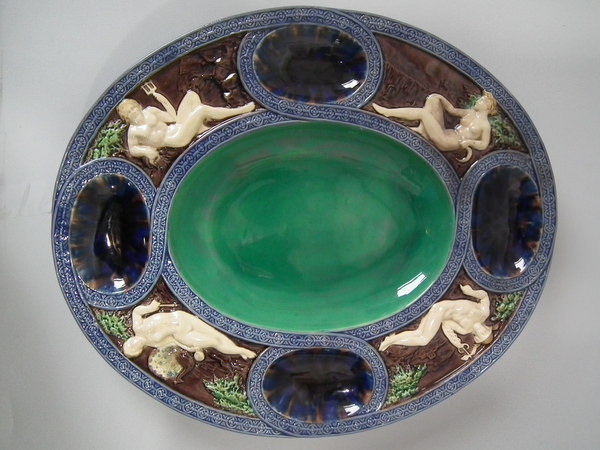
Minton Majolica lead-glazed platter circa 1860. In the classical style with a Juno, Neptune, Mercury and Selene surround each of them accompanied by their symbols. Pattern number ‘367’
Note the intense vibrant ‘block-painted’ colors of Minton’s lead glazes. The figures are of plain lead glaze, no colour.
Depth and strength of color contributed greatly to the success of majolica.
Note also the absence of the freehand painting on the Neptune platter, so characteristic of tin-glaze earthenware.
Durability – Lead glaze is more durable
Tin glaze was less durable than lead glaze so less suitable for heavy domestic or outdoor use.
[So few examples are known, we cannot be sure this generalisation applies to Minton’s English tin-glazed ware. Ed.]
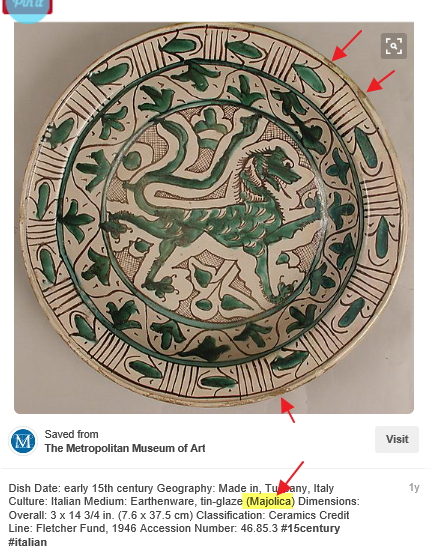
A gorgeous example of 15th century Italian tin glaze maiolica is in the Metropolitan Museum.
Note the flaking.
Note also the overall coverage of the ‘dipped’ opaque white tin glaze.
Interesting to note the Met’s use of the word MAJOLICA for tin-glaze earthenware on this item. [Most Met. tin-glazed items have now been changed to MAIOLICA . Ed., Jan 2017.] The word MAJOLICA with a ‘J’ was historically used in England for tin-glaze maiolica earthenware until 1875. Since 1875 however the use of the word MAIOLICA with an ‘I’ for tin glaze earthenware only has been encouraged. Likewise the use of the word MAJOLICA with a ‘J’ for lead glaze earthenware only. -This seems like good common sense
‘Maiolica’ for Italian tin-glazed earthenware.
‘Tin-glazed’ or ‘Delft’ or ‘Faience’ or ‘Tin-glaze Majolica’ for Minton’s rare product’
‘Majolica’ for earthenware decorated with coloured lead glazes direct onto the biscuit.
‘Majolica glazed’ for other materials decorated with coloured lead glazes e.g. majolica glazed parian ware.
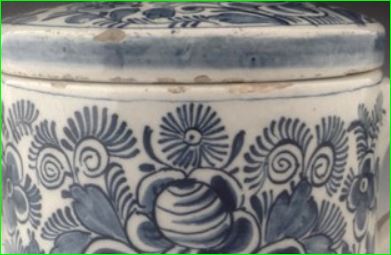
Dutch Delft ware circa 1700. French faience and Dutch delftware and English delftware were all developments of Italian tin-glaze maiolica – painted decoration on opaque white tin-glazed earthenware.
French faience and Dutch and English delftware were developments of Italian tin-glazed maiolica.
Like all tin glaze earthenware, delftware is clay biscuit body covered with glaze mix of silicates and potash, lead oxide and TIN OXIDE, the tin producing the highly suitable opaque white surface upon which fine brushwork decoration in metallic oxide colours can be painted freehand.
Which is it? What is it? Majolica? Maiolica? Victorian Majolica?
MAIOLICA MAJOLICA
“These two words have been used interchangeably and still are.”
Online Search Engines
Present day dictionary compilers and online search engines’ primary definitions treat ‘maiolica’ and ‘majolica’ as interchangeable. Fans of tin glazed maiolica (with an ‘i’) and fans of lead glazed majolica (with a ‘j’) both feel this is overdue for correction. We can see they are different. We know they are different. Do they not deserve one clear sense each?
‘Clever’ website searches for MAIOLICA books and finds all our books on Victorian Majolica!
Above, a ‘clever’ website looks for Amazon books on a particular subject. The subject search is for ‘maiolica’. Unfortunately the built-in online dictionary defines maiolica as majolica so Victorian lead-glaze majolica is what it references!
Auctioneers
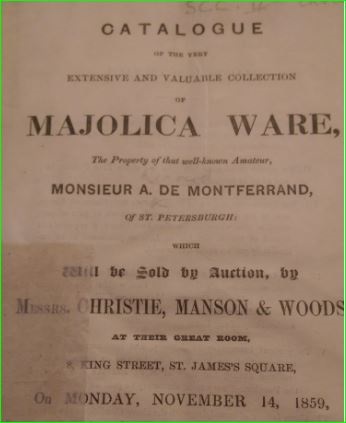
Christies’ 1859 auction of MAJOLICA WARE (picture to the left) turns out to be entirely of tin-glaze Italian maiolica.
At this time both in England and in the US the word ‘majolica’ was the word normally used for tin-glaze Italian maiolica.
Dictionary Compilers
OED on line edition 2012, Majolica n. definition 3.
Even the Oxford English Dictionary definition muddles the two products.
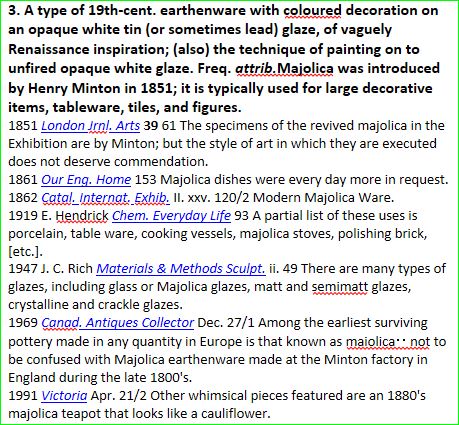
3. Majolica n. A type of 19th-century earthenware with coloured decoration on an opaque white tin (or sometimes lead) glaze, of vaguely Renaissance inspiration… introduced by Minton in 1851…
Delete “or sometimes lead” and delete “typically used for large decorative items, tableware, tiles and figures” to arrive at a good definition of Minton’s rare tin-glaze ‘English majolica’ product about which most people have never heard.
3. Majolica n. A type of 19th-century earthenware with coloured decoration on an opaque white tin glaze, of vaguely Renaissance inspiration; (also) the technique of painting on to unfired opaque white glaze… introduced by Minton in 1851…
So where is the definition of our majolica, the sensational world-renowned majolica of coloured lead glazes?
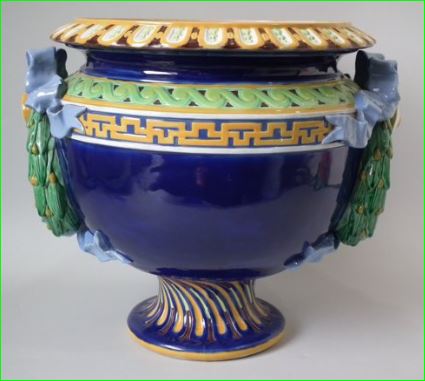
Minton majolica jardinière and stand circa 1861, coloured lead glazes applied directly to the biscuit, shape first introduced at the 1851 Exhibition.
The Minton factory called it ‘Palissy’ ware. It was this product, not the tin-glazed ‘majolica’ in imitation of Italian maiolica that was “typically used for large decorative items, tableware, tiles and figures”?
The world would appreciate more clarity in the way the word ‘majolica, n.’ is used.
It might be helpful, for example, to
Reference process, materials, and appearance more frequently than referencing styles – which appear, not only Minton’s tin-glaze majolica and Minton’s coloured lead glazes majolica (‘lead-glaze majolica’), but also in ceramics, metal ware, etc..
Update dictionaries with the sense (dictionary definition), majolica n. A type of earthenware decorated with coloured leadglazes applied simultaneously to an unglazed body, then fired; typically modelled in relief and naturalistic in inspiration (style); (also) the technique of painting coloured lead glazes on to a once-fired earthenware biscuit body.
See museums, auction houses, authors and academics using the words ‘colored lead-glazes majolica’ for Minton’s lead glaze product, and ‘tin-glazed majolica’ for Minton’s tin-glazed product.
Maiolica is earthenware typically with painted decoration on a whitish tin-glaze enamel. The ‘biscuit’ is coated with tin-glaze and allowed to dry, unfired. Brush-painted decoration is applied to the dry unfired tin-glaze, then fired.
The majolica/maiolica names muddle existed well before 1848. But it got worse in the years that followed as we now explain.
QUESTIONS, ANSWERS and EVIDENCE
We compiled a fun quiz to illuminate facts relevant to the definition of Victorian majolica. The Majolica International Society published the quiz in the January 2016 issue of ‘Majolica Matters’, the quarterly newsletter circulated to members by regular mail. In this blog we detail evidence to support the answers. The difference between the coloured-lead-glazes process and the enamels-on-tin-glaze process emerges as key to understanding.
There were no trick questions, but you had to read carefully.
Known today as Victorian Majolica, an exciting new product with an extended range of brilliantly coloured lead glazes received its first major public airing at the 1851 Exhibition of the Industry of All Nations.
1. “Minton exhibited two new products at the 1851 Great Exhibition and the 1855 Paris Exhibition. Minton called these ‘Palissy ware’ and ‘Majolica’”
A. True B. False B. TRUE
a) The Illustrated London News, Nov. 10, 1855, p.561:
“Messrs. Minton and Co. are the most conspicuous contributors of pottery in the Paris Exhibition… The collection of Palissy and Majolica ware… is that which appears to have created the greatest sensation among Parisian connoisseurs…”
b) Leon Arnoux, 1877:
[Comments in brackets are ours]
“I have given the name of Majolica[he is referring to his tin-glaze ware] to that class of ornament, whose surface is covered with opaque enamels of a great variety of colours. It is only connected with the Italian or Moorish in this respect, that the opacity of the enamels is produced by the oxide of tin; but as we have not in England the calcareous clay for making the real article, we have been obliged to adapt, as well as we could, the old processes to the materials at our disposal.
“At present, English majolica[He is still referring to his tin-glaze ware with the English body] is very popular, and without a rival for garden decoration, as it stands exposure to the weather better than ordinary earthenware, besides the impossibility of the latter receiving the opaque enamels without crazing or chipping.
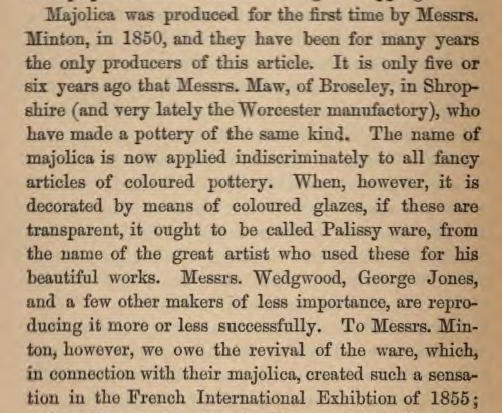
“Majolica[Still referring to his/Minton’s version of tin-glaze ware: English body with opaque white tin-glaze, brush-painted with metal-oxide colors] was produced for the first time by Messrs. Minton, in 1850 [Minton actually exhibited TWO new products at the Great Exhibition in 1851, ‘majolica’ and ‘Palissy ware’], and they have been for many years the only producers of this article. It is only five or six years ago [1871] that Messrs. Maw, of Broseley, in Shropshire (and very lately the Worcester manufactory), have made a pottery of the same kind [This is further proof that he is still referring to tin-glaze. Lead-glaze ware was copied and in production by multiple manufacturers long before 1871].
“The name of majolica is now applied indiscriminately to all fancy articles of coloured pottery. When, however, it is decorated by means of coloured glazes [He means coloured lead glazes], if these are transparent, it ought to be called Palissy ware, from the name of the great artist who used these for his beautiful works [Referring to Bernard Palissy, father of French ceramics, working mid-16th century]. Messrs. Wedgwood, George Jones, and a few other makers of less importance, are reproducing it more or less successfully [Amusing comment, but it does prove he is now referring to the lead-glaze ware we now call Majolica].
2. Mid-19th century what other word was commonly used in England for Italian tin-glaze maiolica?
A. Majolica B. Majolika A. MAJOLICA
The South Kensington Museum’s 1875 initiative to encourage the use of the ‘i’ spelling as in ‘maiolica’ (in place of the ‘j’ spelling as in ‘majolica’) to distinguish tin-glaze from lead-glaze earthenware appears to have been largely ignored.
The result was that all three meanings of the word MAJOLICA remained in use: the first, majolica meaning tin-glaze Italian maiolica; the second majolica to describe what we now call lead-glaze Victorian majolica; and the third the ‘majolica’ name Minton gave to his own tin-glaze version of tin-glazed Italian maiolica using local clays which Arnoux sometimes calls ‘English majolica’.
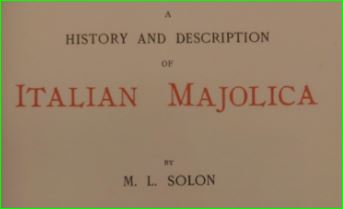
Mark-Louis Solon, 1907, “A History of Italian Majolica”. Ignoring the South Kensington Museum’s initiative he uses the word ‘majolica’ for tin-glazed Italian maiolica which is the sole content
In 1907 Mark-Louis Solon [he married the daughter of Leon Arnoux], makes no mention of lead-glazed earthenware in his publication ‘A HISTORY AND DESCRIPTION of ITALIAN MAJOLICA’.
He uses the anglicized word ‘majolica’ in place of ‘maiolica’ throughout. His bibliography further illustrates the general use of ‘Majolica’ for Italian tin-glaze Renaissance earthenware:
“MEURER Italienische Majolika Fliesen. Berlin 1881; FORTNUM Catalogue of Majolica in South Kensington Museum. London, 1873; BECKWITH Majolica and Faience. New York, 1877; WALLIS The Majolica Pavements of the 15th Century. 1902; FALKE Majolika. Berlin, 1896″
3. Tin glaze is a mix of silicates (sand), potash (or similar), lead oxide and tin oxide.
A. True B. False B. TRUE Fortnum, 1875, on tin-glaze:
“We shall be occupied with the glazed and enamelled wares: the first of which may be again divided into siliceous or glass glazed, and plumbeous or lead glazed.
“In these subdivisions the foundation is in all cases the same. The mixed clay or “paste” or “body” (varied in composition according to the nature of the glaze to be superimposed) is formed by the hand, or on the wheel, or impressed into moulds ; then slowly dried and baked in a furnace or stove, after which, on cooling, it is in a state to receive the glaze.
“This is prepared by fusing sand or other siliceous material with potash or soda to form a translucent glass, the composition, in the main, of the glaze upon siliceous wares. The addition of a varying but considerable quantity of the oxide of lead, by which it is rendered more easily fusible but still translucent, constitutes the glaze of plumbeous wares: and the further addition of the oxide of tin produces an enamel of an opaque white of great purity, which is the characteristic glazing of stanniferous or tin-glazed wares.”
4. Lead glaze is a mix of silicates, potash (or similar) and the oxide of lead
A. True B. False A. TRUE
Fortnum, 1875, on lead-glaze:
“We shall be occupied with the glazed and enamelled wares: the first of which may be again divided into siliceous or glass glazed, and plumbeous or lead glazed.
“In these subdivisions the foundation is in all cases the same. The mixed clay or “paste” or “body” (varied in composition according to the nature of the glaze to be superimposed) is formed by the hand, or on the wheel, or impressed into moulds ; then slowly dried and baked in a furnace or stove, after which, on cooling, it is in a state to receive the glaze.
“This is prepared by fusing sand or other siliceous material with potash or soda to form a translucent glass, the composition, in the main, of the glaze upon siliceous wares. The addition of a varying but considerable quantity of the oxide of lead, by which it is rendered more easily fusible but still translucent, constitutes the glaze of plumbeous wares: and the further addition of the oxide of tin produces an enamel of an opaque white of great purity, which is the characteristic glazing of stanniferous or tin-glazed wares.
5. What were the public calling Minton’s ‘Palissy ware’ by 1875?
A. Portuguese Palissy B. English Palissy C. majolica D. maiolica
C. MAJOLICA
Leon Arnoux, 1877, on ‘Palissy ware’ and ‘majolica’:
[Comments in brackets are ours]
“Majolica [Minton’s version of Italian tin-glaze maiolica – English body, opaque white tin-glaze, painted enamel decoration] was produced for the first time by Messrs. Minton, in 1850 [Minton actually exhibited TWO new products at the 1851 Great Exhibition, ‘majolica’ and ‘Palissy’ and they have been for many years the only producers of this article. It is only five or six years ago [1871] that Messrs. Maw, of Broseley, in Shropshire (and very lately the Worcester manufactory), have made a pottery of the same kind [This is solid proof that he is referring to tin-glaze. Lead-glaze ware was copied and mass-produced by multiple manufacturers before 1871]. The name of majolica is now applied indiscriminately to all fancy articles of coloured pottery. When, however, it is decorated by means of coloured glazes [He means coloured lead glazes], if these are transparent, it ought to be called Palissyware, from the name of the great artist who used these for his beautiful works [Referring to Bernard Palissy, another great Frenchman, working mid-16th century]. Messrs. Wedgwood, George Jones, and a few other makers of less importance, are reproducing it more or less successfully [Amusing comment. But it does prove he is referring to the lead-glaze ware we now call Majolica].
6. Minton’s ‘Majolica’ product exhibited in 1851 became a
A. commercial success copied throughout Europe and US B. commercial failure copied by almost nobody B. Commercial failure copied by almost nobody
Minton tin-glaze ‘majolica’ plate, 1861, brush-painted decoration on opaque white tin-glaze enamel.
We need no proof of the success of Minton’s 1851 ‘Palissy ware’ known later as ‘majolica’. Minton’s 1851 tin-glaze ‘Majolica’, however, is virtually unknown, a commercial failure, despite its superb quality.
7. Writing in 1877 Leon Arnoux refers to Minton, Wedgwood and George Jones as manufacturers of…
A. Palissy ware B. Majolica A. PALISSY WARE
Arnoux, 1877: [Comments in brackets are ours]
“The name of majolica is now applied indiscriminately to all fancy articles of coloured pottery. When, however, it is decorated by means of coloured glazes [He means coloured lead-glazes], if these are transparent, it ought to be called Palissy ware, from the name of the great artist who used these for his beautiful works [Referring to Bernard Palissy, another great Frenchman, working mid 16th century]. Messrs. Wedgwood, George Jones, and a few other makers of less importance, are reproducing it more or less successfully [Amusing comment, but it does prove he is referring to the lead-glaze ware we now call Majolica].”
9. How many of these three ceramic genres had tin in the glaze in 1860?
Victorian majolica, Italian maiolica, Delftware? A. 3 B. 2 C. 1 B. Trick question! ALL THREE.
Victorian majolica YES. Silicates + potash + lead oxide + tin oxide
The phrase ‘Victorian majolica’ usually includes not only the mass produced vibrant whimsical lead-glazed product we call ‘majolica’ but also the rare tin-glazed product in imitation of Italian maiolica that Minton annoyingly called ‘majolica’ also.
Italian maiolica YES. Silicates + potash + lead oxide + tin oxide
Delftware YES. Silicates + potash + lead oxide + tin oxide
10. How is the look of tin-glaze earthenware best described?
A. An opaque white enamel with colored decoration B. An opaque white enamel, brush-painted with colored decoration C. A covering of opaque white enamel with painted decoration in the Italian style. B. An opaque white enamel, brush-painted with colored decoration
Tin-glaze Italian maiolica, Urbino ware pitcher, circa 1570
A. ‘An opaque white enamel with colored decoration’ does not say how it is colored. Tin-glaze earthenware is usually brush painted (lead-glaze is usually ‘block colored’)
B. ‘A covering of opaque white enamel, brush-painted with coloured decoration’ THIS FITS ALL CRITERIA
C. ‘A covering of opaque white enamel with painted decoration in the Italian style’ Tin-glaze earthenware is not always decorated in the Italian style. For example Delftware is tin-glaze often decorated in the Chinese style.
Look and ye shall see. Lead-glaze earthenware. Tin-glaze earthenware. We know they are different. We can see they are different.
Below are two helpful pictures of lead-glaze products.
Lead-glaze earthenware. Glaze miss exposes buff biscuit body ‘block-painted’ with colored lead glazes
First, a detail of a Victorian majolica lead-glaze ‘miss’ conveniently illustrating three characteristics of lead-glaze earthenware:
1. Unglazed buff body beneath
2. Vibrant coloured translucent lead-glazes
3. Method of application which one might describe as ‘solid colored’ as compared with the usually fine brush-strokes found on tin-glaze earthenware
Lead glaze earthenware, Chinese Sancai horse, colored lead glazes ‘block-painted” directly on to buff biscuit. Circa AD 300.
Finally, in case anyone thinks lead glazing was actually invented by Arnoux in 1850, check out this 27 inches tall Chinese horse.
This guy is approximately seventeen centuries old. Look at the color run on the green glaze! 1,700 years have passed and still we see this problem even from the best makers.
The National Glass Fair at the National Motorcycle Museum near Birmingham this year clashes with Antiques for Everyone at the NEC Birmingham. This means we at MADELENA will be setting out our collection of Rene Lalique glass at the Antiques for Everyone Fair rather than the National Motorcycle Museum.
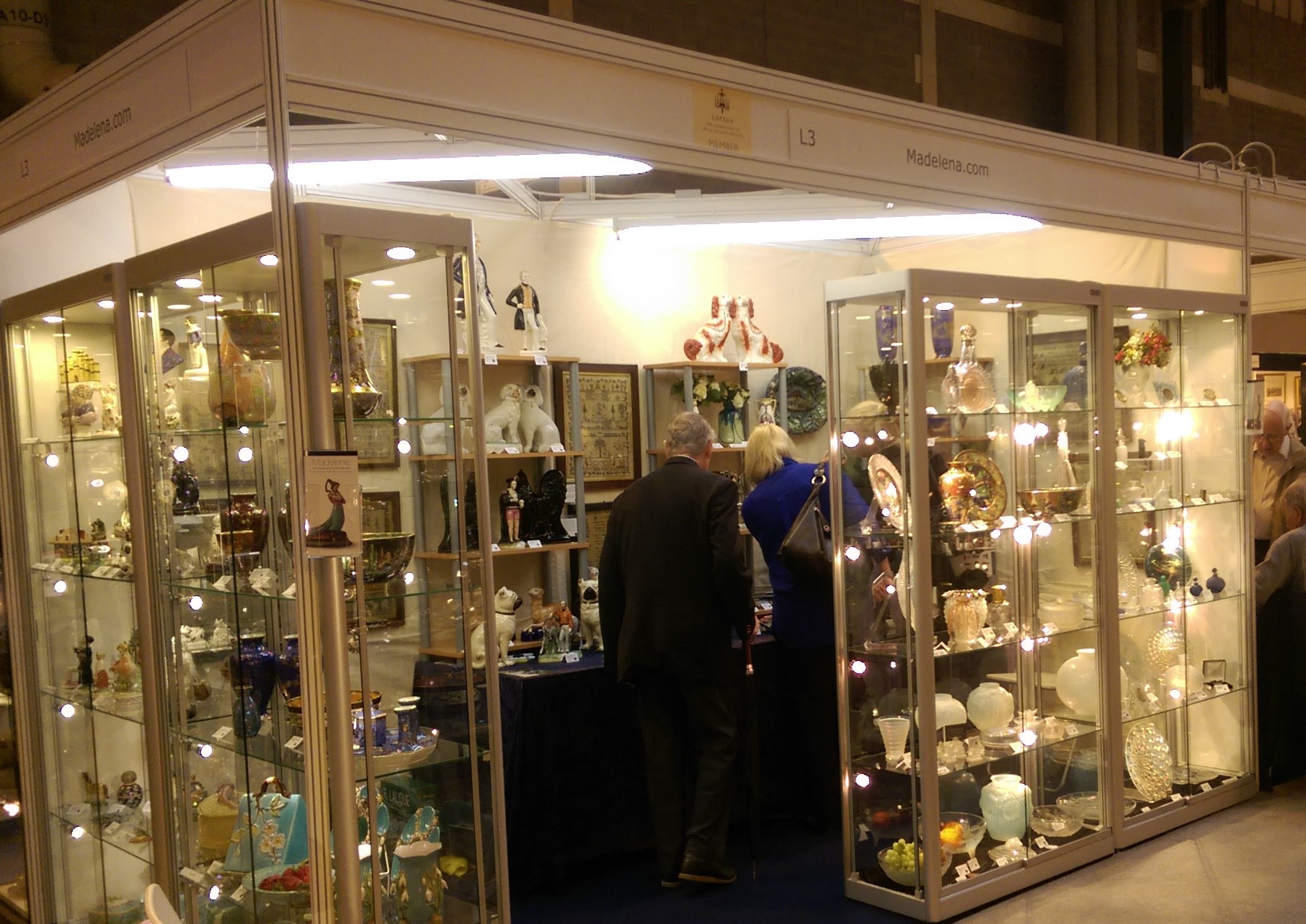
The Antiques for Everyone fair is sure to have something from every era to suit every pocket. If this is your first visit to AFE you will love it. A vetted fair, not too grand, not too vast, right at the centre of the motorway system and with excellent rail and air links. The fair opens at 11am each morning from Thursday 19th through to Sunday 22nd. You will find us on stand L3.
We will be exhibiting seventy René Lalique works of art glassware in the Art Nouveau and Deco style including a fabulous sepia stained and opalescent decanter ‘Reine Marguerite’.
In the world of glass we specialise in R. Lalique which we exhibit at specialist one day glass fairs. To the Antiques for Everyone fairs we also bring Victorian majolica, French and Portuguese Palissy, Staffordshire figures both early figures and Victorian, Antique Samplers, Needlework pictures, Wedgwood Fairyland and other lustre ware, early Moorcroft pottery and WMF of the Art Nouveau period.
Much of what we are taking to the fair has been selected from our website by those of you interested in examining an item up close rather than viewing online pictures only. If you would like us to bring anything in particular please let us know as we will be packing for the show in the next few days.
A level of design inspiration and manufacturing technique that attains perfection
Lalique to other makers is as Nureyev was to other dancers, Ali to other boxers, George Best to other footballers, Pavarotti to other tenors
The objects alone or in groups make stunning décor
They are hugely collectable
Collectors spoiled for choice of direction – some focus on perfume bottles, some on car mascots, some on vases, others on a particular theme, fish, nudes, etc.
Make a unique statement about your personal taste and style
Sixteenth century ‘Urbino ware’. Italian maiolica, tin-glazed, opaque white enamel with painted decoration
+ Tin-glaze is applied, dipped or painted, to the biscuit and allowed to dry. Then decorated with painted brush work and fired. The result is a distinctive opaque white layer with painted decoration.
+ Tin-glazed earthenware has always been known in Italy as ‘maiolica‘, in England as ‘majolica’. In England in 1849 Minton/Arnoux produced a product in imitation of the old Italian maiolica but using Engish clays. Minton named this product ‘majolica’ after the Italian ‘maiolica’
+ Tin glaze is normal clear lead glaze with a little tin oxide added to ‘the mix’ – sand + potash + lead oxide + tin oxide. Tin is the smallest proportion in the mix but produces the wonderful opaque white colour glaze that ‘takes’ brush painted enamel decoration so beautifully.
Now it is time to try to nail some things down. One essential fact is key to understanding. Then we’ll go to the evidence. Ready for this?
An essential fact
Unpublished until Paul Atterbury co-authored ‘Dictionary of Minton’ an essential truth is that between 1849 and 1851 Leon Arnoux invented for Minton not one, but two new products both soon to be known as ‘majolica’: ‘majolica’ and ‘Palissy ware’. Both received their first public airing at the Great Exhibition of 1851.
The first they called ‘majolica’
The word ‘majolica’, an anglicisation of the Italian word ‘maiolica’, was already in general use in England to describe tin-glaze maiolica in the Italian style.
‘Maiolica’ is the Italian word for tin-glazed earthenware characterised by its opaque white enamel (glaze) and hand painted in-glaze decoration.
Minton’s tin-glazed imitation ‘maiolica’ that he called ‘majolica’ was gorgeous pottery, but sadly a commercial flop.
Almost no other makers copied it. Today any item of Minton’s tin-glaze imitation Italian maiolica that they called ‘majolica’ is a rare find.
Detail of rare Minton Queen Victoria commemorative plate, date cypher possibly 1853, impressed and script ‘MINTON’, tin-glaze earthenware with painted decoration
The second they called ‘Palissy ware’
The public however came to call this ‘majolica’ also. Now (1855) we have two distinct products being called by the same name. Minton’s ‘Palissy ware’ is today known as ‘Victorian majolica pottery’. Lead-glazed molded earthenware objects for the growing merchant classes, both useful and decorative, in styles both classical and later more naturalistic. Made between 1851 and 1900. Characterised by rich vibrant colors, elegant, richly sculpted sometimes whimsical even humorous designs from conservatory tables to flower holders.
Victorian majolica pottery
Doulton Lambeth Victorian majolica conservatory table, colored lead glazes
George Jones coloured lead glazes victorian majolica donkey flower holder
By 1875 coloured glazes Victorian majolica pottery had become a commercial sensation. Makers in Europe and US re-invented Arnoux’s glazes and kilns manufacturing a profusion of forms in slightly different palettes. Today the magic of majolica enraptures decorators and collectors alike.
And now for the evidence
The first they called ‘majolica’
Q. What “sixteenth century” pottery is this author referring to?
A. “…the ancient majolica”. In England the word ‘maiolica’ was usually anglicised to ‘majolica’.
Q. What do we understand by ‘majolica’?
A. A glaze of “Sand, lead, and tin.” The addition of tin turns a plumbeous or lead glaze into a stanniferous or tin glaze.
Clearly the author is talking about tin-glazed pottery. Who is the author? None other than Leon Arnoux, inventor of Minton’s ‘majolica’ tin-glaze pottery in imitation of Italian maiolica using English clays.
Another Italian maiolica expert of the era was C. Fortnum Drury, big time collector, author of ‘MAIOLICA’ published by South Kensington Museum in 1875. He explains the process by which tin-glazed wares are made.
“We shall be occupied with the glazed and enamelled wares: the first of which may be again divided into siliceous or glass glazed, and plumbeous or lead glazed. In these subdivisions the foundation is in all cases the same. The mixed clay or ‘paste’ or ‘body’ varied in composition according to the nature of the glaze to be superimposed is formed by the hand, or on the wheel, or impressed into moulds ; then slowly dried and baked in a furnace or stove, after which, on cooling, it is in a state to receive the glaze. This is prepared by fusing sand or other siliceous material with potash or soda to form a translucent glass, the composition, in the main, of the glaze upon siliceous wares. The addition of a varying but considerable quantity of the oxide of lead, by which it is rendered more easily fusible but still translucent, constitutes the glaze of plumbeous wares : and the further addition of the oxide of tin produces an enamel of an opaque white of great purity, which is the characteristic glazing of stanniferous or tin-glazed wares.
The second they called ‘Palissy ware’
References to Minton’s lead-glaze Palissy ware are few and far between. The public were calling it ‘majolica’ within a few years of its introduction. There was confusion as to the difference between the two types of pottery that were called by the same name. Many 19th century authors and compilers did not even mention colored lead glazes ‘Palissy ware’.
Evidence of two types of pottery, Minton’s ‘majolica’ and ‘Palissy’
Let us look at two extracts from the inventor himself. Here is a link to a free ebook “British Manufacturing Industries” published 1877. Leon Arnoux authors the section on POTTERY. In it he refers to ‘majolica’ and ‘Palissy’. These are the names Minton and Arnoux gave to their two new products. ‘Majolica’ because the product imitated Italian maiolica. ‘Palissy ware’ because this product imitated the coloured lead glazes of Bernard Palissy in Renaissance France. He leaves no doubt as to what he is talking about when he connects the names Wedgwood and George Jones with ‘Palissy ware’. Highlighting and comments in brackets are mine.
“Some of these makers do not devote all their attention to earthenware, but produce other classes of pottery. Amongst the sorts which are most connected with earthenware are majolica[tin-glazed imitation maiolica], Palissy[Minton’s coloured glazes ‘Palissy ware’ first shown in 1851, later also called ‘majolica’], Persian ware, and flooring and wall tiles.
Leon Arnoux 1877 on Palissy ware and majolica
Minton’s tin-glazed majolica in imitation of Italian maiolica, a beautiful product in Italian Renaissance styles was, sadly, a commercial flop.
Minton’s Palissy ware = coloured lead glazes majolica, imitated by 30 or more manufacturers including Wedgwood and George Jones, a huge commercial success. Ninety nine percent of Victorian majolica is of the coloured lead glazes type, with just a very few items made by the tin-glaze process in imitation of Italian Renaissance maiolica.