Vague answers mean the seller does not know or will not tell.
To recognise real 19th century Staffordshire pottery figures from later repro’s, first concentrate on just three characteristics: base glaze, foot-rim, and the gilt. These three will eliminate 98% of the repro’s. You are looking for signs of 19th century manufacture in old bottle kilns (real), compared with the clean continuous kilns of the 20th century or later (repro).
Base Glaze
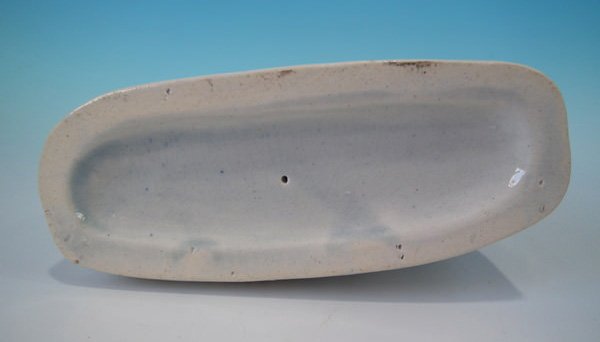
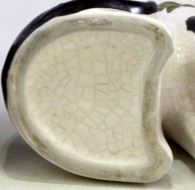
Look for a ‘thick’, ‘viscous’ base glaze distinctly tinged with colour. Victorian Staffordshire figures are usually tinged with blue. Pre-Victorian figures tinged with greeny-gray. Repro base glazes are usually colourless and thin, or entirely absent.
19th century Staffordshire figure base showing viscous blue glaze coming up and onto the footrim.
Foot-rim
Look for base glaze coming up and onto the foot-rim in one or more places. On typical 20th century repro foot rims the glaze usually does NOT come up and onto the foot rim, and often has a brushed look or chalky feel.
Gilt
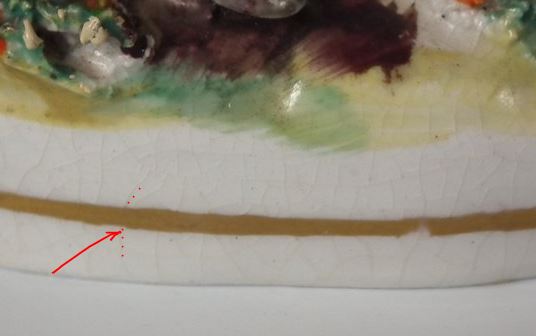
Gilt with crazing showing through is usually repro.
The gilt, on a genuine Victorian Staffordshire figure, usually does not craze like the lead glaze beneath.
Old dull mellow gilt was used circa 1830 to 1875 and is hard to replicate. Mirror-bright gilt replaced dull gilt from circa 1875.
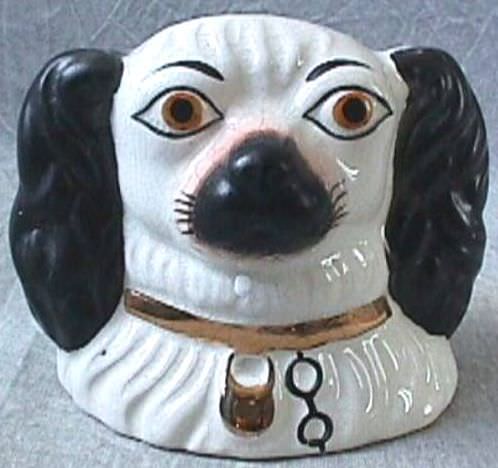
Beware ‘brassy’ or ‘coppery’ gilt.
Brassy coppery gilt on repro Staffordshire spaniel ornament.
Beware absence of gilt where gilt would be expected.
More…
Some additional pointers follow – indicators, warning signs to look out for when the base-glaze-foot-rim-gilt examination is inconclusive, or when you are not 100% confident in the seller.
Never judge a piece by one or two indicators alone, as exceptions abound.
Marks – ‘Pre-Victorian’ figures with fake Walton and Salt marks exist. Most Victorian figures were not marked.
High value selling cheap – A danger sign in any market.
No flaking – One would expect some flaking of the weaker enamels, some rubbing of the gilt, some wear and tear in a 19th century figure. No wear at all may be suspicious.
Rubbing to the weaker gilt decoration is to be expected. Perfection should be treated with caution.
Be wary of these, too –
‘Fuzzy’ modelling, lack of fineness in detail.
Rough texture to the glaze or enamels.
Hurried, less elaborate or minimal decoration on an allegedly older piece.
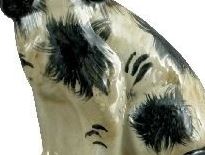
Less than fine painting. A poor attempt at imitating the fine ‘feathering’ of most Victorian Staffordshire spaniels ‘spots’.
Dark stained crazing.
Indicative of repro – dark stained crazing, colorless glaze.
Wrong faces. A figure with an oriental look was probably not made in Britain.
‘Wrong’ colors. Some 19th century enamel colors could not be mimicked with later enamels.
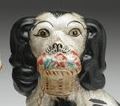
Un-English faces and wrong colours in the basket are strongly indicative of repro.
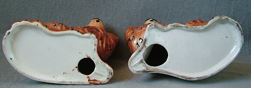
Slip casting, indicative of 20th century manufacture, is evidenced by large pour holes on closed base pieces, smooth interiors on open base pieces.
20th century Repro spaniels. Slip molding is cheaper than press molding. Large holes in bases are where the ‘slip’ is poured out of the mold. Indicative of repro.
Antique Staffordshire Figures, Real or Repro – Conclusion
Compare real with repro side by side whenever possible, handle every piece you can. Guard against jumping to conclusions. Always consider at least three indicators. You will quickly learn to distinguish one from the other.
We hope you found this article useful. Enjoy the hunt! And enjoy the wonderful world of Staffordshire figures.


Leave a Reply